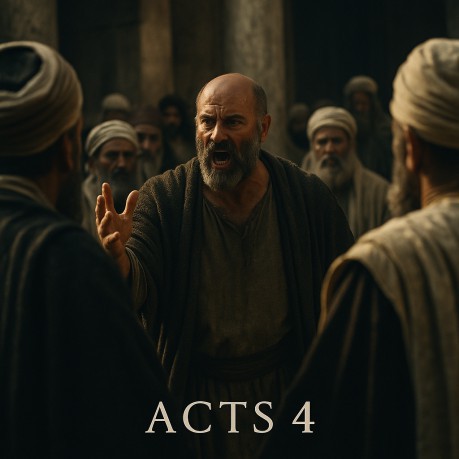
Acts 4:1-2 † The Sadducees denied resurrection (Josephus,
Antiquities 18.1.4). Peter and John's proclamation directly
contradicted their doctrine. This bold preaching challenged the power
of the temple authorities. Acts 4:3-4 † Persecution could not stop the spread of the
gospel. The church rapidly multiplied, fulfilling Isaiah 60:22, "the
least of you will become a thousand, and the smallest a mighty
nation." Acts 4:5-7 † The very leaders who condemned Jesus now
interrogated His apostles. They ask the same question posed to
Christ: "By what authority?" (Luke 20:2). Acts 4:8-10 † Peter boldly attributes the miracle to Jesus.
The crucified and risen Christ is vindicated, and His name heals. Acts 4:11-12 † Psalm 118:22 is fulfilled in Christ. He is
the rejected stone made cornerstone. Salvation is exclusive to Him. † The early church fathers (Irenaeus, Against
Heresies 3.12.2) stressed this exclusivity, rejecting any rival path
of salvation. Acts 4:13 † Their boldness amazed the rulers. Training in
rabbinic schools was not their source of authority-their authority
came from Christ. Acts 4:14-16 † The miracle was undeniable. The leaders,
though hardened, could not refute the reality of the man's healing. Acts 4:17-18 † The opposition's goal was suppression of the
name of Jesus. This echoes John 11:48 where leaders feared losing
their place and nation. Acts 4:19-20 † The apostles declared civil disobedience when
man's commands opposed God's. They were bound to testify of what they
had seen. Acts 4:21-22 † The age of the man underscores the magnitude
of the miracle. The people glorified God, while the rulers feared the
crowd. Acts 4:23-24 † The church responded to persecution with
unified prayer, acknowledging God as Creator and sovereign. Acts 4:25-28 † Psalm 2 is fulfilled in the conspiracy
against Christ. The rulers and nations opposed Him, but God's
sovereign plan prevailed. Acts 4:29-31 † God answered by filling them anew with the
Spirit. The shaking of the place signifies divine presence, as at
Sinai. Acts 4:32-35 † The unity of the early church reflected
covenant restoration. They lived out the principle of Deuteronomy
15:4, that there should be no needy among God's people. † Eusebius praised this communal love as
evidence of the Spirit's work (Ecclesiastical History 2.5). Acts 4:36-37 † Barnabas is introduced as a model of
generosity and encouragement. His role would become significant in
the mission to the Gentiles. How it applies to us today † The exclusivity of salvation in Christ must
be boldly proclaimed, no matter the opposition. † The church must respond to threats not with
fear but with prayer and Spirit-empowered boldness. † Unity, generosity, and care for one another
remain essential marks of the covenant community. † The rulers of this world cannot silence the
gospel. Our confidence is in God's sovereignty. † This is the fulfilled perspective we proclaim at
Fulfilled Prophecies † Source Index
By Dan MainesActs 4
As they were speaking to the
people, the priests and the captain of the temple guard, and the
Sadducees came up to them, being greatly disturbed because they were
teaching the people and proclaiming in Jesus the resurrection from
the dead.
And they laid hands on them and
put them in prison until the next day, for it was already evening.
But many of those who had heard the message believed; and the number
of the men came to be about five thousand.
On the next day, their rulers and
elders and scribes were gathered together in Jerusalem; and Annas the
high priest was there, and Caiaphas, John, Alexander, and all who
were of high-priestly descent. When they had placed them in the
center, they began to inquire, "By what power, or in what name,
have you done this?"
Then Peter, filled with the Holy
Spirit, said to them, "Rulers and elders of the people, if we
are on trial today for a benefit done to a sick man, as to how this
man has been made well, let it be known to all of you, and to all the
people of Israel, that by the name of Jesus Christ the Nazarene, whom
you crucified, whom God raised from the dead-by this name this man
stands here before you in good health."
"He is the stone which was
rejected by you, the builders, but which became the chief
cornerstone. And there is salvation in no one else; for there is no
other name under heaven that has been given among mankind by which we
must be saved."
Now as they observed the
confidence of Peter and John and understood that they were uneducated
and untrained men, they were amazed, and began to recognize them as
having been with Jesus.
And seeing the man who had been
healed standing with them, they had nothing to say in reply. But when
they had ordered them to leave the Council, they began to confer with
one another, saying, "What are we to do with these men? For the
fact that a noteworthy miracle has taken place through them is
apparent to all who live in Jerusalem, and we cannot deny it."
But so that it will not spread
any further among the people, let's warn them not to speak any longer
to any person in this name. And when they had summoned them, they
commanded them not to speak or teach at all in the name of Jesus.
But Peter and John answered and
said to them, "Whether it is right in the sight of God to listen
to you rather than to God, make your own judgment; for we cannot stop
speaking about what we have seen and heard."
When they had threatened them
further, they let them go (finding no basis on which to punish them)
on account of the people, because they were all glorifying God for
what had happened; for the man on whom this miracle of healing had
been performed was more than forty years old.
When they had been released,
they went to their own companions and reported everything that the
chief priests and the elders had said to them. And when they heard
this, they raised their voices to God with one mind and said, "Lord,
it is You who made the heaven and the earth and the sea, and
everything that is in them."
who by the Holy Spirit, through
the mouth of our father David Your servant, said, ‘Why were the
nations insolent, and the peoples plotting in vain? The kings of the
earth took their stand, and the rulers were gathered together against
the Lord and against His Christ.' For truly in this city they were
gathered together against Your holy servant Jesus, whom You anointed,
both Herod and Pontius Pilate, along with the Gentiles and the
peoples of Israel, to do whatever Your hand and purpose predestined
to occur.
"And now, Lord, look at
their threats, and grant it to Your bond-servants to speak Your word
with all confidence, while You extend Your hand to heal, and signs
and wonders take place through the name of Your holy servant Jesus."
And when they had prayed, the place where they had gathered together
was shaken, and they were all filled with the Holy Spirit and began
to speak the word of God with boldness.
And the congregation of those
who believed were of one heart and soul; and not one of them claimed
that anything belonging to him was his own, but all things were
common property to them. And with great power the apostles were
giving testimony to the resurrection of the Lord Jesus, and abundant
grace was upon them all. For there was not a needy person among them,
for all who were owners of land or houses would sell them and bring
the proceeds of the sales and lay them at the apostles' feet, and
they would be distributed to each to the extent that any had need.
Now Joseph, a Levite of Cyprian
birth, who was also called Barnabas by the apostles (which translated
means Son of Encouragement), owned a tract of land, and he sold it
and brought the money and laid it at the apostles' feet.
† Josephus,
Antiquities 18.1.4 – Sadducees' denial of resurrection
†
Isaiah 60:22 – Growth of God's people into a mighty nation
†
Psalm 118:22 – Rejected stone made cornerstone
†
Irenaeus, Against Heresies 3.12.2 – Salvation in no other name
†
John 11:48 – Fear of losing place and nation
†
Psalm 2:1-2 – Nations rage against the Lord and His Christ
†
Deuteronomy 15:4 – No needy among God's people
†
Eusebius, Ecclesiastical History 2.5 – Communal love in the early
church
Links