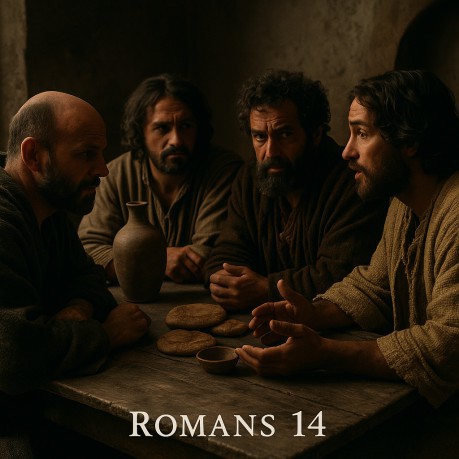
Romans 14:1 † Paul calls for unity, urging believers to
welcome the weak without engaging in disputes over doubtful matters. † Josephus (Antiquities 13.8.1) noted that Jews
often quarreled over sectarian differences. Paul warns the church not
to fall into the same trap. Romans 14:2 † Dietary issues divided believers. Some
abstained out of conscience, while others embraced liberty. Paul
stresses patience with both. † The Dead Sea Scrolls (CD 12.10-14) show how
Jewish sects were strict on diet. Paul insists faith, not food,
defines covenant membership. Romans 14:3-4 † God alone is the judge of His servants.
Mutual acceptance is commanded because Christ is the one who sustains
His people. Romans 14:5-6 † Disputes over days (Sabbath and feast
observances) are addressed. Each must act in conscience before the
Lord. † Philo exalted Jewish feast days, but Paul
frees believers from mandatory observance. Christ is the fulfillment. Romans 14:7-9 † All of life and death belongs to Christ.
Covenant identity is found in Him alone. Romans 14:10-12 † Judgment belongs to God alone. Paul cites
Isaiah 45:23, fulfilled in Christ's reign. † Early Christians confessed Jesus as Lord even
before Roman tribunals, demonstrating this fulfillment. Romans 14:13 † The stronger in faith must not use their
liberty to cause others to stumble. Love restrains freedom. Romans 14:14 † Paul affirms Jesus' teaching in Mark 7:15,
that food does not defile. But conscience matters, and faith must
guide. Romans 14:15 † Liberty must yield to love. To destroy a
brother over food is to despise Christ's sacrifice. Romans 14:16-18 † The kingdom is not about external rituals but
righteousness, peace, and joy in the Spirit. † The Didache (ch. 14) reminds believers that
worship is spiritual, not bound to ritual food laws. Romans 14:19 † Peace and edification are the priorities in
Christ's kingdom. Romans 14:20-21 † Christian liberty is real, but love limits
liberty. Avoid anything that harms a brother's conscience. Romans 14:22-23 † Faith must guide conduct. Whatever is not
from faith is sin. Conscience is critical in the covenant life. How it applies to us today † Disputes over non-essentials still divide
believers. Paul calls us to unity and love over liberty. † The kingdom is not about rituals but
righteousness, peace, and joy in the Spirit. † We must avoid causing others to stumble,
valuing love over personal freedom. † Everything must be done in faith, for
whatever is not from faith is sin. † This is the fulfilled perspective we proclaim at
Fulfilled Prophecies † Source Index
By Dan MainesRomans 14
Now accept the one who is weak
in faith, but not to have quarrels over opinions.
One person has faith that he may
eat all things, but the one who is weak eats only vegetables.
The one who eats is not to
regard with contempt the one who does not eat, and the one who does
not eat is not to judge the one who eats, for God has accepted him.
Who are you to judge the servant of another? To his own master he
stands or falls; and he will stand, for the Lord is able to make him
stand.
One person values one day over
another, another values every day the same. Each person must be fully
convinced in his own mind. The one who observes the day, observes it
for the Lord, and the one who eats, does so with regard to the Lord,
for he gives thanks to God; and the one who does not eat, it is for
the Lord that he does not eat, and he gives thanks to God.
For not one of us lives for
himself, and not one dies for himself; for if we live, we live for
the Lord, or if we die, we die for the Lord. Therefore whether we
live or die, we are the Lord's. For to this end Christ died and lived
again, that He might be Lord both of the dead and of the living.
But as for you, why do you
judge your brother or sister? Or you as well, why do you regard your
brother or sister with contempt? For we will all appear before the
judgment seat of God. For it is written: "As I live, says the
Lord, to Me every knee will bow, and every tongue will give praise to
God." So then each one of us will give an account of himself to
God.
Therefore let's not judge one
another anymore, but rather determine this: not to put an obstacle or
a stumbling block in a brother's or sister's way.
I know and am convinced in the
Lord Jesus that nothing is unclean in itself; but to the one who
thinks something is unclean, to that person it is unclean.
For if because of food your
brother or sister is hurt, you are no longer walking in accordance
with love. Do not destroy with your choice of food that person for
whom Christ died.
Therefore do not let what is
for you a good thing be spoken of as evil; for the kingdom of God is
not eating and drinking, but righteousness and peace and joy in the
Holy Spirit. For the one who serves Christ in this way is acceptable
to God and approved by other people.
So then we pursue the things
which make for peace and the building up of one another.
Do not tear down the work of
God for the sake of food. All things indeed are clean, but they are
evil for the person who eats and causes offense. It is good not to
eat meat or to drink wine, or to do anything by which your brother or
sister stumbles.
The faith which you have,
have as your own conviction before God. Blessed is the one who does
not condemn himself by what he approves. But the one who doubts is
condemned if he eats, because his eating is not from faith; and
whatever is not from faith is sin.
† Josephus,
Antiquities 13.8.1 – Jewish sectarian quarrels
†
Dead Sea Scrolls, CD 12.10-14 – Dietary restrictions of sects
†
Philo, On the Special Laws – Jewish feast observances
†
Isaiah 45:23 – Every knee bowing to God
†
Mark 7:15 – Jesus declares food does not defile
†
Didache, chapter 14 – Spiritual worship over ritual observance
Links