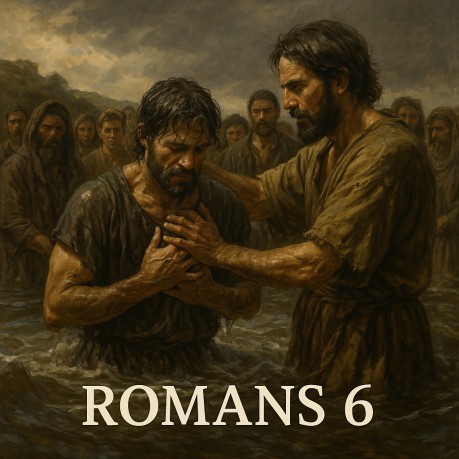
Romans 6:1-2 † Paul anticipates a false charge, that grace
encourages sin. He rejects it firmly. Believers died to sin, so
living in it is a contradiction. † Grace does not excuse sin, it delivers from
its dominion. To remain in sin would deny the reality of covenant
transformation in Christ. Romans 6:3-4 † Baptism unites believers with Christ's death
and resurrection. This is not mere ritual but covenant participation. † Colossians 2:12 echoes this, we were buried
with Him in baptism and raised through faith. † Chrysostom emphasized that baptism is not
symbolic alone but marks entrance into covenant life, a death to the
old order and rising into new life. Romans 6:5-6 † Union with Christ means the old self is
crucified. The "body of sin" refers to life under Adam and
the old covenant world of death. In Christ, that body is destroyed. † The Dead Sea Scrolls (1QS 3.6-10) also spoke
of two spirits, one of truth and one of wickedness. Paul shows that
in Christ, the old realm of wickedness is broken. Romans 6:7-8 † Death severs the claim of sin. In dying with
Christ, we are free from sin's dominion. † To live with Him is present covenant life. It
is not postponed to a distant resurrection but realized in union with
the risen Christ. Romans 6:9-10 † Christ's resurrection is final and complete.
Death no longer rules. His once-for-all death breaks sin's power
forever. † Hebrews 9:26 confirms that Christ's sacrifice
was once at the consummation of the ages, never to be repeated. Romans 6:11 † The call is to reckon ourselves in covenant
truth. We are dead to sin's dominion and alive to God in Christ. Romans 6:12-13 † Sin is no longer master. Believers must live
as those raised from the dead, offering themselves to God. † This echoes Romans 12:1, where we are called
to present our bodies as living sacrifices. Romans 6:14 † The dominion of sin was tied to the law.
Grace frees us from that dominion. † The Mishnah (Makkot 1:10) said that greater
Torah study lessened sin. Paul says only grace breaks sin's rule. Romans 6:15-16 † Freedom from the law does not mean license to
sin. Everyone serves a master, either sin unto death or obedience
unto righteousness. Romans 6:17-18 † Believers have been transferred from slavery
to sin into slavery to righteousness. True freedom is service to God. † Clement of Rome (1 Clement 35) also speaks of
obedience from the heart as the mark of covenant life. Romans 6:19 † Paul uses slavery as an analogy. Just as they
once served impurity, now they are to serve righteousness leading to
holiness. Romans 6:20-21 † Sin seemed like freedom, but its fruit was
only shame and death. Romans 6:22-23 † Sin pays wages, death. God gives a gift,
eternal life in Christ. The contrast is total. † Futurists misplace eternal life into an age
to come, but Paul says it is already the present possession of those
in Christ. How it applies to us today † Baptism unites us with Christ's death and
resurrection. Our covenant life is rooted in this union. † Grace does not excuse sin, it frees us from
its dominion. We are called to live as those dead to sin and alive to
God. † Every person serves a master. We must yield
ourselves daily to righteousness, bearing fruit that leads to life. † Eternal life is not a future hope but a
present reality in Christ. We already share in His victory over sin
and death. † This is the fulfilled perspective we proclaim at
Fulfilled Prophecies † Source Index
By Dan MainesRomans 6
What shall we say then? Are we
to continue in sin so that grace may increase? Far from it! How shall
we who died to sin still live in it?
Or do you not know that all of
us who have been baptized into Christ Jesus have been baptized into
His death? Therefore we have been buried with Him through baptism
into death, so that, just as Christ was raised from the dead through
the glory of the Father, so we too may walk in newness of life.
For if we have become united
with Him in the likeness of His death, certainly we shall also be in
the likeness of His resurrection, knowing this, that our old self was
crucified with Him, in order that our body of sin might be done away
with, so that we would no longer be slaves to sin.
For the one who has died is
freed from sin. Now if we have died with Christ, we believe that we
shall also live with Him.
knowing that Christ, having
been raised from the dead, is never to die again, death no longer is
master over Him. For the death that He died, He died to sin once for
all time, but the life that He lives, He lives to God.
So you too, consider yourselves
to be dead to sin, but alive to God in Christ Jesus.
Therefore sin is not to reign
in your mortal body so that you obey its lusts, and do not go on
presenting the parts of your body to sin as instruments of
unrighteousness, but present yourselves to God as those who are alive
from the dead, and your body's parts as instruments of righteousness
for God.
For sin shall not be master over
you, for you are not under the Law but under grace.
What then? Are we to sin
because we are not under the Law but under grace? Far from it! Do you
not know that the one to whom you present yourselves as slaves for
obedience, you are slaves of that same one whom you obey, either of
sin resulting in death, or of obedience resulting in righteousness?
But thanks be to God that
though you were slaves of sin, you became obedient from the heart to
that form of teaching to which you were entrusted, and after being
freed from sin, you became slaves to righteousness.
I am speaking in human terms
because of the weakness of your flesh. For just as you presented the
parts of your body as slaves to impurity and to lawlessness,
resulting in further lawlessness, so now present your body's parts as
slaves to righteousness, resulting in sanctification.
For when you were slaves of
sin, you were free in relation to righteousness. Therefore what
benefit were you then deriving from the things of which you are now
ashamed? For the outcome of those things is death.
But now that you have been
freed from sin and enslaved to God, you derive your benefit,
resulting in sanctification, and the outcome, eternal life. For the
wages of sin is death, but the gracious gift of God is eternal life
in Christ Jesus our Lord.
†
Chrysostom, Homilies on Romans – Baptism as entrance into covenant
life
† Dead Sea Scrolls, 1QS 3.6-10 – Two
spirits of truth and wickedness
† Hebrews
9:26 – Christ's sacrifice once at the consummation of the ages
†
Mishnah, Makkot 1:10 – Torah study as a means to restrain sin
†
Clement of Rome, 1 Clement 35 – Obedience from the heart
Links