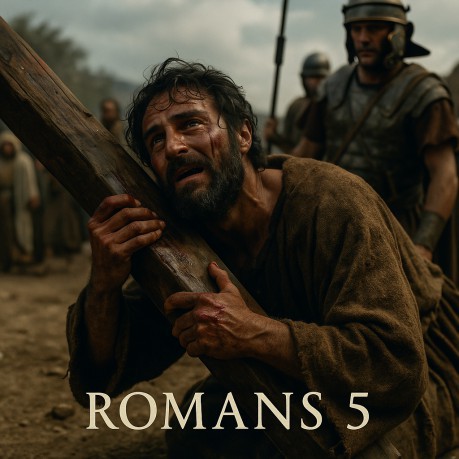
Romans 5:1 † Paul declares the result of justification:
peace with God. This peace is not temporary relief but covenant
reconciliation. Isaiah 32:17 promised that the work of righteousness
would be peace. That promise is fulfilled in Christ. † Peace in the Roman world was associated with
the Pax Romana, but Paul points to a greater peace. Unlike Rome's
enforced stability, the peace of Christ reconciles Jew and Gentile
into one body. Romans 5:2 † Faith gives us access into grace, not works
or heritage. Standing in grace means a secure covenant position. † The hope of the glory of God points back to
Romans 3:23, where all fell short. Now, through Christ, that glory is
restored. Romans 5:3-4 † Tribulation is not meaningless but produces
perseverance, character, and hope. This was vital for the
first-century church facing persecution. † Tacitus and Suetonius both record the
tribulations of early Christians under Rome. Paul frames suffering
not as defeat but as the pathway to covenant hope. Romans 5:5 † Hope is secured by the Spirit. God's love is
not distant but poured out in the hearts of believers. † The Spirit was the seal of the New Covenant.
Ephesians 1:13 echoes this truth, showing that the Spirit was given
to confirm the promises fulfilled in Christ. Romans 5:6 † The timing of Christ's death was divinely
appointed. Galatians 4:4 says He came in the fullness of time. † The ungodly here refers to both Jew and
Gentile, showing that salvation was not earned but given when
humanity was powerless. Romans 5:7-8 † Human love is limited, but God's love is
demonstrated supremely in Christ's death. He died not for the
righteous but for sinners. † Philo described God's mercy as His greatest
attribute. Paul shows that mercy manifested in the cross. Romans 5:9 † Justification is by Christ's blood, not the
blood of temple sacrifices. † The wrath Paul refers to was the imminent
covenant wrath coming upon Israel in AD 70. Believers would be
delivered from that judgment through Christ. Romans 5:10-11 † Reconciliation is both past and present.
Christ's death secured it, and His life guarantees it. This is
covenantal restoration, not a future hope but a present reality. Romans 5:12 † Adam's sin introduced death into the covenant
world. All sinned, so all share in death. This sets the stage for
Christ as the new Adam. † The Dead Sea Scrolls (1QH Thanksgiving Hymns)
describe the universal corruption of mankind. Paul ties this reality
to Adam's sin. Romans 5:13-14 † Sin was present before the law, but the law
defined and exposed it. Death reigned from Adam to Moses, showing
universal corruption. † Adam is presented as a type of Christ. Where
Adam brought death, Christ brings life. Romans 5:15 † Adam's sin brought death to many. Christ's
grace overflows to many. The gift surpasses the offense. Romans 5:16-17 † Adam's offense brought condemnation. Christ's
obedience brings justification. Those in Him reign in life, not
death. Romans 5:18-19 † The parallel between Adam and Christ is
complete. Adam's disobedience made many sinners. Christ's obedience
makes many righteous. † Early church fathers such as Irenaeus
emphasized this Adam-Christ contrast, seeing Christ as the "second
Adam" who undid the first Adam's failure. Romans 5:20-21 † The law exposed sin, making it increase. Yet
grace abounded beyond sin. Grace reigns through righteousness,
leading to eternal life in Christ. † Futurism looks for grace in a future age, but
Paul says grace reigns now through Christ. How it applies to us today † Our peace with God is secure in Christ. We
are reconciled, not waiting for reconciliation in a distant future. † Suffering produces perseverance and hope.
Just as the first-century church endured tribulation, so we are
called to trust God in trials. † Adam brought death, but Christ brings life.
Our covenant identity is in Him, not in the old creation. † Grace abounds beyond sin. No matter the depth
of human corruption, Christ's righteousness overflows to life. † This is the fulfilled perspective we proclaim at
Fulfilled Prophecies † Source Index
By Dan MainesRomans 5
Therefore, having been justified
by faith, we have peace with God through our Lord Jesus Christ,
through whom we also have
obtained our introduction by faith into this grace in which we stand;
and we celebrate in hope of the glory of God.
And not only this, but we also
celebrate in our tribulations, knowing that tribulation brings about
perseverance; and perseverance, proven character; and proven
character, hope.
and hope does not disappoint,
because the love of God has been poured out within our hearts through
the Holy Spirit who was given to us.
For while we were still helpless,
at the right time Christ died for the ungodly.
For one will hardly die for a
righteous person; though perhaps for the good person someone would
even dare to die. But God demonstrates His own love toward us, in
that while we were still sinners, Christ died for us.
Much more then, having now been
justified by His blood, we shall be saved from the wrath of God
through Him.
For if while we were enemies
we were reconciled to God through the death of His Son, much more,
having been reconciled, we shall be saved by His life. And not only
this, but we also celebrate in God through our Lord Jesus Christ,
through whom we have now received the reconciliation.
Therefore, just as through one
man sin entered into the world, and death through sin, and so death
spread to all mankind, because all sinned—
for until the Law sin was in
the world, but sin is not counted against anyone when there is no
law. Nevertheless, death reigned from Adam until Moses, even over
those who had not sinned in the likeness of the violation committed
by Adam, who is a type of Him who was to come.
But the gracious gift is not
like the offense. For if by the offense of the one the many died,
much more did the grace of God and the gift by the grace of the one
Man, Jesus Christ, overflow to the many.
The gift is not like that
which came through the one who sinned; for on the one hand the
judgment arose from one offense, resulting in condemnation, but on
the other hand the gracious gift arose from many offenses, resulting
in justification. For if by the offense of the one, death reigned
through the one, much more will those who receive the abundance of
grace and of the gift of righteousness reign in life through the One,
Jesus Christ.
So then, as through one
offense the result was condemnation to all mankind, so also through
one act of righteousness the result was justification of life to all
mankind. For as through the one man's disobedience the many were made
sinners, so also through the obedience of the One the many will be
made righteous.
The Law came in so that the
offense would increase; but where sin increased, grace abounded all
the more, so that, as sin reigned in death, so also grace would reign
through righteousness to eternal life through Jesus Christ our Lord.
† Isaiah
32:17 – The effect of righteousness is peace
†
Tacitus, Annals 15.44 – Roman persecution of Christians
†
Philo, On the Special Laws – God's mercy as His greatest
attribute
† Josephus, Wars of the Jews 6.9.3
– Wrath on Jerusalem in AD 70
† Dead Sea
Scrolls, 1QH (Thanksgiving Hymns) – Human corruption and sin
†
Irenaeus, Against Heresies 3.22.4 – Christ as the second Adam
Links