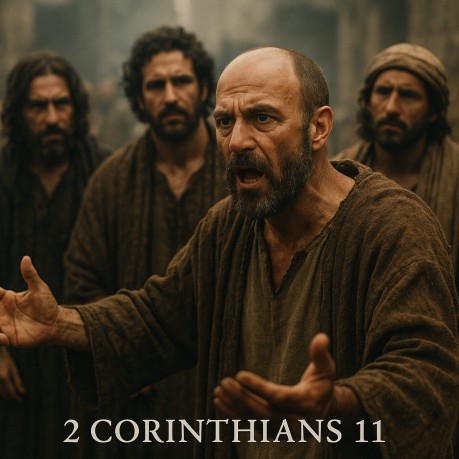
2 Corinthians 11 2 Corinthians 11:1 † Paul prepares to boast reluctantly, calling
it "foolishness." 2 Corinthians 11:2-3 † Paul's jealousy is protective, not selfish,
desiring their loyalty to Christ alone. 2 Corinthians 11:4 † Paul rebukes the Corinthians for tolerating
false gospels. 2 Corinthians 11:5-6 † Paul admits his lack of eloquence but
emphasizes true knowledge of Christ. 2 Corinthians 11:7-9 † Paul preached freely in Corinth, supported by
other churches. 2 Corinthians 11:10-12 † Paul boasts in his integrity, refusing to
exploit the Corinthians. 2 Corinthians 11:13-15 † Paul unmasks false apostles as servants of
Satan. 2 Corinthians 11:16-18 † Paul stoops to the level of his opponents by
boasting, though he calls it foolishness. 2 Corinthians 11:19-21 † Paul uses irony to expose their tolerance of
abusive leaders. 2 Corinthians 11:22-23 † Paul matches his opponents' claims, then
surpasses them in suffering for Christ. 2 Corinthians 11:24-27 † Paul's suffering catalog proves his
authenticity. 2 Corinthians 11:28-29 † Beyond physical trials, Paul carried constant
care for the churches. 2 Corinthians 11:30-31 † Paul boasts only in weakness, for weakness
reveals God's strength. 2 Corinthians 11:32-33 † Paul recalls his humiliating escape from
Damascus, proof that his ministry began in weakness. How it applies to us today † This is the fulfilled perspective we proclaim at
Fulfilled Prophecies † Source Index
By Dan Maines
I wish that you would
bear with me in a little foolishness, but indeed you are bearing with
me.
† He appeals to
the Corinthians' patience as he defends his apostleship.
For I am jealous for
you with a godly jealousy, for I betrothed you to one husband, to
present you as a pure virgin to Christ. But I am afraid that, as the
serpent deceived Eve by his trickery, your minds will be led astray
from sincere and pure devotion to Christ.
† He
fears false teachers may corrupt them as the serpent did Eve.
†
Irenaeus (Against Heresies 5.23.2) compared false teachers to the
serpent's deception.
For if one comes and
preaches another Jesus whom we have not preached, or you receive a
different spirit which you have not received, or a different gospel
which you have not accepted, this you tolerate very well!
† False Christs and false
spirits threaten the church.
For I consider myself
not in the least inferior to the most eminent apostles. But even if I
am unskilled in speech, yet I am not so in knowledge, in fact, in
every way we have made this evident to you in all things.
†
Knowledge of the gospel outweighs rhetorical skill.
†
Lucian of Samosata often mocked Christian preachers as poor speakers,
showing how critics judged by style, not truth.
Or did I commit a sin
by humbling myself so that you might be exalted, because I preached
the gospel of God to you without charge? I robbed other churches by
taking wages from them to serve you, and when I was present with you
and was in need, I was not a burden to anyone, for when the brothers
came from Macedonia they fully supplied my need, and in everything I
kept myself from being a burden to you, and will continue to do so.
† His sacrifice was for their
spiritual exaltation.
† Clement of Rome (1
Clement 5) remembered Paul's sacrifices for the churches.
As the truth of
Christ is in me, this boasting of mine will not be stopped in the
regions of Achaia. Why? Because I do not love you? God knows I do!
But what I am doing I will also continue to do, so that I may
eliminate the opportunity from those who want an opportunity to be
regarded just as we are in the matter about which they are boasting.
† He exposes false
apostles who boasted for selfish gain.
For such men are
false apostles, deceitful workers, disguising themselves as apostles
of Christ. No wonder, for even Satan disguises himself as an angel of
light. Therefore it is not surprising if his servants also disguise
themselves as servants of righteousness, whose end will be according
to their deeds.
† Outward appearance may deceive, but
judgment reveals truth.
† The Dead Sea
Scrolls (1QS 4.23) also describe spirits of deceit masquerading as
light.
Again I say, no one
is to think me foolish, but if you do, accept me even as foolish, so
that I also may boast a little. What I am saying, I am not saying as
the Lord would, but as in foolishness, in this confidence of
boasting. Since many boast according to the flesh, I will boast also.
†
He contrasts fleshly boasting with true boasting in Christ.
For you, being so
wise, tolerate the foolish gladly. For you tolerate it if anyone
enslaves you, if anyone devours you, if anyone takes advantage of
you, if anyone exalts himself, if anyone hits you in the face. To my
shame I must say that we have been weak by comparison.
† True apostleship is marked
by humility and service, not domination.
Are they Hebrews? So
am I. Are they Israelites? So am I. Are they descendants of Abraham?
So am I. Are they servants of Christ? I speak as if insane, I more
so, in far more labors, in far more imprisonments, beaten times
without number, often in danger of death.
† His
apostleship is proven by endurance, not status.
Five times I received
from the Jews thirty-nine lashes. Three times I was beaten with rods,
once I was stoned, three times I was shipwrecked, a night and a day I
have spent adrift at sea. I have been on frequent journeys, in
dangers from rivers, dangers from robbers, dangers from my
countrymen, dangers from the Gentiles, dangers in the city, dangers
in the wilderness, dangers at sea, dangers among false brothers, I
have been in labor and hardship, through many sleepless nights, in
hunger and thirst, often without food, in cold and exposure.
† Josephus (Wars 2.14.9)
described similar perils in travel, giving historical context to
Paul's hardships.
Apart from such
external things, there is the daily pressure on me of concern for all
the churches. Who is weak without my being weak? Who is led into sin
without my intense concern?
† His love made him
share in their weakness and struggles.
If I have to boast, I
will boast of what pertains to my weakness. The God and Father of the
Lord Jesus, He who is blessed forever, knows that I am not lying.
In Damascus the
ethnarch under Aretas the king was guarding the city of the
Damascenes in order to seize me, and I was let down in a basket
through a window in the wall, and so escaped his hands.
†
Eusebius (Ecclesiastical History 2.1) noted Paul's early sufferings,
showing his humility and perseverance.
†
2 Corinthians 11 teaches that true apostleship is proven by
suffering, humility, and faithfulness, not outward show.
†
False teachers may appear as light, but their fruits expose them.
†
The church must discern truth from deception, holding fast to Christ
alone.
† Like Paul, we boast only in
weakness, that Christ's strength may be revealed.
† Irenaeus,
Against Heresies 5.23.2 - false teachers compared to the serpent
†
Lucian of Samosata - mockery of Christian preachers' speech
†
Clement of Rome, 1 Clement 5 - Paul's sacrifices remembered
†
Dead Sea Scrolls, 1QS 4.23 - spirits of deceit appearing as light
†
Josephus, Wars 2.14.9 - dangers of travel in Paul's era
†
Eusebius, Ecclesiastical History 2.1 - Paul's early sufferings
Links