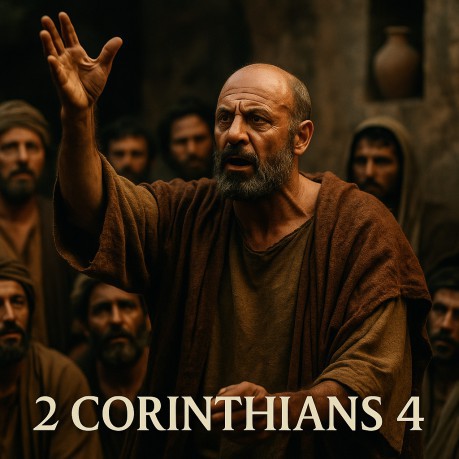
2 Corinthians 4 2 Corinthians 4:1-2 † Paul affirms his perseverance in ministry,
sustained by mercy. 2 Corinthians 4:3-4 † The gospel's veil remains for those perishing
in unbelief. 2 Corinthians 4:5-6 † Paul preaches Christ, not himself. 2 Corinthians 4:7 † The gospel is a treasure, and believers are
fragile vessels. 2 Corinthians 4:8-9 † Paul lists his trials, but God sustains him
through all. 2 Corinthians 4:10-11 † Paul's suffering reflects Christ's death, but
also reveals His life. 2 Corinthians 4:12 † Paul's suffering benefits the Corinthians,
bringing them life. 2 Corinthians 4:13-14 † Faith speaks boldly, trusting resurrection
hope. 2 Corinthians 4:15 † Paul's trials and ministry serve to spread
grace, increasing thanksgiving. 2 Corinthians 4:16 † Physical decline is real, but inward renewal
by the Spirit is daily. 2 Corinthians 4:17-18 † Affliction is momentary compared to eternal
glory. How it applies to us today † This is the fulfilled perspective we proclaim at
Fulfilled Prophecies † Source Index
By Dan Maines
Therefore, since we have
this ministry, as we received mercy, we do not lose heart, but we
have renounced the things hidden because of shame, not walking in
trickery nor distorting the word of God, but by the open proclamation
of the truth commending ourselves to every person's conscience in the
sight of God.
† He rejects deception or
distortion, proclaiming the truth openly.
†
Eusebius (Ecclesiastical History 2.25) notes Paul's integrity against
the deceit of false apostles.
But if our gospel is
veiled, it is veiled to those who are perishing, in whose case the
god of this world has blinded the minds of the unbelieving so that
they will not see the light of the gospel of the glory of Christ, who
is the image of God.
† Satan blinds minds to prevent
seeing Christ's glory.
† Justin Martyr
(Dialogue with Trypho 38) explained Israel's blindness as a veil
covering them from seeing Christ.
For we do not preach
ourselves, but Christ Jesus as Lord, and ourselves as your
bond-servants on account of Jesus. For God, who said, "Light
shall shine out of darkness," is the One who has shone in our
hearts to give the Light of the knowledge of the glory of God in the
face of Christ.
†
God's creative light now shines in hearts, revealing His glory in
Christ.
† Philo (On the Creation 31)
described light as the first work of God, which Paul applies
spiritually here.
But we have this treasure
in earthen containers, so that the extraordinary greatness of the
power will be of God and not from ourselves.
† God's power is shown in
weakness.
† Irenaeus (Against Heresies 4.5.1)
described believers as clay in the Potter's hand, echoing Paul's
teaching.
We are afflicted in
every way, but not crushed, perplexed, but not despairing,
persecuted, but not abandoned, struck down, but not destroyed.
† Suffering is real but never
final.
† Josephus (Wars 2.22.2) recorded the
persecutions of Jews and early believers, providing historical
context to Paul's words.
Always carrying around
in the body the dying of Jesus, so that the life of Jesus may also be
revealed in our body. For we who live are constantly being handed
over to death because of Jesus, so that the life of Jesus may also be
revealed in our mortal flesh.
† Affliction displays
resurrection power in weak vessels.
So death works in us, but
life in you.
† Ministry often requires
sacrifice for others' growth.
But having the same
spirit of faith, according to what is written: "I believed,
therefore I spoke," we also believe, therefore we also speak,
knowing that He who raised the Lord Jesus will also raise us with
Jesus, and will present us with you.
† The same God who raised Christ will
also vindicate His people.
† Clement of Rome
(1 Clement 24) tied creation and resurrection together as reasons for
hope.
For all things are for
your sakes, so that grace, having spread to more and more people,
will cause thanksgiving to overflow to the glory of God.
Therefore we do not lose
heart, but though our outer person is decaying, yet our inner person
is being renewed day by day.
† Ignatius (Letter to
the Romans 7) spoke of outer decay but inner renewal in Christ.
For our momentary,
light affliction is producing for us an eternal weight of glory far
beyond all comparison, while we look not at the things which are
seen, but at the things which are not seen, for the things which are
seen are temporary, but the things which are not seen are eternal.
† Faith focuses on unseen, eternal
realities.
† Origen (On First Principles
2.11.2) emphasized the unseen eternal as superior to the visible.
†
2 Corinthians 4 reminds us that our weakness magnifies God's power.
†
The gospel is treasure in fragile vessels, proving salvation is of
God, not man.
† Affliction is real but
temporary, producing eternal glory.
† With
unveiled hearts, we look beyond the temporary to the eternal, walking
in the light of Christ.
† Eusebius,
Ecclesiastical History 2.25 - Paul's integrity against false
apostles
† Justin Martyr, Dialogue with
Trypho 38 - Israel's blindness to Christ
†
Philo, On the Creation 31 - God's light in creation
†
Irenaeus, Against Heresies 4.5.1 - clay in the Potter's hand
†
Josephus, Wars 2.22.2 - persecutions and afflictions
†
Clement of Rome, 1 Clement 24 - hope in creation and resurrection
†
Ignatius, Letter to the Romans 7 - inner renewal amid decay
†
Origen, On First Principles 2.11.2 - unseen eternal realities
Links