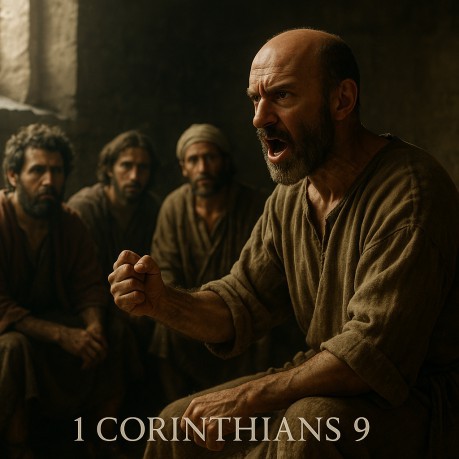
1 Corinthians 9 1 Corinthians 9:1-2 † Paul defends his apostleship, reminding them
he has seen the risen Christ. 1 Corinthians 9:3-6 † Paul appeals to the natural rights of
apostles, including support and family. 1 Corinthians 9:7-10 † Paul uses examples from daily life and the
Law to show ministers deserve support. 1 Corinthians 9:11-12 † Paul and his coworkers chose self-denial for
the sake of the gospel's advance. 1 Corinthians 9:13-14 † As priests in the Old Covenant lived from the
altar, so ministers of Christ may live from the gospel. 1 Corinthians 9:15-18 † Paul glories in preaching freely, motivated
by divine compulsion. 1 Corinthians 9:19-23 † Paul adapts to every audience without
compromising truth. 1 Corinthians 9:24-27 † Paul compares Christian discipline to
athletic contests. How it applies to us today † This is the fulfilled perspective we proclaim at
Fulfilled Prophecies † Source Index
By Dan Maines
Am I not free? Am I not
an apostle? Have I not seen Jesus our Lord? Are you not my work in
the Lord? If I am not an apostle to others, at least I am to you, for
you are the seal of my apostleship in the Lord.
† The
Corinthians themselves are proof of his calling, being the fruit of
his labor.
† Ignatius (Letter to the Romans
4) emphasized apostles as eyewitnesses of Christ, aligning with
Paul's defense.
My defense to those who
examine me is this: Do we not have a right to eat and drink? Do we
not have a right to take along a believing wife, even as the rest of
the apostles, and the brothers of the Lord, and Cephas? Or do only
Barnabas and I have no right to refrain from working?
† Yet
he and Barnabas labored without demanding these rights.
Who at any time serves
as a soldier at his own expense? Who plants a vineyard and does not
eat its fruit? Or who tends a flock and does not consume some of the
milk of the flock? I am not just asserting these things according to
human judgment, am I? Or does the Law not say these things as well?
For it is written in the Law of Moses: "You shall not muzzle the
ox while it is threshing." God is not concerned about oxen, is
He? Or is He speaking entirely for our sake? Yes, it was written for
our sake, because the plowman ought to plow in hope, and the thresher
to thresh in hope of sharing the crops.
†
Deuteronomy 25:4 provided a principle for fairness, applied to gospel
work.
If we sowed spiritual
things in you, is it too much if we reap material things from you? If
others share the right over you, do we not more? Nevertheless, we did
not use this right, but we endure all things so that we will cause no
hindrance to the gospel of Christ.
† The
gospel's progress outweighed their personal rights.
Do you not know that
those who perform sacred services eat the food of the temple, and
those who attend regularly to the altar have their share from the
altar? So also the Lord directed those who proclaim the gospel to get
their living from the gospel.
†
Jesus affirmed this principle in Luke 10:7.
But I have used none
of these things. And I am not writing these things so that it will be
done so in my case, for it would be better for me to die than have
anyone deprive me of my ground for boasting. For if I preach the
gospel, I have nothing to boast of, for I am under compulsion, for
woe to me if I do not preach the gospel! For if I do this
voluntarily, I have a reward, but if against my will, I have been
entrusted with a commission regardless. What, then, is my reward?
That, when I preach the gospel, I may offer the gospel without
charge, so as not to make full use of my right in the gospel.
† His reward is the joy
of offering the gospel without charge.
†
Chrysostom (Homilies on 1 Corinthians 22) praised Paul's zeal and
refusal to burden others.
For though I am free
from all people, I have made myself a slave to all, so that I may
gain more. To the Jews I became as a Jew, so that I might gain Jews.
To those who are under the Law, I became as one under the Law, though
not being under the Law myself, so that I might gain those who are
under the Law. To those who are without the Law, I became as one
without the Law, though not being without the law of God but under
the law of Christ, so that I might gain those who are without the
Law. To the weak I became weak, so that I might gain the weak. I have
become all things to all people, so that I may by all means save
some. I do all things for the sake of the gospel, so that I may
become a fellow participant in it.
† His flexibility shows
love and mission focus, never self-interest.
Do you not know that
those who run in a race all run, but only one receives the prize? Run
in such a way that you may win. Everyone who competes in the games
exercises self-control in all things. So they do it to obtain a
perishable wreath, but we an imperishable. Therefore I run in such a
way as not to run aimlessly, I box in such a way as to avoid hitting
air, but I strictly discipline my body and make it my slave, so that,
after I have preached to others, I myself will not be disqualified.
† Self-control and
endurance are vital to finish the race.
† The
prize is eternal, unlike the fading crowns of the games.
†
Epictetus, a Stoic philosopher, also emphasized discipline in life,
but Paul points to Christ as the goal, not human virtue.
†
1 Corinthians 9 calls believers to lay down rights for the sake of
the gospel.
† Ministry is about service,
sacrifice, and endurance, not privilege.
†
The call is to discipline ourselves, live missionally, and endure for
the eternal reward.
† The gospel must be
advanced without hindrance, in love and humility.
† Ignatius,
Letter to the Romans 4 - apostles as eyewitnesses
†
Deuteronomy 25:4 - do not muzzle the ox
†
Chrysostom, Homilies on 1 Corinthians 22 - Paul's zeal in preaching
freely
† Epictetus, Discourses 3.12 -
discipline in life
Links