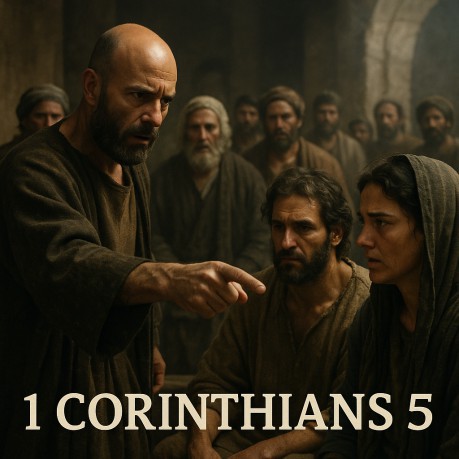
1 Corinthians 5 1 Corinthians 5:1 † Paul rebukes the Corinthians for tolerating
scandalous sin that even pagans condemned. 1 Corinthians 5:2 † Their pride led to tolerance instead of
grief. 1 Corinthians 5:3-5 † Paul pronounces judgment, showing apostolic
authority in Christ. 1 Corinthians 5:6-7 † Tolerated sin corrupts the whole church. 1 Corinthians 5:8 † The Christian life is a continual Passover
feast in sincerity and truth. 1 Corinthians 5:9-10 † Paul clarifies that separation applies to
those claiming to be believers, not unbelievers. 1 Corinthians 5:11 † Discipline applies to professing believers
living in sin. 1 Corinthians 5:12-13 † The church judges inside, not outside. How it applies to us today † This is the fulfilled perspective we proclaim at
Fulfilled Prophecies † Source Index
By Dan Maines
It is actually reported
that there is sexual immorality among you, and immorality of such a
kind as does not exist even among the Gentiles, namely, that someone
has his father's wife.
†
The church's failure to discipline revealed pride and compromise.
†
Josephus (Antiquities 20.200) condemned similar immoral practices in
Jewish history, showing Paul's outrage was consistent with cultural
standards.
You have become arrogant,
and have not mourned instead, so that the one who had done this deed
would be removed from your midst.
† True love for holiness demands
discipline.
For I, on my part,
though absent in body but present in spirit, have already judged him
who has so committed this, as though I were present. In the name of
our Lord Jesus, when you are assembled, and I am with you in spirit,
with the power of our Lord Jesus, I have decided to turn such a
person over to Satan for the destruction of his body, so that his
spirit may be saved on the day of the Lord.
† Delivering to Satan
meant excommunication, outside the protection of the church, so
repentance might come.
† Tertullian (On
Repentance 7) pointed to church discipline as a means of salvation,
not destruction.
Your boasting is not
good. Do you not know that a little leaven leavens the whole lump of
dough? Clean out the old leaven so that you may be a new lump, just
as you are in fact unleavened. For Christ our Passover also has been
sacrificed.
†
Christ, our Passover Lamb, calls us to purity.
†
Philo (On the Special Laws 2.145) wrote of leaven as corruption,
aligning with Paul's imagery.
Therefore let's celebrate
the feast, not with old leaven, nor with leaven of malice and
wickedness, but with the unleavened bread of sincerity and truth.
† Holiness
marks the true people of God.
I wrote to you in my
letter not to associate with sexually immoral people, I did not at
all mean with the sexually immoral people of this world, or with the
greedy and swindlers, or with idolaters, for then you would have to
leave the world entirely.
†
The church lives in the world but is not to imitate its corruption.
But actually, I wrote to
you not to associate with any so-called brother if he is a sexually
immoral person, or greedy, or an idolater, or is verbally abusive, or
habitually drunk, or a swindler—not even to eat with such a person.
† Fellowship must reflect
holiness.
For what business of
mine is it to judge outsiders? Do you not judge those who are within
the church? But those who are outside, God judges. Remove the evil
person from among yourselves.
†
God judges the world, but the church must discipline its own.
†
Deuteronomy 17:7 commanded Israel to purge evil from their midst,
fulfilled here in the church's call.
†
1 Corinthians 5 teaches that holiness cannot be compromised by
tolerance of sin.
† The church is called to
discipline for the sake of restoration and purity.
†
Christ is our Passover, and we must live as unleavened bread, in
sincerity and truth.
† The world is judged by
God, but the church must be vigilant in judging itself.
† Josephus,
Antiquities 20.200 - condemnation of sexual immorality
†
Tertullian, On Repentance 7 - discipline for restoration
†
Philo, On the Special Laws 2.145 - leaven as corruption
†
Deuteronomy 17:7 - remove evil from among you
Links