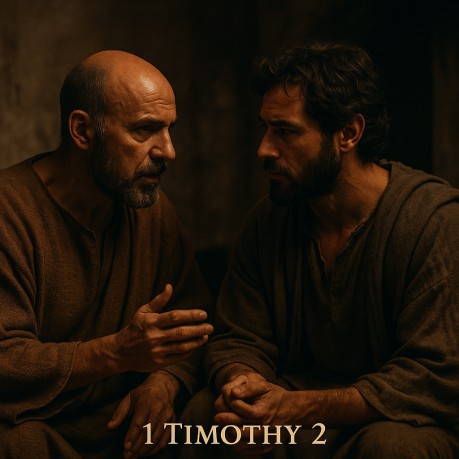
1 Timothy 2 1 Timothy 2:1-2 † Paul commands prayer for all people,
including rulers, showing the church's mission is broader than
itself. 1 Timothy 2:3-4 † God's desire is universal salvation,
fulfilled through the gospel. 1 Timothy 2:5-6 † Christ alone is the mediator, bridging God
and humanity. 1 Timothy 2:7 † Paul highlights his divine appointment to
teach the Gentiles. 1 Timothy 2:8 † Men are called to lead in prayer with purity,
not quarrels. 1 Timothy 2:9-10 † Women are called to modesty, prioritizing
good works over outward adornment. 1 Timothy 2:11-12 † Paul emphasizes order in teaching, reflecting
creation order and avoiding confusion in worship. 1 Timothy 2:13-14 † Paul roots his teaching in creation, not
culture. 1 Timothy 2:15 † Preservation here points to God's protection
and the ultimate fulfillment in Christ's birth. How it applies to us today † This is the fulfilled perspective we proclaim at
Fulfilled Prophecies † Source Index
By Dan Maines
First of all, then, I urge
that requests, prayers, intercession, and thanksgiving be made in
behalf of all people, for kings and all who are in authority, so that
we may lead a tranquil and quiet life in all godliness and dignity.
† The goal of such prayer is peace,
so believers may live godly and dignified lives.
†
Josephus (Antiquities 12.3.3) notes that Jews prayed for rulers, a
practice Paul affirms in Christian worship.
This is good and acceptable
in the sight of God our Savior, who wants all people to be saved and
to come to the knowledge of the truth.
† The church
must reflect this universal scope in its mission.
For there is one God, and
one mediator also between God and mankind, the man Christ Jesus, who
gave Himself as a ransom for all, the testimony given at the proper
time.
† His sacrifice as ransom is
sufficient for all.
† Ignatius (Letter to the
Magnesians 7) affirmed one God and one mediator, contrasting with
false teachers.
For this I was appointed as a
preacher and an apostle, I am telling the truth, I am not lying, as a
teacher of the Gentiles in faith and truth.
† His mission affirms the
universality of the gospel.
Therefore I want the men in
every place to pray, lifting up holy hands, without anger and
dispute.
† The posture of holy hands
signifies both purity and surrender.
Likewise, I want women to
adorn themselves with proper clothing, modestly and discreetly, not
with braided hair, gold, pearls, or expensive apparel, but rather by
means of good works, as is proper for women making a claim to
godliness.
† Roman
society prized display of wealth, but Paul calls for holiness in
action.
† Plutarch (Moralia 142C) critiqued
vanity in women, similar to Paul's concern.
A woman must quietly
receive instruction with entire submissiveness. But I do not allow a
woman to teach or to exercise authority over a man, but to remain
quiet.
†
This was not cultural chauvinism but a consistent application of
headship principles.
† Early church fathers,
like Tertullian (On the Veiling of Virgins 9), applied Paul's words
to preserve order in worship.
For it was Adam who was
first formed, and then Eve. And it was not Adam who was deceived, but
the woman was deceived and became a wrongdoer.
† Eve's deception highlights
vulnerability apart from God's order.
But women will be preserved
through childbirth—if they continue in faith, love, and sanctity,
with moderation.
†
Women share in salvation by living faithfully in their roles.
†
Chrysostom (Homily on 1 Timothy 9) emphasized that holiness, not
childbearing itself, is the focus.
†
1 Timothy 2 shows the importance of prayer for all people, especially
rulers, so that the gospel may flourish in peace.
†
Christ alone is mediator, and the church must reflect His universal
mission.
† Godly order in worship matters,
with men and women called to purity, modesty, and faithfulness.
†
Our identity in Christ produces love, good works, and a focus on
eternal things rather than worldly displays.
† Josephus,
Antiquities 12.3.3 - Jews praying for rulers
†
Ignatius, Letter to the Magnesians 7 - one God and mediator
†
Plutarch, Moralia 142C - critique of vanity
†
Tertullian, On the Veiling of Virgins 9 - women and worship order
†
Chrysostom, Homily on 1 Timothy 9 - holiness emphasized
Links