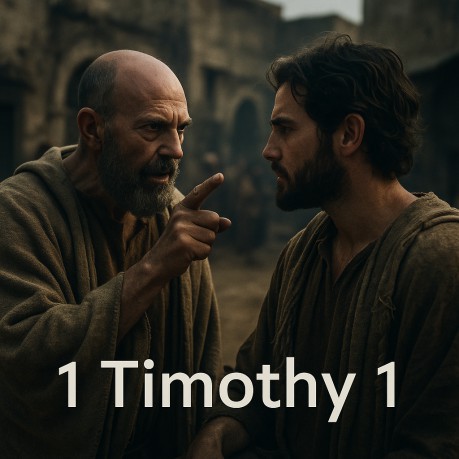
1 Timothy 1 1 Timothy 1:1-2 † Paul begins with his apostolic authority,
reminding Timothy that his mission is by divine command. 1 Timothy 1:3-4 † Timothy's task was to oppose false teaching
in Ephesus. 1 Timothy 1:5 † True teaching produces love, not
speculation. 1 Timothy 1:6-7 † False teachers desired authority but lacked
knowledge. 1 Timothy 1:8-11 † The Law is not for the righteous but for
sinners, to expose their guilt. 1 Timothy 1:12-14 † Paul recounts his transformation from
persecutor to apostle as proof of God's grace. 1 Timothy 1:15-16 † Paul declares the core gospel: Christ came to
save sinners. 1 Timothy 1:17 † Paul erupts into doxology, praising God's
eternal reign. 1 Timothy 1:18-19 † Timothy is to fight faithfully, armed with
prophecy, faith, and conscience. 1 Timothy 1:20 † Paul names false teachers, showing the
seriousness of their sin. How it applies to us today † This is the fulfilled perspective we proclaim at
Fulfilled Prophecies † Source Index
By Dan Maines
Paul, an apostle of Christ
Jesus according to the commandment of God our Savior, and of Christ
Jesus, who is our hope, to Timothy, my true son in the faith: Grace,
mercy, and peace from God the Father and Christ Jesus our Lord.
†
He calls Timothy his true son in the faith, showing their spiritual
father-son relationship.
† Early church
fathers, like Irenaeus (Against Heresies 3.3.4), spoke of apostolic
succession, where men like Timothy carried on the apostolic teaching.
Just as I urged you upon my
departure for Macedonia, to remain on at Ephesus so that you would
instruct certain people not to teach strange doctrines, nor to pay
attention to myths and endless genealogies, which give rise to
useless speculation rather than advance the plan of God, which is by
faith, so I urge you now.
† Myths and genealogies likely
came from Judaizers or early Gnostic tendencies.
†
Josephus (Antiquities 12.1.1) records Jewish fascination with
genealogies, which Paul condemns here as distractions.
But the goal of our
instruction is love from a pure heart, from a good conscience, and
from a sincere faith.
† Love is rooted in purity, good
conscience, and genuine faith.
Some people have strayed
from these things and have turned aside to fruitless discussion,
wanting to be teachers of the Law, even though they do not understand
either what they are saying or the matters about which they make
confident assertions.
† Paul exposes their pride and
ignorance.
† Philo (On the Migration of
Abraham 89) warned about those who sought honor through misusing the
Law.
But we know that the Law is
good, if one uses it lawfully, realizing the fact that law is not
made for a righteous person, but for those who are lawless and
rebellious, for the ungodly and sinners, for the unholy and worldly,
for those who kill their fathers or mothers, for murderers, for the
sexually immoral, for homosexuals, for slave traders, for liars, for
perjurers, and whatever else is contrary to sound teaching, according
to the glorious gospel of the blessed God, with which I have been
entrusted.
† The gospel
fulfills what the Law pointed toward, bringing freedom in Christ.
†
Paul's list mirrors both Mosaic prohibitions and Roman vices,
condemning both Jewish and Gentile sins.
I thank Christ Jesus our
Lord, who has strengthened me, because He considered me faithful,
putting me into service, even though I was previously a blasphemer
and a persecutor and a violent aggressor. Yet I was shown mercy
because I acted ignorantly in unbelief, and the grace of our Lord was
more than abundant, with the faith and love which are found in Christ
Jesus.
†
His past highlights the surpassing abundance of Christ's mercy.
†
Clement of Rome (1 Clement 5) praised Paul's endurance, linking his
past sins with his later faithfulness.
It is a trustworthy
statement, deserving full acceptance, that Christ Jesus came into the
world to save sinners, among whom I am foremost. Yet for this reason
I found mercy, so that in me as the foremost sinner Jesus Christ
might demonstrate His perfect patience, as an example for those who
would believe in Him for eternal life.
† His life is a living
testimony of mercy and patience.
† Augustine
(Confessions 8.12) saw Paul's example as proof that no sinner is
beyond grace.
Now to the King eternal,
immortal, invisible, the only God, be honor and glory forever and
ever. Amen.
† This confession echoes
Jewish prayers but exalts Christ's reign.
This command I entrust to
you, Timothy, my son, in accordance with the prophecies previously
made concerning you, that by them you fight the good fight, keeping
faith and a good conscience, which some have rejected and suffered
shipwreck in regard to their faith.
† Rejecting
these leads to spiritual shipwreck.
† The
Dead Sea Scrolls (1QS 3.13-15) used the imagery of light versus
darkness, similar to Paul's fight of faith.
Among these are Hymenaeus and
Alexander, whom I have handed over to Satan, so that they will be
taught not to blaspheme.
† "Handed over
to Satan" means exclusion from the church for discipline.
†
Early church fathers, like Tertullian (On Modesty 13), saw this as
church discipline to lead to repentance.
†
1 Timothy 1 reminds us that the gospel is about transformation, not
empty speculation.
† True teaching produces
love, faith, and good conscience.
† False
teachers still seek to distract the church with myths and pride, but
the gospel focuses us on Christ who saves sinners.
†
Like Timothy, we are called to fight the good fight with faith,
conscience, and courage.
† Irenaeus,
Against Heresies 3.3.4 - apostolic succession
†
Josephus, Antiquities 12.1.1 - Jewish fascination with genealogies
†
Philo, On the Migration of Abraham 89 - misuse of the Law
†
Clement of Rome, 1 Clement 5 - Paul's endurance
†
Augustine, Confessions 8.12 - Paul's example of grace
†
Dead Sea Scrolls, 1QS 3.13-15 - light and darkness imagery
†
Tertullian, On Modesty 13 - church discipline
Links