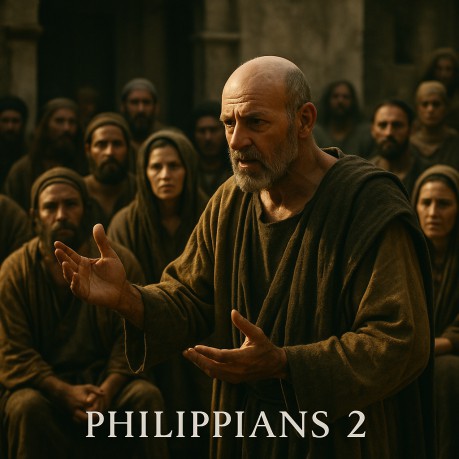
Philippians 2 Philippians 2:1-2 † Paul appeals to unity grounded in
encouragement, love, and the Spirit's fellowship. Philippians 2:3-4 † Selfishness destroys fellowship, humility
sustains it. Philippians 2:5-7 † Christ's humility is the model for
believers. Philippians 2:8-9 † The lowest obedience, death on a cross, led
to the highest exaltation. Philippians 2:10-11 † Christ is Lord over all creation, all will
acknowledge His lordship. Philippians 2:12-13 † Salvation is lived out actively, yet it is
God working within. Philippians 2:14-16 † The church must stand blameless in a corrupt
generation. Philippians 2:17-18 † Paul compares his life to a drink offering,
poured out in service. Philippians 2:19-22 † Timothy's genuine concern and proven service
made him unique among Paul's companions. Philippians 2:23-24 † Paul hopes to send Timothy soon, and even
hopes to come himself. Philippians 2:25-27 † Epaphroditus is honored as a brother, worker,
soldier, and messenger. Philippians 2:28-30 † Paul urges the church to honor those who risk
their lives for the gospel. How it applies to us today † This is the fulfilled perspective we proclaim at
Fulfilled Prophecies † Source Index
By Dan Maines
Therefore if there is any
encouragement in Christ, if any consolation of love, if any
fellowship of the Spirit, if any affection and compassion, make my
joy complete by being of the same mind, maintaining the same love,
united in spirit, intent on one purpose.
†
Joy is complete when the church stands in unity.
†
Ignatius (Letter to the Philadelphians 2) emphasized that unity of
mind and spirit preserves the church.
Do nothing from
selfishness or empty conceit, but with humility consider one another
as more important than yourselves; do not merely look out for your
own personal interests, but also for the interests of others.
† True unity comes when
believers put others first.
† Clement of Rome
(1 Clement 38) exhorted the church to humility and care for one
another.
Have this attitude in
yourselves which was also in Christ Jesus, who, as He already existed
in the form of God, did not consider equality with God something to
be grasped, but emptied Himself by taking the form of a bond-servant
and being born in the likeness of men.
† Though divine, He did not cling
to His rights, but took on servanthood.
†
Irenaeus (Against Heresies 3.19.3) argued that Christ's incarnation
revealed true humility and service.
And being found in
appearance as a man, He humbled Himself by becoming obedient to the
point of death, death on a cross. For this reason also God highly
exalted Him, and bestowed on Him the name which is above every name.
† The cross is the
path to glory.
† Tertullian (On the Flesh of
Christ 5) emphasized the real humanity and real suffering of Christ
in His death.
So that at the name of
Jesus every knee will bow, of those who are in heaven and on earth
and under the earth, and that every tongue will confess that Jesus
Christ is Lord, to the glory of God the Father.
† This echoes
Isaiah 45:23, applied directly to Jesus.
†
Origen (On Prayer 15) taught that this universal confession glorifies
the Father through the Son.
So then, my beloved,
just as you have always obeyed, not as in my presence only, but now
much more in my absence, work out your own salvation with fear and
trembling; for it is God who is at work in you, both to desire and to
work for His good pleasure.
† Fear and trembling
reflect reverence, not despair.
† The Dead
Sea Scrolls (1QS 3.6-9) spoke of God working in His people to
accomplish righteousness, fulfilled in Christ.
Do all things without
complaining or arguments; so that you will prove yourselves to be
blameless and innocent, children of God above reproach in the midst
of a crooked and perverse generation, among whom you appear as lights
in the world, holding firmly the word of life, so that on the day of
Christ I can take pride because I did not run in vain nor labor in
vain.
† Believers shine as lights
through obedience and faithfulness.
†
Josephus (Wars 5.10.5) described Jerusalem's corruption, echoing
Paul's description of a crooked generation.
But even if I am being
poured out as a drink offering upon the sacrifice and service of your
faith, I rejoice and share my joy with you all. You too, I urge you,
rejoice in the same way and share your joy with me.
† Joy is shared even
in suffering.
† Clement of Alexandria
(Stromata 4.9) taught that martyrdom was the ultimate witness of joy
in Christ.
But I hope, in the Lord
Jesus, to send Timothy to you shortly, so that I also may be
encouraged when I learn of your condition. For I have no one else of
kindred spirit who will genuinely be concerned for your welfare. For
they all seek after their own interests, not those of Christ Jesus.
But you know of his proven character, that he served with me in the
furtherance of the gospel like a child serving his father.
†
Paul compares their relationship to that of father and son.
Therefore I hope to send
him immediately, as soon as I see how things go with me; and I trust
in the Lord that I myself also will be coming shortly.
† His trust is in the
Lord's providence, not in circumstance.
But I thought it
necessary to send to you Epaphroditus, my brother and fellow worker
and fellow soldier, who is also your messenger and minister to my
need, because he was longing for you all and was distressed since you
had heard that he was sick. For indeed he was sick to the point of
death, but God had mercy on him, and not on him only but also on me,
so that I would not have sorrow upon sorrow.
† His illness nearly
took his life, but God spared him.
† Eusebius
(Ecclesiastical History 3.4) mentioned such faithful men who risked
their lives in service to the gospel.
Therefore I have sent
him all the more eagerly so that when you see him again you may
rejoice and I may be less concerned about you. Receive him then in
the Lord with all joy, and hold people like him in high regard,
because he came close to death for the work of Christ, risking his
life to compensate for your absence in your service to me.
† Epaphroditus
stands as a model of sacrificial service.
†
Philippians 2 calls us to humility, unity, and sacrificial service,
modeled after Christ Himself.
† The
exaltation of Christ assures His lordship over all, and our calling
is to live as lights in the world.
† In the
fulfilled kingdom, joy, service, and unity mark the true body of
Christ.
† Ignatius,
Letter to the Philadelphians 2 - unity of mind and spirit
†
Clement of Rome, 1 Clement 38 - humility and care
†
Irenaeus, Against Heresies 3.19.3 - Christ's humility in the
incarnation
† Tertullian, On the Flesh of
Christ 5 - real humanity and suffering of Christ
†
Origen, On Prayer 15 - universal confession glorifies the Father
†
Dead Sea Scrolls, 1QS 3.6-9 - God working in His people
†
Josephus, Wars 5.10.5 - Jerusalem's corruption
†
Clement of Alexandria, Stromata 4.9 - martyrdom as joyful witness
†
Eusebius, Ecclesiastical History 3.4 - faithful men risking their
lives
Links