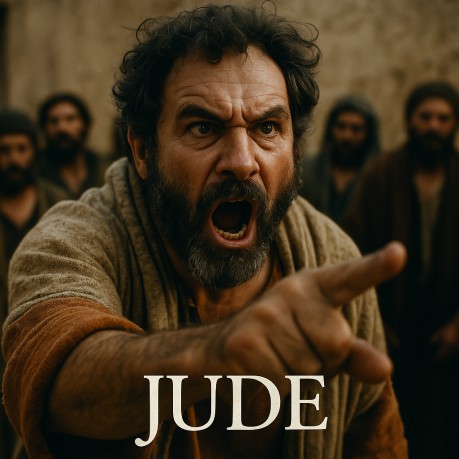
Jude Jude 1 † Jude identifies himself as the brother of
James, linking him to the family of Jesus. Jude 2 † The blessings of the new covenant are
centered in mercy, peace, and love. Jude 3 † Jude's intent shifts from encouragement to
urgent warning. Jude 4 † False teachers perverted grace into license
and denied Christ's authority. Jude 5 † Jude recalls Israel's history: salvation
followed by judgment on unbelief. Jude 6 † Jude refers to angels who sinned, held under
restraint until judgment. Jude 7 † Sodom's destruction is an example of God's
eternal judgment. Jude 8 † False teachers rejected authority and
blasphemed spiritual realities. Jude 9 † Jude cites a Jewish tradition showing even
Michael respected God's authority in judgment. Jude 10 † False teachers act without reason, driven by
instinct rather than truth. Jude 11 † Jude ties false teachers to Cain's hatred,
Balaam's greed, and Korah's rebellion. Jude 12-13 † Jude uses vivid imagery to describe the
emptiness and danger of false teachers. Jude 14-15 † Jude quotes 1 Enoch, a text well known among
Jews, showing the Lord coming in judgment. Jude 16 † False teachers flatter for personal gain and
live by lust and complaint. Jude 17-18 † The apostles foretold the rise of false
teachers in the last days of the covenant. Jude 19 † Divisiveness, carnality, and lack of the
Spirit mark these deceivers. Jude 20-21 † Believers are called to strengthen themselves
in faith, prayer, and love. Jude 22-23 † Different responses are needed: gentle mercy
for doubters, urgent rescue for the perishing, careful mercy for the
defiled. Jude 24-25 † The doxology closes with confidence in God's
ability to preserve His people. How it applies to us today † This is the fulfilled perspective we proclaim at
Fulfilled Prophecies † Source Index
By Dan Maines
Jude, a bond-servant of Jesus Christ
and brother of James, to those who are the called, beloved in God the
Father, and kept for Jesus Christ.
†
Believers are described as called, beloved, and kept, showing God's
covenant faithfulness.
May mercy, peace, and love be
multiplied to you.
† Clement
of Rome (1 Clement 59) also prayed for multiplied blessings of peace
in the church.
Beloved, while I was making every
effort to write you about our common salvation, I felt the necessity
to write to you appealing that you contend earnestly for the faith
that was once for all time handed down to the saints.
† The faith was delivered
once for all, not to be altered or added to.
†
Irenaeus (Against Heresies 1.10.1) affirmed the same: the apostolic
faith is complete and unchangeable.
For certain people have crept in
unnoticed, those who were long beforehand marked out for this
condemnation, ungodly persons who turn the grace of our God into
indecent behavior and deny our only Master and Lord, Jesus Christ.
† Josephus
(Wars 4.6.3) described lawless men creeping in and corrupting
Jerusalem, similar to Jude's warning.
Now I want to remind you, though you
know everything once and for all, that the Lord, after saving a
people out of the land of Egypt, subsequently destroyed those who did
not believe.
† Salvation
does not excuse rebellion.
And angels who did not keep their own
domain but abandoned their proper dwelling place, these He has kept
in eternal restraints under darkness for the judgment of the great
day.
† The Dead Sea
Scrolls (1 Enoch traditions preserved at Qumran) also recorded the
fall of angels, explaining Jude's reference.
Just as Sodom and Gomorrah and the
cities around them, since they in the same way as these angels
indulged in sexual perversion and went after strange flesh, are
exhibited as an example in undergoing the punishment of eternal fire.
† Philo (On Abraham 133)
described Sodom's sins, aligning with Jude's teaching.
Yet in the same way these people
also, dreaming, defile the flesh, reject authority, and speak
abusively of angelic majesties.
But Michael the archangel, when he
disputed with the devil and argued about the body of Moses, did not
dare pronounce against him an abusive judgment, but said, "The
Lord rebuke you!"
†
Early Christians preserved this account from the Assumption of Moses,
which Jude references.
But these people disparage all the
things that they do not understand; and all the things that they know
by instinct, like unreasoning animals, by these things they are
destroyed.
Woe to them! For they have gone the
way of Cain, and for pay they have given themselves up to the error
of Balaam, and perished in the rebellion of Korah.
†
Josephus (Antiquities 4.3.2) described Korah's rebellion as the worst
of Israel's sins.
These are the ones who are hidden
reefs in your love feasts when they feast with you without fear, like
shepherds caring only for themselves; clouds without water, carried
along by winds; autumn trees without fruit, doubly dead, uprooted;
wild waves of the sea, churning up their own shameful deeds like
dirty foam; wandering stars, for whom the gloom of darkness has been
reserved forever.
†
Their presence in the church threatens to wreck the faithful.
It was also about these people
that Enoch, in the seventh generation from Adam, prophesied, saying,
"Behold, the Lord has come with many thousands of His holy ones,
to execute judgment upon all, and to convict all the ungodly of all
their ungodly deeds which they have done in an ungodly way, and of
all the harsh things which ungodly sinners have spoken against Him."
†
Early Christians did not consider 1 Enoch scripture, but Jude used it
to affirm truth.
These are grumblers, finding fault,
following after their own lusts; they speak arrogantly, flattering
people for the sake of gaining an advantage.
But you, beloved, ought to
remember the words that were spoken beforehand by the apostles of our
Lord Jesus Christ, that they were saying to you, "In the last
time there will be mockers, following after their own ungodly lusts."
†
Peter said the same in 2 Peter 3:3, showing harmony of teaching.
These are the ones who cause
divisions, worldly-minded, devoid of the Spirit.
But you, beloved, building
yourselves up on your most holy faith, praying in the Holy Spirit,
keep yourselves in the love of God, looking forward to the mercy of
our Lord Jesus Christ to eternal life.
† Mercy and
eternal life are assured in Christ.
And have mercy on some, who are
doubting; save others, snatching them out of the fire; and on some
have mercy with fear, hating even the garment polluted by the flesh.
Now to Him who is able to protect
you from stumbling, and to make you stand in the presence of His
glory, blameless, with great joy, to the only God our Savior, through
Jesus Christ our Lord, be glory, majesty, dominion, and authority
before all time and now and forever. Amen.
† Glory and
dominion belong to Christ eternally.
†
Eusebius (Ecclesiastical History 2.23) praised Christ's authority,
echoing Jude's conclusion.
†
Jude calls us to contend earnestly for the faith, guarding against
false teachers.
† History shows their
presence in John and Jude's generation, marking the last days of the
old covenant.
† Today, we stand secure in the
fulfilled kingdom, with mercy, truth, and love as our calling.
† Josephus,
Wars 4.6.3 - lawless men creeping into Jerusalem
†
Josephus, Antiquities 4.3.2 - Korah's rebellion
†
Clement of Rome, 1 Clement 59 - prayer for peace
†
Philo, On Abraham 133 - sins of Sodom
†
Irenaeus, Against Heresies 1.10.1 - apostolic faith unchangeable
†
The Dead Sea Scrolls (1 Enoch, Qumran) - fallen angels and judgment
†
Assumption of Moses - Michael's dispute with the devil
†
Eusebius, Ecclesiastical History 2.23 - Christ's eternal authority
Links