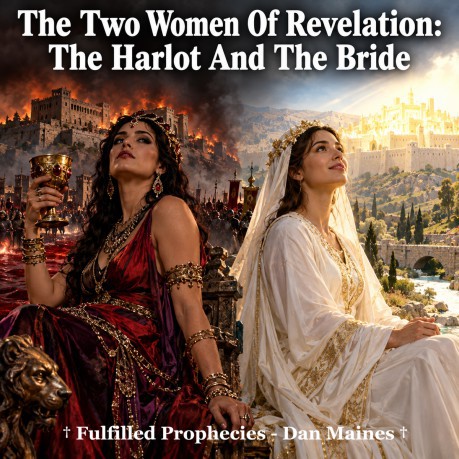
The Two Women Of Revelation:
The Harlot And The Bride Introduction Revelation 17:1-2 Revelation 17:4-6 Revelation 17:18 Revelation 18:20-21 Revelation 18:24 Revelation 19:1-2 Revelation 19:7-8 Revelation 21:1-2 Revelation 21:9-10 Revelation 21:22-23 Revelation 21:24-27 Historical References How It Applies To Us Today Q & A Appendix Q: Why is she called a harlot? Q: Who is the bride? Q: Are the harlot and the bride intended to be
contrasted? Q: Does the New Jerusalem require a future
physical temple? Q: Are believers still waiting to come to the
heavenly Jerusalem? † This is the fulfilled perspective we proclaim at
Fulfilled Prophecies † Source Index
By Dan Maines
† Revelation
presents two women and two cities in deliberate contrast. One is the
harlot, called Babylon the Great, and the other is the bride, the New
Jerusalem.
† These aren't two unrelated
visions. Revelation uses the two women to portray two opposing
covenant realities. The harlot represents the unfaithful city under
judgment, while the bride represents the covenant people of God
revealed in glory.
† The contrast becomes
especially clear when Revelation identifies the guilty city as the
place where the Lord was crucified (Revelation 11:8), charges her
with the blood of prophets and saints (Revelation 18:24), and then
describes the bride as the holy city coming down from God (Revelation
21:2).
† Jesus had already placed
responsibility for the blood of the prophets upon first-century
Jerusalem and declared that judgment would come upon that generation
(Matthew 23:34-38).
† Revelation isn't
describing the destruction of the physical universe. It's showing the
judgment of the unfaithful covenant city and the unveiling of the
faithful covenant city, the bride of Christ.
Then one of the seven
angels who had the seven bowls came and spoke with me, saying, "Come
here, I will show you the judgment of the great prostitute who sits
on many waters, with whom the kings of the earth committed acts of
sexual immorality, and those who live on the earth became drunk with
the wine of her sexual immorality."
†
The vision begins by announcing the judgment of the great harlot. In
prophetic language, harlotry repeatedly described covenant
unfaithfulness, especially when God's covenant people abandoned Him
for political alliances and idolatry (Isaiah 1:21; Ezekiel
16:15-26).
† This is covenant language. A
woman could be charged with spiritual adultery because she had first
been joined to God in covenant.
†
Revelation's harlot therefore isn't merely a wicked political power.
Her sin is portrayed as betrayal of a covenant relationship.
The woman was clothed in
purple and scarlet, and adorned with gold, precious stones, and
pearls, holding in her hand a gold cup full of abominations and of
the unclean things of her sexual immorality, and on her forehead a
name was written, a mystery: "BABYLON THE GREAT, THE MOTHER OF
PROSTITUTES AND OF THE ABOMINATIONS OF THE EARTH." And I saw the
woman drunk with the blood of the saints, and with the blood of the
witnesses of Jesus. When I saw her, I wondered greatly.
†
The identifying characteristic is bloodguilt. The woman is drunk with
the blood of the saints and the witnesses of Jesus.
†
Jesus had already accused Jerusalem of killing the prophets and those
sent to her. He said, Jerusalem, Jerusalem, who kills the prophets
and stones those who are sent to her (Matthew 23:37).
†
Jesus didn't leave the timing open. He declared, Truly I say to you,
all these things will come upon this generation (Matthew 23:36).
The woman whom you saw is
the great city, which reigns over the kings of the earth.
†
Revelation identifies the woman as the great city. Earlier in the
book, John had already given his readers a decisive identification of
the great city.
† Revelation 11:8 says the
great city was spiritually called Sodom and Egypt, where also their
Lord was crucified. Jesus was crucified at Jerusalem.
†
This connection is important because Revelation isn't asking its
original readers to guess the city's identity thousands of years
later. The book supplies its own covenant and geographical markers.
Rejoice over her, O
heaven, and you saints and apostles and prophets, because God has
pronounced judgment for you against her. Then a strong angel picked
up a stone like a great millstone and threw it into the sea, saying,
So will Babylon, the great city, be thrown down with violence, and
will never be found again.
† The judgment
answers the cries of the saints, apostles, and prophets. The city
that persecuted God's messengers receives the judgment announced
against her.
† Jesus had warned Jerusalem
that He was sending prophets, wise men, and scribes, and that some
would be killed, crucified, scourged, and persecuted from city to
city (Matthew 23:34).
† Revelation describes
the covenant lawsuit reaching its conclusion. The city responsible
for persecuting God's messengers is brought under judgment.
And in her was found the
blood of prophets and of saints, and of all who have been slaughtered
on the earth.
† This is one of Revelation's
strongest identifying statements. The blood of prophets and saints is
found in Babylon.
† Jesus used remarkably
similar language concerning Jerusalem. He said that upon them would
fall all the righteous blood shed on earth, and He placed that
judgment upon His generation (Matthew 23:35-36).
†
Revelation's bloodguilt language and Jesus' judgment language point
to the same covenant crisis. The prophets had been rejected, Christ
had been crucified, His messengers had been persecuted, and judgment
was approaching.
After these things I heard
something like a loud voice of a great multitude in heaven, saying,
"Hallelujah! Salvation, glory, and power belong to our God,
because His judgments are true and righteous; for He has judged the
great prostitute who was corrupting the earth with her sexual
immorality, and He has avenged the blood of His bond-servants on
her."
† Heaven celebrates because God's
judgment against the harlot is righteous. The blood of His servants
has been avenged.
† This corresponds with
Jesus' warning that the first-century generation would be held
accountable for the righteous blood associated with Jerusalem's long
history of rejecting God's messengers (Matthew 23:35-36).
†
The fall of the harlot clears the stage for Revelation's next woman,
the bride.
Let's rejoice and be glad
and give the glory to Him, because the marriage of the Lamb has come,
and His bride has prepared herself. It was given to her to clothe
herself in fine linen, bright and clean; for the fine linen is the
righteous acts of the saints.
† The contrast
couldn't be stronger. The harlot is judged, while the bride is
prepared for marriage.
† Revelation moves
from an unfaithful woman to a faithful woman, from judgment to
marriage, and from Babylon to the New Jerusalem.
†
This is covenant transition imagery. What belonged to the old
covenant order was passing away, while the completed new covenant
reality was being revealed (Hebrews 8:13).
Then I saw a new heaven
and a new earth; for the first heaven and the first earth passed
away, and there is no longer any sea. And I saw the holy city, new
Jerusalem, coming down out of heaven from God, prepared as a bride
adorned for her husband.
† John now sees the
bride as a city. Just as the harlot was a woman representing a city,
the bride is a woman representing the holy city, New Jerusalem.
†
The contrast is intentional. Revelation isn't moving from one literal
woman to another literal woman. These women symbolize two covenant
cities.
† Paul had already contrasted the
Jerusalem of his day with the Jerusalem above. The present Jerusalem
was associated with slavery, while the Jerusalem above was free and
was the mother of believers (Galatians 4:24-26).
Then one of the seven
angels who had the seven bowls, full of the seven last plagues, came
and spoke with me, saying, "Come here, I will show you the
bride, the wife of the Lamb." And he carried me away in the
Spirit to a great and high mountain, and showed me the holy city,
Jerusalem, coming down out of heaven from God,
†
John doesn't leave the bride unidentified. The angel says he will
show John the bride, and then shows him the holy city Jerusalem.
†
Notice the deliberate parallel with Revelation 17:1. One of the bowl
angels says he will show John the harlot, and another bowl angel says
he will show John the bride.
† Revelation
intentionally places these women opposite each other. One city is
characterized by covenant unfaithfulness and bloodguilt. The other is
characterized by covenant faithfulness, holiness, and the presence of
God.
I saw no temple in it,
for the Lord God the Almighty and the Lamb are its temple. And the
city has no need of the sun or of the moon to shine on it, for the
glory of God has illuminated it, and its lamp is the Lamb.
†
The New Jerusalem doesn't contain a physical temple because God and
the Lamb are its temple.
† This agrees with
the New Testament teaching that God's people are His dwelling place.
Believers are being built together into a dwelling of God in the
Spirit (Ephesians 2:19-22).
† The story has
moved beyond a geographical sanctuary. God's covenant presence isn't
centered in a stone building in earthly Jerusalem.
The nations will walk by
its light, and the kings of the earth will bring their glory into it.
In the daytime (for there will be no night there) its gates will
never be closed; and they will bring the glory and the honor of the
nations into it; and nothing unclean, and no one who practices
abomination and lying, shall ever come into it, but only those whose
names are written in the Lamb's book of life.
†
The gates remain open, and the nations walk by the city's light. This
describes the continuing mission and blessing of God's kingdom among
the nations.
† The New Jerusalem isn't
presented as a city waiting for believers to reach it after the
physical universe disappears. Hebrews told first-century believers
that they had already come to Mount Zion and the city of the living
God, the heavenly Jerusalem (Hebrews 12:22-24).
†
Revelation shows that covenant city fully revealed after the judgment
of the old order.
†
Josephus described the catastrophic destruction of Jerusalem and the
temple in AD 70, including famine, internal violence, slaughter,
fire, and the final Roman conquest. His account provides an important
first-century historical background for understanding the judgment
setting surrounding Revelation's imagery.
†
Tacitus also recorded the Roman siege of Jerusalem under Titus and
described the enormous population gathered in the city during the
conflict.
† Eusebius later recorded the
tradition that believers in Jerusalem were warned to leave the city
before the war and settled at Pella. This corresponds with Jesus'
warning that His disciples should flee when they saw Jerusalem
surrounded by armies (Luke 21:20-22).
† These
historical witnesses don't establish the interpretation by
themselves. Scripture establishes the interpretation, while history
demonstrates that the first-century judgment Jesus announced actually
occurred.
†
We aren't waiting for the harlot to fall. The covenant judgment
announced against Jerusalem belonged to the generation Jesus
addressed (Matthew 23:36; Matthew 24:34).
†
We aren't waiting for God to establish His dwelling among His people.
In Christ, believers are God's temple and His dwelling in the Spirit
(1 Corinthians 3:16; Ephesians 2:21-22).
† We
don't belong to the city of slavery. Paul said the Jerusalem above is
free, and she is our mother (Galatians 4:26).
†
We don't need a rebuilt temple, restored animal sacrifices, or
another earthly covenant capital. God and the Lamb are the temple of
the New Jerusalem (Revelation 21:22).
† The
message of Revelation moves from harlot to bride, from judgment to
marriage, from the condemned city to the holy city, and from the old
covenant order to the completed new covenant reality.
†
The bride isn't waiting to become God's city someday. In Christ,
God's people belong to the heavenly Jerusalem and live in His
covenant presence now (Hebrews 12:22-24).
Q: Who
is the harlot of Revelation?
A: Revelation
identifies her as the great city and describes her as guilty of the
blood of prophets and saints. Those descriptions correspond with
Jerusalem, where the Lord was crucified and which Jesus held
accountable for the blood of the prophets (Revelation 11:8;
Revelation 17:18; Revelation 18:24; Matthew 23:34-37).
A:
Harlotry is covenant unfaithfulness imagery. The prophets had
previously described unfaithful Jerusalem in this way when she
abandoned her covenant relationship with God (Isaiah 1:21; Ezekiel
16:15-26).
A:
John explicitly identifies the bride as the holy city, the New
Jerusalem (Revelation 21:9-10). She represents God's new covenant
people in union with Christ.
A: Yes. Revelation 17:1 introduces
the harlot through one of the seven bowl angels, while Revelation
21:9 introduces the bride through one of those same seven bowl
angels. The literary structure deliberately contrasts the two women
and the two cities.
A: No. John specifically says
he saw no temple in the city because the Lord God Almighty and the
Lamb are its temple (Revelation 21:22). The New Testament identifies
God's people as His dwelling place (Ephesians 2:19-22).
A: Hebrews told believers,
"you have come" to Mount Zion, the heavenly Jerusalem, and
the assembly of God's people (Hebrews 12:22-24). Revelation portrays
the completed covenant reality of that city.
© Fulfilled Prophecies - Dan
Maines.
† Revelation
17:1-2; Revelation 17:4-6; Revelation 17:18; Revelation 18:20-21;
Revelation 18:24; Revelation 19:1-2; Revelation 19:7-8; Revelation
21:1-2; Revelation 21:9-10; Revelation 21:22-23; Revelation
21:24-27
† Historical writers: Josephus, The
Wars of the Jews; Tacitus, Histories; Eusebius, Ecclesiastical
History
Links