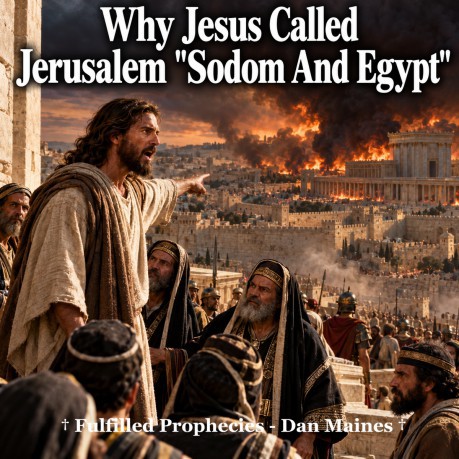
Why Jesus Called Jerusalem
"Sodom And Egypt" Introduction Revelation 11:8 Isaiah 1:9-10 Ezekiel 16:46-50 Exodus 7:17-18 Revelation 8:8 Luke 13:33-35 Matthew 23:35-36 Revelation 18:24 Historical References How It Applies To Us Today Q & A Appendix Q: How do we know the great city was
Jerusalem? Q: Had Jerusalem ever been called Sodom before
Revelation? Q: Why is Exodus imagery used in Revelation? Q: Was this judgment still future to us? Q: What should Christians understand from this
today? † This is the fulfilled perspective we proclaim at
Fulfilled Prophecies † Source Index
By Dan Maines
† Revelation
doesn't leave the identity of the great city in Revelation 11:8 to
speculation. John says it was the city where their Lord was
crucified. Jesus was crucified at Jerusalem.
†
Calling Jerusalem "Sodom and Egypt" wasn't a geographical
identification. It was covenant judgment language drawn from Israel's
own Scriptures.
† The prophets had already
compared rebellious Jerusalem to Sodom, and the Exodus provided the
pattern of plagues, bondage, deliverance, and judgment that
Revelation applies to the first-century conflict.
†
Revelation takes those familiar prophetic images and brings them
together. The covenant city had become spiritually like the enemies
God had judged in the past.
† This
identification is important because Revelation's judgment isn't
centered on modern nations thousands of years later. Its imagery
points directly back to apostate Jerusalem and the covenant judgment
that culminated in AD 70.
And their dead bodies will
lie on the street of the great city which spiritually is called Sodom
and Egypt, where also their Lord was crucified.
†
John gives us the identifying marker within the verse itself. The
great city was where the Lord was crucified. That points directly to
Jerusalem (Luke 13:33).
† John says the city
was "spiritually" called Sodom and Egypt. Jerusalem hadn't
literally become either place. These names described her spiritual
condition and approaching judgment.
† Sodom
represented extreme covenant corruption and divine judgment, while
Egypt represented oppression, bondage, plagues, and God's judgment
upon a persecuting power.
† Jerusalem had
rejected Christ, persecuted His messengers, and shed the blood of the
righteous. Jesus had already declared that Jerusalem would bear
responsibility for righteous blood and that judgment would fall upon
that generation (Matthew 23:34-36).
If the Lord of armies Had not
left us a few survivors, We would be like Sodom, We would be like
Gomorrah. Hear the word of the Lord, You rulers of Sodom; Listen to
the instruction of our God, You people of Gomorrah!
†
Isaiah was speaking to Judah and Jerusalem, yet he called their
rulers "rulers of Sodom" and their people "Gomorrah."
This establishes the prophetic pattern long before Revelation was
written.
† Jerusalem didn't have to be
geographically located in Sodom to receive Sodom's name. The name
described covenant rebellion and the judgment that rebellion
deserved.
† Revelation 11 uses the same
prophetic method. Calling Jerusalem "Sodom" would've been
immediately understandable to readers familiar with Isaiah.
†
The connection also explains why Revelation can use the names of
ancient enemies while speaking about a city existing in John's own
time.
Now your older sister is
Samaria, who lives north of you with her daughters; and your younger
sister, who lives south of you, is Sodom with her daughters. Yet you
have not merely walked in their ways and committed their
abominations; but, as if that were too little, you also acted more
corruptly in all your conduct than they. As I live, declares the Lord
God, Sodom, your sister and her daughters have not done as you and
your daughters have done! Behold, this was the guilt of your sister
Sodom: she and her daughters had arrogance, plenty of food, and
carefree ease, but she did not help the poor and needy. So they were
haughty and committed abominations before Me. Therefore I removed
them when I saw it.
† Ezekiel went even
further than Isaiah. Jerusalem was compared directly with Sodom and
was charged with becoming more corrupt than Sodom.
†
Revelation 11:8 therefore isn't introducing a strange new symbol. It
continues an established prophetic indictment against Jerusalem.
†
The prophets repeatedly used earlier judgments as patterns for later
covenant judgments. Jerusalem could become "Sodom" because
she had embraced the rebellion associated with Sodom.
†
By John's generation, Jerusalem's rejection of the Messiah and
persecution of His followers brought that prophetic pattern to its
climax (Matthew 21:33-45).
This is what the Lord says:
"By this you shall know that I am the Lord: behold, I am going
to strike the water that is in the Nile with the staff that is in my
hand, and it will be turned into blood. Then the fish that are in the
Nile will die, the Nile will stink, and the Egyptians will no longer
be able to drink water from the Nile."
†
Egypt was remembered as the nation upon which God poured out plagues
before delivering His people.
† Revelation
deliberately echoes Exodus. Waters become blood, plagues strike the
land, darkness appears, and other judgments recall what happened to
ancient Egypt (Revelation 8:8; 16:3-4, 10).
†
This doesn't mean Revelation predicts another literal Egypt. It means
the Exodus judgment pattern was being applied again.
†
The startling reversal is that the city once associated with God's
covenant people was now spiritually identified with the oppressive
Egypt from which Israel had originally been delivered.
The second angel sounded, and
something like a great mountain burning with fire was hurled into the
sea; and a third of the sea became blood,
†
The blood imagery deliberately recalls the Egyptian plague.
Revelation presents its judgments using the language of Israel's
foundational deliverance story.
† Jerusalem
had become an oppressor of Christ's people. Jesus warned His
disciples that they would be persecuted, beaten, imprisoned, and
killed before the judgment arrived (Matthew 23:34; Luke 21:12-18).
†
The Exodus pattern had been reversed. God was delivering His faithful
covenant people while bringing judgment upon the persecuting city.
†
Revelation therefore isn't merely borrowing dramatic imagery. It
presents a new Exodus centered in Christ and the passing away of the
old covenant order.
Nevertheless I must go on My
journey today and tomorrow and the next day; for it cannot be that a
prophet would perish outside Jerusalem. Jerusalem, Jerusalem, the
city that kills the prophets and stones those who have been sent to
her! How often I wanted to gather your children together, just as a
hen gathers her young under her wings, and you were unwilling!
Behold, your house is left to you desolate; and I say to you, you
will not see Me until you say, 'Blessed is the One who comes in the
name of the Lord!'
† Jesus Himself connected
Jerusalem with the killing of God's prophets. Revelation later
describes the great city as the place where God's witnesses were
killed.
† Jesus also pronounced Jerusalem's
house desolate. This wasn't an indefinite warning. He placed the
coming judgment upon the generation that rejected Him (Matthew
23:36-38).
† Revelation 11:8 completes the
identification by saying the great city was where the Lord was
crucified.
† Jerusalem had become the
persecuting city, and Jesus had already announced the covenant
consequences before the cross.
so that upon you will fall
the guilt of all the righteous blood shed on earth, from the blood of
righteous Abel to the blood of Zechariah, the son of Berechiah, whom
you murdered between the temple and the altar. Truly I say to you,
all these things will come upon this generation.
†
Jesus placed responsibility for the accumulated righteous blood upon
the generation standing before Him.
† This
provides the background for Revelation's repeated emphasis on the
blood of prophets and saints. The judgment wasn't disconnected from
Jesus' warnings, it was their fulfillment (Revelation 6:9-11;
18:20-24).
† Jesus didn't place this judgment
thousands of years into the future. He said, "this
generation."
† Revelation's Sodom and
Egypt imagery therefore belongs within the same first-century
covenant lawsuit Jesus had already announced against Jerusalem.
And in her was found the
blood of prophets and of saints, and of all who have been slaughtered
on the earth.
† Revelation says the condemned
city contained the blood of prophets and saints. Jesus had already
assigned that same guilt to Jerusalem (Matthew 23:34-37).
†
This parallel strengthens the identification of Revelation's
condemned city with apostate Jerusalem rather than a distant modern
city.
† Jerusalem was called Sodom because of
her corruption, Egypt because of her oppression, and the great city
because she stood at the center of the covenant judgment described in
Revelation.
† The imagery isn't random.
Isaiah, Ezekiel, Exodus, Jesus' warnings, and Revelation tell one
connected covenant story.
†
Josephus described Jerusalem during the Jewish-Roman War as being
consumed internally by violence, murder, famine, factional warfare,
and corruption before the Romans completed its destruction.
†
Josephus reported that rival factions inside Jerusalem turned against
one another while the Roman armies surrounded the city, creating
suffering within the walls as terrible as the danger outside them.
†
Josephus also described the burning and destruction of Jerusalem and
the temple in AD 70, providing an eyewitness-era historical account
of the catastrophe Jesus had warned was coming.
†
Eusebius later recorded the tradition that believers in Jerusalem
departed before the war and settled at Pella, connecting the escape
of the Christian community with the period surrounding Jerusalem's
destruction.
†
Revelation 11:8 teaches us to let Scripture interpret Scripture.
"Sodom and Egypt" doesn't require us to search the modern
world for another literal Sodom or Egypt.
†
Isaiah and Ezekiel show that Jerusalem had already been prophetically
called Sodom. Exodus explains the Egyptian plague imagery. Jesus
identifies Jerusalem as the city that killed the prophets and where
He would be rejected.
† Reading Revelation
through its Old Testament background removes much of the mystery that
has been created by modern speculation.
† We
aren't waiting for these covenant judgments to happen again. We live
after the old covenant judgment and in the reality of Christ's
established kingdom (Hebrews 12:22-24).
† The
message for us isn't fear of another prophetic countdown. It's
confidence in Jesus Christ, who completed the covenant transition and
brought His people into the lasting kingdom (Hebrews 12:28).
Q: Why
does Revelation 11:8 call the great city "Sodom and Egypt"?
A:
Because these were spiritual and prophetic descriptions. Sodom
represented corruption and judgment, while Egypt represented
oppression, plagues, and deliverance from bondage. Revelation applies
both images to the city where Jesus was crucified (Revelation 11:8).
A: Revelation gives the identifying
information itself, it was "where also their Lord was crucified"
(Revelation 11:8). Jesus also identified Jerusalem as the city
associated with killing the prophets (Luke 13:33-34).
A: Yes. Isaiah addressed
Jerusalem's leaders as "rulers of Sodom," and Ezekiel
compared Jerusalem directly with Sodom (Isaiah 1:10; Ezekiel
16:46-50).
A:
The Exodus established a biblical pattern of oppression, plagues,
judgment, and deliverance. Revelation uses that pattern to describe
God's judgment against the persecuting covenant city and the
deliverance of His people (Revelation 8:8; 11:8).
A:
No. Jesus placed the judgment upon His own generation, saying, "All
these things shall come upon this generation" (Matthew 23:36).
The destruction of Jerusalem in AD 70 brought that covenant judgment
to its historical climax.
A: We should read Revelation through the
prophetic language Scripture itself provides. We aren't waiting for
Jerusalem to become another literal Sodom or Egypt. Those images
described the covenant rebellion and judgment associated with the
first-century city where Christ was crucified (Revelation 11:8).
© Fulfilled Prophecies - Dan
Maines.
† Revelation
11:8; Isaiah 1:9-10; Ezekiel 16:46-50; Exodus 7:17-18; Revelation
8:8; Luke 13:33-35; Matthew 23:35-36; Revelation 18:24
†
Josephus, The Wars of the Jews; Eusebius, Ecclesiastical History
Links