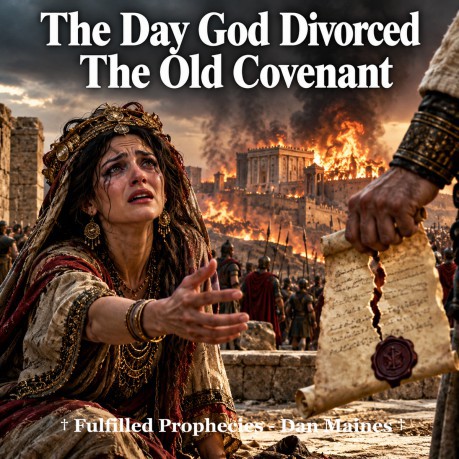
The Day God Divorced The Old
Covenant Introduction Jeremiah 3:8 Isaiah 50:1 Hosea 2:2 Matthew 23:38 Hebrews 8:13 Revelation 18:8 Revelation 18:21 Revelation 19:7 Revelation 19:9 Historical References How It Applies To Us Today Q & A Appendix Q: Did God's divorce language mean He broke His
promises? Q: Was Judah warned after seeing what happened to
Israel? Q: When did Jesus say Jerusalem's judgment would
occur? Q: Was the old covenant still awaiting its final
disappearance when Hebrews was written? Q: Did the new covenant begin only after
Jerusalem was destroyed? Q: Why does Revelation move from Babylon's
destruction to the marriage of the Lamb? Q: Are Christians waiting for another earthly
temple to restore God's presence? † This is the fulfilled perspective we proclaim at
Fulfilled Prophecies †
By Dan Maines
† The Bible
uses the language of marriage, adultery, divorce, widowhood, and a
new marriage to describe God's covenant relationship with Israel.
This isn't merely poetic language. God presented Himself as Israel's
husband, while Israel repeatedly broke covenant through spiritual
adultery (Jeremiah 31:32; Ezekiel 16:8, 32).
†
Jeremiah explicitly says God gave faithless Israel a certificate of
divorce because of her adultery. Yet Judah watched what happened and
committed the same covenant unfaithfulness (Jeremiah 3:6-11).
†
Isaiah asked for the certificate of divorce to expose why judgment
had come. Israel's separation wasn't because God had failed His
covenant promises. Their own sins and covenant rebellion brought
judgment upon them (Isaiah 59:1-2).
† Hosea
used the broken marriage of Hosea and Gomer as a prophetic picture of
God's covenant controversy with His unfaithful people (Hosea 1:2;
3:1).
† Jesus later stood in Jerusalem and
announced that her house was being left desolate. Hebrews declared
the old covenant obsolete and ready to disappear. Revelation then
pictured the covenant city as a corrupt woman judged and followed her
destruction with the marriage of the Lamb.
†
From the fulfilled perspective, AD 70 wasn't simply the destruction
of a city. It was the visible historical removal of the old covenant
order that had already become obsolete through Christ's finished work
(Colossians 2:14; Hebrews 9:8-10).
And I saw that for all the
adulteries of faithless Israel, I had sent her away and given her a
certificate of divorce, yet her treacherous sister Judah did not
fear; but she went and prostituted herself also.
†
God Himself used divorce language to describe covenant judgment.
Israel's adultery was spiritual unfaithfulness, and the divorce
concerned the covenant relationship established with the nation
(Jeremiah 2:20; 3:6).
† Judah saw what
happened to the northern kingdom but refused to learn from it.
Instead of remaining faithful, Judah followed the same pattern of
covenant rebellion (Jeremiah 3:10-11).
† This
establishes the biblical pattern. Covenant marriage could be
violated, covenant judgment could follow, and the unfaithful covenant
partner could be put away because of persistent rebellion
(Deuteronomy 31:16-18).
This is what the Lord says:
Where is the certificate of divorce By which I have sent your mother
away? Or to whom of My creditors did I sell you? Behold, you were
sold for your wrongdoings, And for your wrongful acts your mother was
sent away.
† Isaiah makes clear that God's
people weren't rejected because God was powerless or indebted to
anyone. Their own covenant rebellion brought the separation and
judgment described by the prophet (Isaiah 59:1-2).
†
God hadn't failed Israel. Israel had violated the covenant. The
responsibility rested upon the covenant-breaking people, not upon the
faithfulness of God (Deuteronomy 28:15, 45).
†
This distinction matters because God's judgment upon the old covenant
nation didn't make God unfaithful. It demonstrated His faithfulness
to the covenant sanctions He had already revealed through Moses
(Deuteronomy 28:49-52).
Dispute with your mother, dispute,
Because she is not my wife, and I am not her husband; But she must
remove her infidelity from her face And her adultery from between her
breasts,
† Hosea again describes covenant
apostasy through marriage language. The nation had acted as an
adulterous wife by pursuing other gods and trusting in other sources
for what God had provided (Hosea 2:5, 8).
†
The statement she is not my wife, neither am I her husband describes
a covenant relationship broken through unfaithfulness. This wasn't
about God's inability to keep His promises. It was about Israel
violating the covenant she had entered (Exodus 24:3-8).
†
Yet Hosea also pointed toward restoration. God's purpose wasn't
merely to end something old, but to establish His people in a
restored relationship characterized by righteousness, faithfulness,
and knowing the LORD (Hosea 2:19-20).
Behold, your house is being
left to you desolate!
† Jesus spoke these
words directly to Jerusalem after pronouncing judgment upon its
religious leaders. He had just declared that the blood of the
righteous would come upon that generation (Matthew 23:34-36).
†
The house that had once represented God's covenant presence was being
abandoned to judgment. Jesus wasn't predicting something thousands of
years away. He identified the generation upon which the judgment
would fall (Matthew 23:36).
† Jesus
immediately continued this judgment prophecy on the Mount of Olives,
where He foretold the destruction of the temple and said all these
things would occur within that generation (Matthew 24:2, 34).
When He said, "A new
covenant," He has made the first obsolete. But whatever is
becoming obsolete and growing old is about to disappear.
†
When Hebrews was written, the old covenant was already obsolete,
aging, and near disappearance. The writer didn't describe it as
something that would remain alongside the new covenant forever.
†
The new covenant had already been established through Christ, but the
old covenant system still had a visible temple, priesthood,
sacrifices, and earthly sanctuary during the transition period
(Hebrews 9:6-10).
† That explains the
language near disappearance. The theological basis of the old
covenant ended through Christ's sacrifice, while its visible
institutional structure remained until the temple system was removed
in AD 70 (Hebrews 10:9-14).
† The destruction
of Jerusalem didn't make Christ's work effective. Christ had already
accomplished redemption. AD 70 publicly and historically removed the
old covenant system that Hebrews said was ready to disappear (Hebrews
8:6; 10:18).
For this reason in one day
her plagues will come, plague and mourning and famine, and she will
be burned up with fire; for the Lord God who judges her is strong.
†
Revelation portrays the condemned city as a corrupt woman whose
judgment arrives suddenly. Earlier she is identified with the blood
of the saints and witnesses of Jesus (Revelation 17:6).
†
Revelation also identifies the great city spiritually as the place
where their Lord was crucified, providing an important internal
marker for understanding the city under judgment (Revelation 11:8).
†
Jesus had already charged Jerusalem with shedding the blood of the
prophets and righteous and said that judgment would come upon His
generation (Matthew 23:34-37). Revelation uses the same covenant
lawsuit imagery as it announces judgment upon the blood-guilty city
(Revelation 18:20, 24).
Then a strong angel picked
up a stone like a great millstone and threw it into the sea, saying,
So will Babylon, the great city, be thrown down with violence, and
will never be found again.
† The image
recalls Old Testament prophetic judgment language in which a city or
kingdom is symbolically cast down because its appointed judgment has
arrived (Jeremiah 51:63-64).
† Revelation
isn't describing the destruction of planet Earth. It describes the
fall of the great city that had become guilty of covenant corruption
and the blood of God's servants (Revelation 18:24).
†
The old persecuting covenant city falls, clearing the prophetic stage
for the marriage imagery that immediately follows in Revelation 19.
Let's rejoice and be glad
and give the glory to Him, because the marriage of the Lamb has come,
and His bride has prepared herself."
†
Revelation moves directly from the judgment of the corrupt woman to
the marriage of the Lamb. The contrast is deliberate. One covenant
order is judged while the bride associated with the Lamb is revealed
in glory (Revelation 18:20; 21:2).
† The
bride isn't another earthly political nation. Revelation later
identifies the bride as the holy city, new Jerusalem, coming down out
of heaven from God (Revelation 21:2, 9-10).
†
This matches the rest of the New Testament. Believers had already
come to Mount Zion, the heavenly Jerusalem, and the Jerusalem above
was already identified as free (Hebrews 12:22-24; Galatians 4:26).
Then he said to me, "Write:
'Blessed are those who are invited to the wedding feast of the
Lamb.'" And he said to me, "These are the true words of
God."
† The story ends in marriage, not
abandonment. God wasn't destroying His redemptive purpose. He was
bringing the old covenant age to its appointed conclusion and
revealing the new covenant reality established in Christ (Hebrews
9:15).
† What the prophets anticipated had
reached fulfillment in Christ. The temporary covenant administration
gave way to the better covenant established on better promises
(Hebrews 8:6).
† The bride belongs to Christ,
and God's dwelling isn't centered in an earthly temple made with
hands. His people are His dwelling place through the Spirit
(Ephesians 2:19-22).
†
Josephus described Jerusalem's destruction in AD 70, including
famine, internal violence, the burning of the temple, and the
devastation that followed the Roman siege. His account provides an
eyewitness-era historical description of the catastrophe Jesus had
warned that generation about (Matthew 24:1-2; Luke 21:20-24).
†
Josephus reported that the temple was burned during the Roman
conquest and Jerusalem was devastated afterward. Whatever theological
conclusions are drawn from his history, his account confirms the
extraordinary historical collapse of the temple-centered order.
†
Eusebius later recorded the Christian tradition that believers in
Jerusalem departed before the war and settled at Pella. He connected
the devastation of Jerusalem with divine judgment following the
rejection and persecution of Christ and His apostles (Luke
21:20-22).
† These historical witnesses don't
establish doctrine. Scripture establishes doctrine. Their value is
that they describe historical events remarkably consistent with the
first-century setting of Jesus' warnings.
†
We're not waiting for the old covenant to disappear. Hebrews said it
was already obsolete and near disappearance in the first century
(Hebrews 8:13).
† We're not approaching an
earthly Jerusalem to find God's covenant presence. We've come to
Mount Zion and the heavenly Jerusalem through Christ (Hebrews
12:22-24).
† We don't need another earthly
temple, Levitical priesthood, or animal sacrifice. Christ offered the
sufficient sacrifice, and His people are now God's dwelling place
(Hebrews 10:10-14; Ephesians 2:21-22).
†
God's judgment of the old covenant order wasn't the failure of His
promises. It was the fulfillment of His promises and warnings, while
the better covenant established through Christ remains (Hebrews
8:6).
† The message of AD 70 isn't that God
abandoned His people. It's that the temporary covenant order reached
its appointed end and God's redemptive purpose reached its promised
new covenant reality in Christ (Hebrews 9:15).
†
We aren't waiting to become citizens of the Jerusalem above. In
Christ, our citizenship and covenant identity are already centered in
the heavenly reality God established through His Son (Galatians 4:26;
Philippians 3:20).
Q: Did
God literally call His covenant relationship with Israel a
marriage?
A: Yes. God described Himself as
Israel's husband and Israel's covenant rebellion as adultery
(Jeremiah 3:8; 31:32).
A: No. Scripture places the covenant
violation upon Israel's unfaithfulness. God's judgment carried out
the warnings already contained in the covenant itself (Deuteronomy
28:15, 45; Isaiah 50:1).
A: Yes. Jeremiah says Judah saw
Israel's unfaithfulness and judgment but still followed the same path
(Jeremiah 3:7-11).
A: Jesus placed the judgment upon His
own generation and then foretold the destruction of Jerusalem and its
temple (Matthew 23:36-38; 24:2, 34).
A: Yes.
Hebrews called it obsolete, aging, and near disappearance (Hebrews
8:13).
A: No. Christ had
already established the new covenant through His blood. AD 70 removed
the remaining visible old covenant system, it didn't create the new
covenant (Luke 22:20; Hebrews 8:6; 9:15).
A: The
imagery presents the judgment of the corrupt city followed by the
celebration of the Lamb and His bride. Revelation later identifies
that bride with the new Jerusalem (Revelation 19:7-9; 21:2, 9-10).
A: No. God's
people are His temple, and believers have already come to the
heavenly Jerusalem (Ephesians 2:19-22; Hebrews 12:22-24).
© Fulfilled Prophecies - Dan
Maines.
Source Index
†
Jeremiah 3:8; Isaiah 50:1; Hosea 2:2; Matthew 23:38; Hebrews 8:13;
Revelation 18:8, 21; Revelation 19:7, 9
†
Historical writers: Josephus, The Wars of the Jews; Eusebius,
Ecclesiastical History
Links