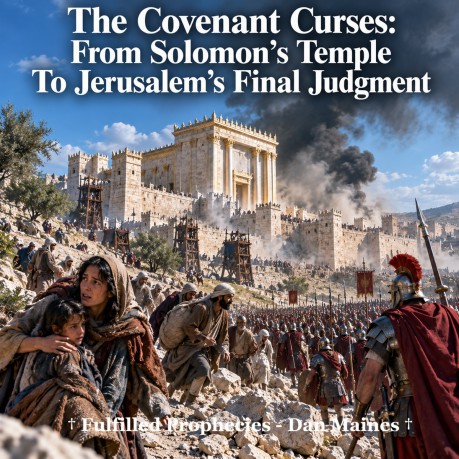
The Covenant Curses: From
Solomon's Temple To Jerusalem's Final Judgment Introduction Deuteronomy 28:15 Leviticus 26:23-25 Deuteronomy 28:49-52 Deuteronomy 28:53 Leviticus 26:27-29 Leviticus 26:31-33 2 Chronicles 36:15-21 Revelation 6:7-8 Revelation 11:1-2 Revelation 11:8 Revelation 18:8 Revelation 18:20 Revelation 19:1-2 Historical References How It Applies To Us Today Q & A Appendix Q: Was the destruction of Solomon's temple simply
a military event? Q: Why is Solomon's temple destruction important
for understanding AD 70? Q: Did Jesus connect Jerusalem's coming
destruction with Old Testament prophecy? Q: Why does Revelation describe the judged city
as responsible for the blood of God's servants? Q: Was AD 70 merely an unfortunate historical
event for the Jewish people? † This is the fulfilled perspective we proclaim at
Fulfilled Prophecies †
By Dan Maines
† Revelation
didn't introduce a new kind of judgment. Its plagues, famine, sword,
pestilence, siege, bloodshed, destruction, and desolation come
directly from the covenant judgment language God had already given
Israel in the Law. When Israel broke the covenant, God had already
stated what the consequences would be.
† This
pattern is essential for understanding both temple destructions.
Solomon's temple wasn't destroyed by Babylon because Jerusalem simply
suffered an unfortunate military defeat. Judah had violated the
covenant, rejected God's messengers, practiced idolatry, and filled
Jerusalem with wickedness. Babylon became the historical instrument
through which the covenant curses were administered.
†
The same covenant framework reaches its climactic expression in the
first century. Jesus identified Jerusalem as the city responsible for
shedding the blood of the prophets, declared that judgment would fall
upon that generation, and announced the destruction of the temple
(Matthew 23:34-38; 24:1-2, 34).
† Revelation
therefore shouldn't be separated from Deuteronomy, Leviticus, the
prophets, Jesus' warnings, or Israel's covenant history. Revelation
presents the final administration of covenant judgment against the
city that rejected the prophets and ultimately crucified her Messiah.
But it shall come about,
if you do not obey the Lord your God, to be careful to follow all His
commandments and His statutes which I am commanding you today, that
all these curses will come upon you and overtake you:
†
The covenant curses weren't random disasters. They were judicial
penalties attached to Israel's covenant. Blessing followed covenant
faithfulness, while covenant rebellion brought covenant judgment.
†
This explains why later biblical judgments against Jerusalem
repeatedly use the language of the Law. The prophets weren't
inventing new punishments. They were announcing the enforcement of
penalties already written into Israel's covenant (Jeremiah 11:6-8;
Daniel 9:11-14).
† Revelation follows the
same pattern. Its judgments are presented as righteous acts of God
against covenant rebellion, bloodshed, idolatry, and rejection of His
servants (Revelation 16:5-7; 18:20).
And if by these things
you do not learn your lesson regarding Me, but you show hostility
toward Me, then I in turn will show hostility toward you; and I, even
I, will strike you seven times for your sins. I will also bring upon
you a sword which will execute vengeance for the covenant; and when
you gather together into your cities, I will send a plague among you,
so that you will be handed over to the enemy.
†
Notice the expression vengeance of the covenant. This wasn't ordinary
warfare. Sword, pestilence, siege, and defeat were covenant
sanctions.
† Revelation uses these same
categories. The sword, death, famine, and destructive judgments
aren't disconnected apocalyptic inventions. They belong to an
established biblical vocabulary of covenant judgment (Ezekiel 5:12,
17; 14:21).
† This continuity helps explain
Revelation's imagery. John expected readers who knew Israel's
Scriptures to recognize the language. The judgments of Revelation
echo the covenant curses because covenant accountability stands
behind the judgment.
The Lord will bring a
nation against you from far away, from the end of the earth, as the
eagle swoops down; a nation whose language you will not understand, a
nation with a defiant attitude, who will have no respect for the old,
nor show favor to the young. Furthermore, it will eat the offspring
of your herd and the produce of your ground until you are destroyed;
a nation that will leave you no grain, new wine, or oil, nor the
newborn of your cattle or the young of your flock, until they have
eliminated you. And it will besiege you in all your towns until your
high and fortified walls in which you trusted come down throughout
your land, and it will besiege you in all your towns throughout your
land which the Lord your God has given you.
†
Deuteronomy specifically describes an invading nation, siege,
collapsing defenses, famine, and destruction. These covenant
sanctions formed the background for later judgments upon Jerusalem.
†
They were experienced in the Babylonian destruction of Jerusalem, and
Jesus later used the same covenant pattern when He warned
first-century Jerusalem that armies would surround the city and that
its enemies would tear it down (Luke 19:41-44; 21:20-24).
†
Jesus didn't describe an unrelated tragedy. He announced another
covenant judgment upon Jerusalem, this time against the generation
that rejected Him.
Then you will eat the
offspring of your own body, the flesh of your sons and of your
daughters whom the Lord your God has given you, during the siege and
the hardship by which your enemy will oppress you.
†
One of the most horrifying covenant curses was famine so severe
during siege that normal human bonds would collapse. This wasn't
symbolic language without historical precedent. Scripture records its
fulfillment during earlier judgments upon Israel and Judah (2 Kings
6:28-29; Lamentations 4:10).
† Josephus later
described terrible famine during the Roman siege of Jerusalem,
including the infamous account of a woman named Mary who, driven by
starvation, killed and ate her own child.
†
The similarity isn't accidental. The Roman siege followed the same
covenant judgment pattern established in Deuteronomy and demonstrated
previously in Israel's history.
Yet if in spite of this
you do not obey Me, but act with hostility against Me, then I will
act with wrathful hostility against you, and I for My part will
punish you seven times for your sins. Further, you will eat the flesh
of your sons, and you will eat the flesh of your daughters.
†
Leviticus confirms the same pattern. Persistent covenant rebellion
intensified covenant judgment.
† The repeated
language of multiplied judgment in Leviticus also helps us understand
the escalating character of judgment throughout Revelation. Warning
follows warning, judgment follows judgment, yet rebellion continues
(Revelation 9:20-21; 16:9-11).
† Revelation
is saturated with the language and structure of Israel's covenant
Scriptures. It shouldn't be interpreted as though John suddenly
abandoned that biblical framework.
I will turn your cities
into ruins as well and make your sanctuaries desolate, and I will not
smell your soothing aromas. And I will make the land desolate so that
your enemies who settle in it will be appalled at it. You, however, I
will scatter among the nations, and I will draw out a sword after
you, as your land becomes desolate and your cities become ruins.
†
God specifically warned that covenant rebellion could result in
devastated cities and a desolated sanctuary. That makes the
destruction of the temple covenantally significant.
†
Solomon's temple wasn't immune because it was God's sanctuary.
Jeremiah confronted the false confidence of those who believed
possession of the temple guaranteed their security while they
continued breaking the covenant (Jeremiah 7:4-14).
†
The same mistake appeared again in the first century. The physical
temple couldn't protect a generation that rejected God's Son. Jesus
pronounced its desolation and declared that not one stone would be
left upon another (Matthew 23:38; 24:2).
Yet the Lord, the God
of their fathers, sent word to them again and again by His
messengers, because He had compassion on His people and on His
dwelling place; but they continually mocked the messengers of God,
despised His words, and scoffed at His prophets, until the wrath of
the Lord rose against His people, until there was no remedy. So He
brought up against them the king of the Chaldeans, who killed their
young men with the sword in the house of their sanctuary, and had no
compassion on young man or virgin, old man or frail; He handed them
all over to him. He brought all the articles of the house of God,
great and small, and the treasures of the house of the Lord, and the
treasures of the king and his officers, to Babylon. Then they burned
the house of God and broke down the wall of Jerusalem, and burned all
its fortified buildings with fire and destroyed all its valuable
articles. He took into exile those who had escaped from the sword to
Babylon; and they were servants to him and to his sons until the rule
of the kingdom of Persia, to fulfill the word of the Lord by the
mouth of Jeremiah, until the land had enjoyed its Sabbaths. All the
days of its desolation it kept the Sabbath until seventy years were
complete.
† Scripture itself interprets the
Babylonian destruction covenantally. God sent His messengers, the
people rejected them, judgment became unavoidable, Jerusalem was
destroyed, and the temple was burned.
† This
becomes extremely important when we come to Jesus. He accused
first-century Jerusalem of following the same pattern, persecuting
and killing God's messengers, and He said that all these things would
come upon this generation (Matthew 23:29-36).
†
The parallel is powerful. Before Solomon's temple fell, God sent
prophets and the people rejected them. Before the second temple fell,
God sent His Son, apostles, prophets, and messengers, and Jerusalem
rejected them. The second destruction wasn't meaningless history. It
was the climactic covenant judgment Jesus Himself announced.
When the Lamb broke the
fourth seal, I heard the voice of the fourth living creature saying,
"Come!" I looked, and behold, an ashen horse; and the one
who sat on it had the name Death, and Hades was following with him.
Authority was given to them over a fourth of the earth, to kill with
sword, and famine, and plague, and by the wild animals of the
earth.
† Sword, famine, death, and beasts
should immediately remind a Bible reader of the covenant judgments
already found in the Law and the prophets (Ezekiel 14:21).
†
Revelation isn't giving us an entirely new judgment vocabulary. John
draws upon categories that God had repeatedly used when judging
covenant rebellion.
† Once this Old Testament
foundation is recognized, Revelation becomes far more coherent. Its
judgments belong to the same covenant story running from the Law
through the prophets and into the first century.
Then there was given to me
a measuring rod like a staff; and someone said, "Get up and
measure the temple of God and the altar, and those who worship in it.
Leave out the courtyard which is outside the temple and do not
measure it, because it has been given to the nations; and they will
trample the holy city for forty-two months.
†
John sees the temple, the altar, worshipers, the holy city, and
nations trampling that city. This language naturally belongs within
Jerusalem's covenant setting.
† Jesus had
already warned that Jerusalem would be surrounded by armies and
trampled underfoot by the nations (Luke 21:20-24).
†
Revelation's judgment upon the holy city therefore fits the judgment
Jesus announced against Jerusalem. The temple's destruction wasn't a
disconnected historical footnote after the cross. It stood within the
covenant judgment Jesus said would fall upon His generation.
And their dead bodies will
lie on the street of the great city which spiritually is called Sodom
and Egypt, where also their Lord was crucified.
†
Revelation gives us a decisive geographical and covenant marker, the
great city is identified as where their Lord was crucified.
†
Calling the city Sodom and Egypt is covenant lawsuit language.
Jerusalem had previously been compared with Sodom because of covenant
corruption (Isaiah 1:9-10; Jeremiah 23:14).
†
John isn't describing literal ancient Sodom or literal Egypt. He uses
Israel's prophetic vocabulary to identify the covenant condition of
the city where Jesus was crucified.
For this reason in one day
her plagues will come, plague and mourning and famine, and she will
be burned up with fire; for the Lord God who judges her is strong.
†
Once again we find plague, death, famine, and burning. These are
familiar covenant judgment themes, not foreign concepts suddenly
introduced at the end of the Bible.
†
Jerusalem had already experienced destruction by fire when Solomon's
temple was destroyed. That earlier judgment provides a biblical
pattern for understanding another covenantally condemned city facing
destruction after rejecting God's messengers.
†
Revelation presents judgment as deliberate and judicial. God isn't
merely predicting political turmoil. He is judging covenant rebellion
and vindicating His servants.
Rejoice over her, O heaven,
and you saints and apostles and prophets, because God has pronounced
judgment for you against her.
† This verse
brings the issue directly to God's apostles and prophets. The city is
judged in connection with what had been done to God's messengers.
†
Jesus had already placed that responsibility upon Jerusalem when He
said that prophets, wise men, and scribes would be persecuted and
killed, and that the accumulated righteous blood would come upon that
generation (Matthew 23:34-36).
† Revelation
isn't detached from Jesus' warning. It shows the administration of
the judgment He had already announced.
After these things I heard
something like a loud voice of a great multitude in heaven, saying,
"Hallelujah! Salvation, glory, and power belong to our God,
because His judgments are true and righteous; for He has judged the
great prostitute who was corrupting the earth with her sexual
immorality, and He has avenged the blood of His bond-servants on
her."
† Revelation's judgment
culminates in the vindication of God's servants. The blood that had
been shed demanded covenant justice.
† This
matches Jesus' declaration that Jerusalem was accountable for the
righteous blood shed upon the land and that judgment would come upon
His generation (Matthew 23:35-36).
† The
destruction of Jerusalem in AD 70 therefore shouldn't be reduced to
an unfortunate historical event that happened to the Jewish people.
Jesus had specifically announced the coming judgment, identified its
covenant causes, described Jerusalem surrounded by armies, and placed
its fulfillment within that generation (Luke 21:20-22, 32).
†
Just as Babylon administered covenant judgment when Solomon's temple
was destroyed, Rome became the historical instrument through which
the judgment announced by Jesus was administered against Jerusalem
and the second temple.
†
Josephus, an eyewitness to the Jewish-Roman War, described famine,
internal violence, slaughter, fire, and the destruction of Jerusalem
and its temple. His history provides remarkable external testimony to
conditions corresponding to the covenant curse pattern recorded in
Scripture.
† Josephus also recorded the
terrible account of Mary during the siege, whose starvation became so
severe that she killed and ate her child. That event closely
resembles the siege curses prescribed centuries earlier in the Law.
†
Tacitus described the Roman campaign against Jerusalem and the city's
destruction within the broader history of the Jewish war.
†
Eusebius later connected Jerusalem's catastrophe with the judgment
that followed the rejection of Christ and recorded the tradition that
believers in Jerusalem escaped before the city's destruction.
†
These historical writers don't establish the doctrine, Scripture
does. Their testimony is valuable because it shows that the siege,
famine, warfare, destruction, and burning described in the historical
record correspond strikingly with the covenant judgment framework
already established in Scripture.
†
We shouldn't read Revelation as though the first sixty-five books of
the Bible don't exist. Revelation is deeply rooted in the Law, the
prophets, Israel's covenant history, and the words of Jesus.
†
The destruction of Solomon's temple teaches us how covenant judgment
worked. God warned His covenant people, sent His messengers, endured
their rebellion, and finally administered the judgment He had
prescribed.
† The destruction of the second
temple follows that same recognizable pattern, but with even greater
covenant significance. Jerusalem didn't merely reject another
prophet, it rejected the Messiah and persecuted those He sent.
†
Jesus said, For these are days of vengeance, so that all things which
are written will be fulfilled (Luke 21:22). That statement directly
connects Jerusalem's coming destruction with what had already been
written.
† The continuity is difficult to
miss once Scripture is allowed to interpret Scripture. Deuteronomy
gives the curses. Leviticus gives the curses. The prophets apply
those curses. Solomon's temple falls under those curses. Jesus
announces covenant judgment upon His generation. Revelation presents
those same judgment patterns, and Jerusalem and the second temple
fall exactly as Jesus said.
† AD 70 wasn't an
embarrassing historical interruption in the biblical story. It was
the covenantal conclusion of an age and the public vindication of
Christ's prophetic warnings.
† We now live
under the completed work of Christ in the New Covenant kingdom. Our
confidence isn't in an earthly city, physical temple, or national
covenant. God's dwelling is with His people, and His kingdom isn't
dependent upon rebuilding what Christ brought to fulfillment (Hebrews
12:22-24; Revelation 21:2-3).
Q: Were
the judgments in Revelation completely new judgments?
A:
No. Revelation repeatedly uses the established biblical language of
sword, famine, pestilence, death, siege, bloodshed, fire, and
desolation found throughout Israel's covenant Scriptures (Ezekiel
5:12, 17; 14:21).
A: No. Scripture explicitly
presents it as divine judgment following persistent covenant
rebellion and rejection of God's messengers (Jeremiah 7:12-14; Daniel
9:11-14).
A: It establishes the
covenant pattern. Rebellion brought warnings, rejection of God's
messengers brought increasing judgment, and persistent covenant
violation ultimately resulted in siege, destruction of Jerusalem, and
destruction of the sanctuary. Jesus applied that same pattern to His
own generation (Matthew 23:34-38; 24:1-2, 34).
A:
Yes. While describing Jerusalem surrounded by armies, Jesus said, For
these are days of vengeance, so that all things which are written
will be fulfilled (Luke 21:20-22).
A:
Because bloodguilt was central to the covenant lawsuit against
Jerusalem. Jesus said the righteous blood would be charged against
that generation, and Revelation portrays the judged city as
responsible for the blood of God's servants (Matthew 23:35-36;
Revelation 18:24).
A: No. Jesus
specifically foretold Jerusalem's siege and destruction and said it
would occur within that generation. Revelation presents the
administration of judgment using the same covenant curse language
that had governed Israel's earlier judgments (Luke 19:41-44;
21:20-24, 32).
© Fulfilled Prophecies - Dan
Maines.
Source Index
†
Deuteronomy 28:15, 49-53; Leviticus 26:23-25, 27-29, 31-33; 2
Chronicles 36:15-21; Revelation 6:7-8; Revelation 11:1-2, 8;
Revelation 18:8, 20; Revelation 19:1-2
†
Historical writers: Josephus, The Wars of the Jews, Books 5-7;
Tacitus, Histories, Book 5; Eusebius, Ecclesiastical History, Books
2-3
Links