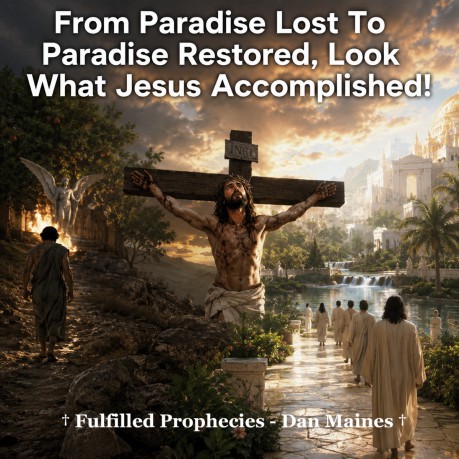
From Paradise Lost To
Paradise Restored, Look What Jesus Accomplished! Introduction Genesis 3:23-24 Luke 23:43 Hebrews 10:19-22 Revelation 21:3-5 Revelation 21:22-25 Revelation 22:1-2 Revelation 22:3 Revelation 22:14 Historical References How It Applies To Us Today Q & A Appendix Q: Did Jesus come to restore what was lost
through Adam? Q: Why does Revelation bring back the tree of
life? Q: Why are the gates of the New Jerusalem never
shut? Q: Does fulfilled prophecy mean God's kingdom
stopped working in AD 70? Q: What's the great WOW moment of this entire
story? † This is the fulfilled perspective we proclaim at
Fulfilled Prophecies † Source Index
By Dan Maines
† The Bible
opens with humanity losing access to paradise, and it closes with
God's people enjoying restored access to life and His presence.
†
Genesis shows separation, curse, death, and exile. Revelation shows
reconciliation, blessing, life, and fellowship with God.
†
This isn't two unrelated stories. It's one great redemption story,
moving from what was lost in Adam to what was accomplished in Christ
(Romans 5:17-19).
† The amazing truth is that
Jesus didn't merely promise restoration. He accomplished the work
necessary to bring His people back into fellowship with God (2
Corinthians 5:18-19).
† Fulfilled prophecy
isn't primarily a story about destruction. It's the story of
restoration, reconciliation, access, and life through Jesus Christ
(Hebrews 10:19-22).
† The Bible begins with
the way to the tree of life guarded. It ends with the tree of life
accessible. That's one of the greatest WOW moments in the entire
Bible.
therefore the Lord God sent
him out of the Garden of Eden, to cultivate the ground from which he
was taken. So He drove the man out; and at the east of the Garden of
Eden He stationed the cherubim and the flaming sword which turned
every direction to guard the way to the tree of life.
†
Humanity's story outside Eden began with expulsion. Adam was driven
from the garden, and access to the tree of life was guarded.
†
The problem wasn't simply that Adam lost beautiful surroundings.
Humanity experienced separation from the special presence and
fellowship represented by Eden (Isaiah 59:2).
†
Notice the wording carefully. The way of the tree of life was
guarded. Genesis leaves humanity standing outside paradise with the
way blocked.
† This creates one of the
Bible's great questions: Will the way to life ever be opened again?
†
The rest of Scripture moves toward God's answer in Jesus Christ (John
14:6).
And He said to him, "Truly I
say to you, today you will be with Me in Paradise."
†
Jesus spoke these words while accomplishing redemption on the cross.
Paradise appears again, but now it's connected directly with
Christ.
† Adam's sin brought death, but
Christ came to overcome the condemnation and death associated with
Adam (Romans 5:18-19).
† The criminal beside
Jesus had no opportunity to build a lifetime record of religious
accomplishments. His hope rested in Jesus.
†
Jesus wasn't pointing him back toward earthly Eden. He was pointing
toward restored fellowship and life in God's presence.
†
The movement of redemption is becoming clear, from paradise lost
through Adam to paradise restored through Christ (1 Corinthians
15:22).
Therefore, brothers and
sisters, since we have confidence to enter the holy place by the
blood of Jesus, by a new and living way which He inaugurated for us
through the veil, that is, through His flesh, and since we have a
great priest over the house of God, let's approach God with a sincere
heart in full assurance of faith, having our hearts sprinkled clean
from an evil conscience and our bodies washed with pure water.
†
Genesis showed the way guarded. Hebrews announces a new and living
way through Jesus.
† That's an incredible
biblical contrast. Humanity was driven away in Genesis, but believers
are told to draw near in Hebrews.
† Jesus
accomplished what humanity couldn't accomplish. Through His
sacrifice, access to God was opened (Ephesians 2:13, 18).
†
The veil represented restricted access under the old covenant system,
but Jesus opened the way into God's presence (Matthew 27:51).
†
Christianity isn't humanity desperately trying to find its way back
to God. It's the announcement that God opened the way through His
Son.
And I heard a loud voice
from the throne, saying, "Behold, the tabernacle of God is among
the people, and He will dwell among them, and they shall be His
people, and God Himself will be among them, and He will wipe away
every tear from their eyes; and there will no longer be any death;
there will no longer be any mourning, or crying, or pain; the first
things have passed away." And He who sits on the throne said,
"Behold, I am making all things new." And He said, "Write,
for these words are faithful and true."
†
Look at where the biblical story arrives. Genesis described humanity
driven from God's garden presence. Revelation describes God's
dwelling with His people.
† This is covenant
restoration language. The separation introduced through sin gives way
to reconciliation and fellowship through Christ (2 Corinthians
5:17-19).
† The first things passing away
fits Revelation's covenantal movement from the former order into the
completed new covenant reality (Hebrews 8:13).
†
God's goal wasn't simply to destroy Jerusalem. The judgment of the
old covenant world cleared the stage for the fully established new
covenant order in which God's dwelling isn't centered in an earthly
temple (John 4:21-24).
† The WOW moment is
enormous. The Bible begins with humanity outside God's garden
sanctuary, but Revelation shows God's dwelling with His people.
I saw no temple in it,
for the Lord God the Almighty and the Lamb are its temple. And the
city has no need of the sun or of the moon to shine on it, for the
glory of God has illuminated it, and its lamp is the Lamb. The
nations will walk by its light, and the kings of the earth will bring
their glory into it. In the daytime (for there will be no night
there) its gates will never be closed;
† Eden
had guarded access after Adam's sin. The New Jerusalem has gates that
aren't shut.
† Under the old covenant, access
to God's presence was represented through priests, sacrifices,
curtains, and a physical temple. In the New Jerusalem, God and the
Lamb are its temple (Hebrews 9:6-10).
† The
nations walking in its light shows an ongoing kingdom reality. The
picture isn't an empty planet after human history has ended. Nations
are pictured receiving the light of God's completed redemptive
work.
† The open gates proclaim access. What
was guarded in Genesis has been opened through Christ.
†
We don't need another earthly temple because God's dwelling place is
with His covenant people (Ephesians 2:19-22).
And he showed me a river
of the water of life, clear as crystal, coming from the throne of God
and of the Lamb, in the middle of its street. On either side of the
river was the tree of life, bearing twelve kinds of fruit, yielding
its fruit every month; and the leaves of the tree were for the
healing of the nations.
† Here is the tree
that humanity couldn't approach after Eden. At the end of Revelation,
the tree of life stands in the New Jerusalem.
†
The tree isn't described as inaccessible. It produces fruit
continually, and its leaves are for the healing of the nations.
†
Genesis 3 and Revelation 22 belong together. The guarded tree in
Genesis becomes the accessible tree in the restored creation imagery
of Revelation.
† Notice again that nations
are present. They need healing. This points to the continuing mission
and blessing of Christ's kingdom in the world (Matthew 28:18-20).
†
Fulfillment didn't end God's work through His people. Fulfillment
established the completed covenant reality from which the gospel
continues flowing to the nations.
There will no longer be any
curse; and the throne of God and of the Lamb will be in it, and His
bond-servants will serve Him;
† These few
words reach all the way back to Genesis. The curse entered the
biblical story after humanity's rebellion, but Revelation declares
that there will no longer be any curse.
†
Jesus became a curse for His people so that the blessing promised
through Abraham could come through Him (Galatians 3:13-14).
†
The biblical movement couldn't be clearer. Curse gives way to
blessing, separation gives way to reconciliation, exile gives way to
access, and death gives way to life.
† What
Adam couldn't repair, Jesus accomplished.
†
Paradise wasn't restored by humanity climbing back to God. Paradise
was restored because God acted decisively through Jesus Christ.
Blessed are those who wash
their robes, so that they will have the right to the tree of life,
and may enter the city by the gates.
†
Genesis ended humanity's access to the tree of life. Revelation
announces the right to the tree of life.
†
Don't miss that contrast. Genesis 3 says the way was guarded.
Revelation 22 speaks of entering through the gates and coming to the
tree.
† Jesus is the reason the story
changed. His redemptive work brought His people from alienation to
reconciliation and from death to life (Colossians 1:20-22).
†
We aren't standing outside Eden waiting for God to someday restore
access. In Christ, the way to God has been opened.
†
That's the great restoration story of Scripture, paradise lost
through Adam, paradise restored through Jesus Christ.
†
Josephus described the catastrophic destruction of Jerusalem and the
temple in AD 70, providing an important historical witness to the end
of the old Jerusalem and its temple-centered order, Wars of the Jews,
Books 5-7.
† Tacitus also recorded the Roman
conflict with Jerusalem and the destruction associated with that
first-century war, Histories, Book 5.
†
Eusebius later connected Jerusalem's catastrophe with Jesus' warnings
concerning that generation and recorded the early Christian
understanding that believers escaped the city's destruction,
Ecclesiastical History, Book 3, chapters 5-7.
†
These historical witnesses don't create our doctrine. Scripture
establishes our doctrine, but history confirms that the first-century
Jerusalem and temple system actually experienced the judgment Jesus
had announced (Luke 21:20-22).
†
We don't live outside the gates begging God to open them. Revelation
presents the gates of the New Jerusalem as open.
†
We don't need to rebuild an earthly temple to approach God. Through
Christ, believers have access to the Father (Ephesians 2:18).
†
We don't need to live as though Adam's failure is greater than
Christ's victory. Where sin brought condemnation and death, Christ
brought righteousness and life (Romans 5:17-19).
†
We can live with joy because Christianity isn't ultimately the story
of what humanity lost. It's the story of what Jesus accomplished.
†
We can invite people to Christ because the water of life is available
and the gates of the city are pictured as open (Revelation 22:17).
†
Fulfilled eschatology doesn't leave us staring backward at AD 70. It
helps us understand what Christ established and how we're called to
live because of His completed work.
† We live
after the great covenant transition, enjoying reconciliation with
God, access through Christ, the blessings of the new covenant, and
the continuing mission of taking His good news to the nations.
†
Genesis says they were driven out. Hebrews says draw near. Revelation
says enter through the gates. That's the restoration story.
†
Paradise lost isn't the final word. Jesus Christ gets the final word,
and His word is restoration, reconciliation, access, life, and God's
presence with His people.
Q: What
was really lost in Eden?
A: Humanity lost
access to the tree of life and experienced exile from the garden
sanctuary. The deeper biblical issue was separation from the
fellowship and life associated with God's presence (Genesis 3:23-24).
A: Yes. Paul deliberately
contrasts Adam and Christ. Adam's trespass brought condemnation,
while Christ's righteous act brings justification and life to His
people (Romans 5:17-19).
A: Because Revelation completes the
restoration theme that began in Genesis. The tree that was guarded
after Adam's sin appears in the New Jerusalem with access restored
(Genesis 3:24; Revelation 22:2, 14).
A: The open gates picture access rather
than exclusion for those who come through Christ. The nations are
pictured walking in the city's light, and the invitation to take the
water of life continues (Revelation 21:24-25; 22:17).
A: No. AD 70 marked
the decisive end of the old covenant age, not the end of Christ's
kingdom. His kingdom continues, the gospel continues, and the nations
continue to receive its blessings (Daniel 7:14; Matthew 28:18-20).
A: The Bible begins with humanity driven
from paradise and the way to life guarded. It ends with God's
dwelling among His people, the curse removed, the tree of life
present, and the gates open. What was lost in Adam has been restored
through the victory of Jesus Christ (Romans 5:17-19).
© Fulfilled Prophecies - Dan
Maines.
† Genesis
3:23-24; Luke 23:43; Hebrews 10:19-22; Revelation 21:3-5; Revelation
21:22-25; Revelation 22:1-2; Revelation 22:3; Revelation 22:14
†
Josephus, Wars of the Jews, Books 5-7; Tacitus, Histories, Book 5;
Eusebius, Ecclesiastical History, Book 3, chapters 5-7
Links