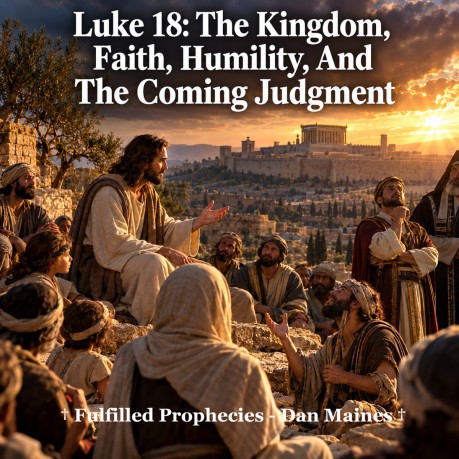
Luke 18: The Kingdom, Faith,
Humility, And The Coming Judgment Introduction Luke 18:1-3 Luke 18:4-5 Luke 18:6-8 Luke 18:9-12 Luke 18:13-14 Luke 18:15-17 Luke 18:18-23 Luke 18:24-27 Luke 18:28-30 Luke 18:31-34 Luke 18:35-38 Luke 18:39-43 Historical References How It Applies To Us Today Q & A Appendix Q: What did Jesus mean when He asked whether the
Son of Man would find faith when He came? Q: Does Luke 18 teach that Christians must sell
everything they own? Q: Why did Jesus say people must receive the
kingdom like a child? Q: Was Jesus' death something that interrupted
God's plan? Q: What does the healing of the blind man teach
us? Q: Are believers today still waiting for the
kingdom to arrive? † This is the fulfilled perspective we proclaim at
Fulfilled Prophecies †
By Dan Maines
† Luke 18
brings together several teachings that reveal what Jesus was doing as
the Old Covenant age approached its end. He taught His disciples to
persevere in prayer, warned against self-righteousness, welcomed
those who received the kingdom with childlike dependence, exposed the
danger of trusting wealth, predicted His death and resurrection, and
restored sight to a blind man who believed.
†
These aren't disconnected stories. Luke places them within Jesus'
journey toward Jerusalem, where He would accomplish redemption and
later bring the covenant judgment He had repeatedly warned was coming
upon that generation (Luke 9:51; Luke 13:33-35; Luke 19:41-44).
†
Luke 18 also contains one of the clearest time statements concerning
the coming vindication of God's people. Jesus didn't tell His
disciples that justice would be delayed for thousands of years. He
said God would bring about justice for His elect speedily.
Now He was telling them a
parable to show that at all times they ought to pray and not become
discouraged, saying, "In a certain city there was a judge who
did not fear God and did not respect any person. Now there was a
widow in that city, and she kept coming to him, saying, 'Give me
justice against my opponent.'
† Jesus taught
this parable immediately after speaking about the days of the Son of
Man. The chapter division shouldn't separate Luke 18 from the
prophetic setting established just before it (Luke 17:22-37).
†
The disciples would face opposition, persecution, and circumstances
that could tempt them to lose heart. Jesus instructed them to remain
faithful and continue praying while they waited for God's promised
vindication (Luke 21:12-19).
† The widow
represents persistent dependence. She had no earthly power to force
the judge's hand, but she continued appealing for justice until her
case was heard.
For a while he was unwilling;
but later he said to himself, 'Even though I do not fear God nor
respect any person, yet because this widow is bothering me, I will
give her justice; otherwise by continually coming she will wear me
out.'"
† Jesus wasn't comparing God
morally to this unjust judge. He was arguing from the lesser to the
greater. If even an unrighteous judge could finally respond, God's
righteous response to His people was absolutely certain.
†
The emphasis isn't that believers must annoy God until He reluctantly
responds. God isn't reluctant to hear His people. The contrast shows
how much more certainly the righteous God would answer His elect.
†
This encouraged first-century believers who were suffering while
waiting for the promised judgment and vindication associated with the
coming of the Son of Man (2 Thessalonians 1:4-10).
And the Lord said, "Listen
to what the unrighteous judge *said; now, will God not bring about
justice for His elect who cry out to Him day and night, and will He
delay long for them? I tell you that He will bring about justice for
them quickly. However, when the Son of Man comes, will He find faith
on the earth?"
† The words speedily and
when the Son of Man comes belong together. Jesus connected the
vindication of His elect with the coming of the Son of Man that He
had just described (Luke 17:24-30).
† Jesus
had already told His disciples that some standing with Him would not
taste death until they saw the Son of Man coming in His kingdom
(Matthew 16:27-28). Luke 18 doesn't overturn that time frame.
†
Revelation uses the same theme. The martyrs cried out asking how long
until their blood would be avenged, and they were told to rest a
little while longer (Revelation 6:9-11). Near the conclusion of
Revelation, judgment on the city responsible for the blood of God's
servants is announced (Revelation 18:20-24).
†
The question about finding faith wasn't a prediction that
Christianity would disappear from the planet thousands of years
later. It challenged Jesus' disciples to remain faithful through the
approaching persecution and tribulation (Matthew 24:9-13).
Now He also told this parable
to some people who trusted in themselves that they were righteous,
and viewed others with contempt: "Two men went up into the
temple to pray, one a Pharisee and the other a tax collector. The
Pharisee stood and began praying this in regard to himself: 'God, I
thank You that I am not like other people: swindlers, crooked,
adulterers, or even like this tax collector. I fast twice a week; I
pay tithes of all that I get.'
† Jesus
identified the fundamental problem before telling the parable, these
people trusted in themselves that they were righteous. Their
confidence rested in themselves rather than God's mercy.
†
The Pharisee measured himself against other people and concluded that
he was righteous because he considered himself morally and
religiously superior.
† This same problem
appeared throughout Jesus' confrontation with the religious
leadership. External religious performance couldn't produce the
righteousness that comes through faith (Matthew 23:25-28; Philippians
3:8-9).
But the tax collector,
standing some distance away, was even unwilling to raise his eyes
toward heaven, but was beating his chest, saying, 'God, be merciful
to me, the sinner!' I tell you, this man went to his house justified
rather than the other one; for everyone who exalts himself will be
humbled, but the one who humbles himself will be exalted."
†
The tax collector offered no list of accomplishments. He recognized
his sin and depended entirely upon God's mercy.
†
Jesus declared that the humble man went home justified rather than
the self-righteous Pharisee. This anticipates the gospel truth that
justification isn't achieved by boasting in human accomplishment
(Romans 3:27-28).
† The kingdom reversed
human expectations. Those who exalted themselves would be humbled,
while those who humbled themselves before God would be exalted
(Matthew 23:12).
Now they were bringing even
their babies to Him so that He would touch them; but when the
disciples saw it, they began rebuking them. But Jesus called for the
little ones, saying, "Allow the children to come to Me, and do
not forbid them, for the kingdom of God belongs to such as these.
Truly I say to you, whoever does not receive the kingdom of God like
a child will not enter it at all."
†
Jesus didn't describe the kingdom as something postponed for
thousands of years. The kingdom was being announced and people were
being called to receive it (Luke 16:16).
† A
child receives rather than earns. Jesus used children to illustrate
humble dependence, directly contrasting with the self-confidence of
the Pharisee.
† Entrance into God's kingdom
isn't based on status, religious achievement, wealth, or personal
greatness. It requires humble dependence upon God (Matthew 18:3-4).
A ruler questioned Him,
saying, "Good Teacher, what shall I do to inherit eternal life?"
But Jesus said to him, "Why do you call Me good? No one is good
except God alone. You know the commandments, 'Do not commit adultery,
Do not murder, Do not steal, Do not give false testimony, Honor your
father and mother.'" And he said, "All these things I have
kept since my youth." Now when Jesus heard this, He said to him,
"One thing you still lack; sell all that you possess and
distribute the money to the poor, and you will have treasure in
heaven; and come, follow Me." But when he had heard these
things, he became very sad, for he was extremely wealthy.
†
The ruler's wealth exposed what controlled his heart. Jesus went
beyond outward commandment keeping and exposed the man's deepest
allegiance.
† Jesus wasn't establishing
poverty as a universal requirement for salvation. He confronted this
particular man's trust in possessions and called him to abandon
everything that prevented him from following Christ.
†
His sorrow demonstrated the conflict. He wanted eternal life, but he
wasn't willing to surrender the security he found in his wealth.
And Jesus looked at him and
said, "How hard it is for those who are wealthy to enter the
kingdom of God! For it is easier for a camel to go through the eye of
a needle, than for a rich person to enter the kingdom of God!"
Those who heard Him said, "And so who can be saved?" But He
said, "The things that are impossible with people are possible
with God."
† Wealth can create the
illusion of independence and security. The problem isn't possessing
money, but trusting in riches instead of God (1 Timothy 6:17).
†
The disciples understood Jesus' statement to be extremely strong,
which is why they asked who could be saved.
†
Jesus' answer places salvation completely beyond human achievement.
What people can't accomplish for themselves, God can accomplish.
Peter said, "Behold, we
have left our own homes and followed You." And He said to them,
"Truly I say to you, there is no one who has left house, or
wife, or brothers, or parents, or children for the sake of the
kingdom of God, who will not receive many times as much at this time,
and in the age to come, eternal life."
†
Peter contrasted the disciples with the wealthy ruler. The ruler
wouldn't leave his possessions, but the disciples had left their
former lives to follow Jesus.
† Jesus
promised that their sacrifice wasn't forgotten. They belonged to a
new covenant family that would extend far beyond natural family and
national boundaries (Mark 10:29-30).
† The
disciples were living during the transition between the Old Covenant
age and the age that was coming. Hebrews described that former
covenant as becoming obsolete and ready to disappear (Hebrews 8:13).
Now He took the twelve aside
and said to them, "Behold, we are going up to Jerusalem, and all
the things that have been written through the prophets about the Son
of Man will be accomplished. For He will be handed over to the
Gentiles, and will be ridiculed, and abused, and spit upon, and after
they have flogged Him, they will kill Him; and on the third day He
will rise." The disciples understood none of these things, and
the meaning of this statement was hidden from them, and they did not
comprehend the things that were said.
† Jesus
deliberately went toward Jerusalem knowing exactly what awaited Him.
His death wasn't an accident or unexpected defeat. It fulfilled what
the prophets had written.
† Jesus
specifically predicted His suffering, death, and resurrection. The
disciples still didn't understand because the significance of these
events hadn't yet become clear to them.
† The
cross and resurrection stand at the center of redemption. Jesus would
accomplish what the sacrifices and shadows of the Old Covenant
pointed toward (Hebrews 9:11-15).
Now as Jesus was approaching
Jericho, a man who was blind was sitting by the road, begging. But
when he heard a crowd going by, he began inquiring what this was.
They told him that Jesus of Nazareth was passing by. And he called
out, saying, "Jesus, Son of David, have mercy on me!"
†
The blind man recognized something about Jesus that many who could
physically see failed to recognize. Calling Him Son of David
identified Jesus with the promised Davidic King (Luke 1:32-33).
†
His physical blindness didn't prevent spiritual recognition. He knew
where mercy was found and cried out to Christ.
†
Luke places this event just before Jesus enters Jericho and continues
toward Jerusalem. The King was approaching the city where He would be
rejected, yet a blind beggar recognized Him.
Those who led the way were
sternly telling him to be quiet; but he kept crying out all the more,
"Son of David, have mercy on me!" And Jesus stopped and
commanded that he be brought to Him; and when he came near, He asked
him, "What do you want Me to do for you?" And he said,
"Lord, I want to regain my sight!" And Jesus said to him,
"Regain your sight; your faith has made you well." And
immediately he regained his sight and began following Him, glorifying
God; and when all the people saw it, they gave praise to God.
†
The crowd tried to silence the blind man, but he refused to stop
calling upon Jesus. His persistence echoes the lesson that opened the
chapter, don't lose heart.
† Jesus responded
with compassion, restored his sight, and acknowledged his faith. The
man immediately followed Jesus and glorified God.
†
Luke 18 begins with persistent faith waiting for vindication and ends
with persistent faith crying out for mercy. Between those accounts,
Jesus exposes self-righteousness, misplaced trust, and unwillingness
to surrender.
†
Josephus described the growing instability, violence, famine, and
destruction surrounding Jerusalem during the Jewish-Roman War. His
account provides historical background for the first-century judgment
setting repeatedly warned about by Jesus in Luke's Gospel.
†
Josephus recorded the catastrophic destruction of Jerusalem and the
temple in AD 70, providing an outside historical witness to the
generation in which Jesus' warnings reached their terrible
conclusion.
† Eusebius later reported that
believers in Jerusalem departed the city before the war and went to
Pella. His account is significant when compared with Jesus'
instructions that His followers flee when they recognized Jerusalem's
approaching desolation (Luke 21:20-22).
†
These historical writers don't establish biblical doctrine. Scripture
establishes the doctrine, while historical records help us understand
the first-century setting in which these events occurred.
†
Luke 18 teaches us to pray without losing heart. We aren't waiting
for the AD 70 coming of the Son of Man, that judgment belongs to the
first-century fulfillment, but persistent dependence upon God remains
part of faithful Christian life.
† We
shouldn't approach God like the Pharisee, measuring ourselves against
others and trusting our religious accomplishments. We approach Him
humbly, knowing that our confidence is in Christ.
†
We receive the kingdom with dependence rather than pride. God's
kingdom isn't a future political government waiting to appear on
earth. Believers have already been brought into the kingdom of His
beloved Son (Colossians 1:13).
† We shouldn't
allow possessions, accomplishments, status, or religious performance
to become our security. Our confidence belongs in Christ.
†
We live after the covenant transition was completed. We aren't
waiting for the Old Covenant age to end, we're living in the reality
established through Christ and fully revealed when that former
covenant order disappeared.
† Like the blind
man, we recognize Jesus as King, depend upon His mercy, follow Him,
and glorify God.
Q: Was
the vindication promised in Luke 18:7-8 thousands of years away?
A:
No. Jesus said God would bring about justice for His elect speedily.
The statement follows His teaching concerning the days of the Son of
Man and fits the first-century time statements Jesus repeatedly gave
His disciples (Luke 17:22-37; Matthew 16:27-28).
A: He
was challenging His disciples concerning perseverance through the
persecution that would precede His coming in judgment. They needed to
remain faithful instead of losing heart (Matthew 24:9-13).
A: No. Jesus exposed the
rich ruler's particular attachment to wealth. The issue was what
possessed his heart and prevented him from following Christ (Luke
12:15; 1 Timothy 6:17).
A: A child illustrates
humble dependence rather than self-sufficiency. This directly
contrasts with the Pharisee who trusted in his own righteousness
(Matthew 18:3-4).
A: No. Jesus said what was written
through the prophets concerning the Son of Man would be accomplished.
His suffering, death, and resurrection were central to God's
redemptive purpose (Acts 2:22-24).
A: The blind man recognized Jesus as the
Son of David, persisted in calling for mercy, received his sight, and
followed Him. His response demonstrates faith, dependence, gratitude,
and discipleship (Luke 1:32-33).
A: No. The New Testament
says believers have been transferred into the kingdom of God's
beloved Son and have come to Mount Zion, the heavenly Jerusalem
(Colossians 1:13; Hebrews 12:22-24).
© Fulfilled Prophecies - Dan
Maines.
Source Index
†
Luke 18:1-3; Luke 18:4-5; Luke 18:6-8; Luke 18:9-12; Luke 18:13-14;
Luke 18:15-17; Luke 18:18-23; Luke 18:24-27; Luke 18:28-30; Luke
18:31-34; Luke 18:35-38; Luke 18:39-43
†
Josephus, The Wars of the Jews; Eusebius, Ecclesiastical History
Links