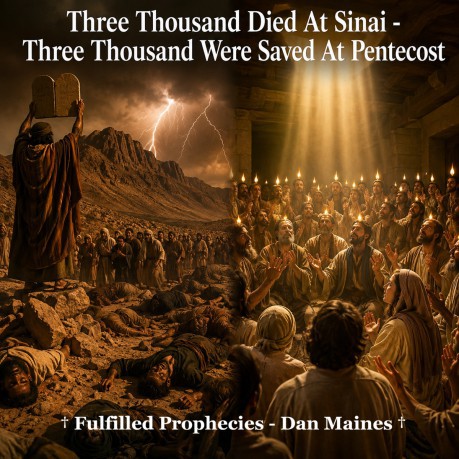
Three Thousand Died At Sinai
- Three Thousand Were Saved At Pentecost Introduction Exodus 32:28 Exodus 32:19 Jeremiah 31:31-33 Acts 2:1-4 Acts 2:36-41 2 Corinthians 3:6-9 Hebrews 12:18-24 Romans 8:2 Historical References How It Applies To Us Today Q: Was the Law itself evil because three thousand died at
Sinai? Q: Does the Bible specifically say Luke intended the three
thousand at Pentecost to correspond to the three thousand at
Sinai? Q: Why is Pentecost connected with the New Covenant? Q: What is the greatest contrast between Sinai and
Pentecost? Q: Are Christians supposed to return to the covenant given
at Mount Sinai? † This is the fulfilled perspective we proclaim at
Fulfilled Prophecies † Source Index
By Dan Maines
† One of the
most remarkable connections between Mount Sinai and Pentecost is
found in two numbers separated by centuries, three thousand died at
Sinai, and about three thousand were saved at Pentecost.
†
This isn't a random numerical coincidence. Both events involved
covenant, both involved God's presence, both involved a people being
formed, and both involved a dramatic response to God's revelation.
†
At Sinai, Israel had just entered covenant with God, but while Moses
was on the mountain receiving God's commandments, the people turned
to the golden calf. Judgment followed, and about three thousand men
died.
† At Pentecost, the risen Christ had
established the New Covenant through His blood, the Holy Spirit was
poured out, Peter preached Jesus as Lord and Christ, and about three
thousand people received the word and were added.
†
Sinai shows the condemnation associated with covenant rebellion.
Pentecost shows the life brought through Jesus Christ and the
ministry of the Spirit (2 Corinthians 3:6-9).
†
The contrast is stunning, three thousand died when Israel broke
covenant at Sinai, and about three thousand received the word when
the New Covenant message was proclaimed at Pentecost.
So the sons of Levi did as
Moses instructed, and about three thousand men of the people fell
that day.
† This happened at the very
beginning of Israel's covenant life. Moses was receiving the
commandments while the people below were already violating the
covenant through idolatry (Exodus 32:1-8).
†
The number is impossible to miss when Acts 2 is placed beside this
passage. About three thousand died in judgment at Sinai, while about
three thousand received the word at Pentecost (Acts 2:41).
†
Sinai revealed the seriousness of covenant rebellion. Israel had
promised obedience, yet almost immediately the golden calf exposed
the condition of their hearts (Exodus 24:3, 7).
†
The problem wasn't that God's Law was evil. The Law was holy,
righteous, and good, but sinful people couldn't produce righteousness
simply by receiving commandments written on stone (Romans 7:12, 8:3).
And it came about, as soon as
Moses approached the camp, that he saw the calf and the people
dancing; and Moses' anger burned, and he threw the tablets from his
hands and shattered them to pieces at the foot of the mountain.
†
Moses came down carrying the tablets of the covenant and found the
people worshiping an idol. The broken tablets became a powerful
picture of a covenant already being violated by the people who had
agreed to obey it (Exodus 24:7).
† Israel
didn't slowly drift into covenant rebellion generations later. Their
failure appeared immediately, showing that commandments written
externally couldn't transform the human heart (Jeremiah 31:31-33).
†
This prepares us for the promise of the New Covenant, when God's law
wouldn't merely stand before His people externally, but would be
written upon their hearts (Hebrews 8:8-10).
"Behold, days are
coming," declares the Lord, "when I will make a new
covenant with the house of Israel and the house of Judah, not like
the covenant which I made with their fathers on the day I took them
by the hand to bring them out of the land of Egypt, My covenant which
they broke, although I was a husband to them," declares the
Lord. "For this is the covenant which I will make with the house
of Israel after those days," declares the Lord: "I will put
My law within them and write it on their heart; and I will be their
God, and they shall be My people.
† Jeremiah
specifically contrasted the coming New Covenant with the covenant
made when Israel came out of Egypt. The New Covenant wasn't simply
Sinai repaired, it was something better.
†
The old covenant had commandments written on tablets of stone. The
promised covenant would involve God's work within His people, writing
His law upon their hearts.
† This is why
Pentecost belongs in the covenant story. The Spirit wasn't poured out
as an isolated supernatural event. Pentecost announced that the
promised age of the New Covenant had arrived through Christ (Acts
2:16-18, 33).
† What Israel couldn't
accomplish through external commandments, God accomplished through
Christ and the Spirit.
When the day of Pentecost had
come, they were all together in one place. And suddenly a noise like
a violent rushing wind came from heaven, and it filled the whole
house where they were sitting. And tongues that looked like fire
appeared to them, distributing themselves, and a tongue rested on
each one of them. And they were all filled with the Holy Spirit and
began to speak with different tongues, as the Spirit was giving them
the ability to speak out.
† Pentecost
deliberately echoes the imagery surrounding God's covenant presence.
There was a heavenly manifestation, fire, a gathered people, and
divine revelation (Exodus 19:16-20).
† But
something had changed. God's presence wasn't confined to a mountain
that the people couldn't approach. The Spirit came upon God's
people.
† The movement is from external
separation toward internal presence. The New Covenant was producing
the reality promised by the prophets, God dwelling with and within
His covenant people (Ezekiel 36:26-27).
†
Pentecost wasn't Christianity disconnected from Israel's story. It
was Israel's covenant story reaching its fulfillment in Jesus Christ.
Therefore let all the house of
Israel know for certain that God has made Him both Lord and
Christ—this Jesus whom you crucified." Now when they heard
this, they were pierced to the heart, and said to Peter and the rest
of the apostles, "Brothers, what are we to do?" Peter said
to them, "Repent, and each of you be baptized in the name of
Jesus Christ for the forgiveness of your sins; and you will receive
the gift of the Holy Spirit. For the promise is for you and your
children and for all who are far away, as many as the Lord our God
will call to Himself." And with many other words he solemnly
testified and kept on urging them, saying, "Be saved from this
perverse generation!" So then, those who had received his word
were baptized; and that day there were added about three thousand
souls.
† Here is the extraordinary reversal.
At Sinai, about three thousand fell. At Pentecost, about three
thousand received the word and were added.
†
Notice where the change occurred, they were pierced to the heart. The
New Covenant transformation promised by the prophets was centered
upon the heart, not merely commandments written externally (Jeremiah
31:33).
† Peter was speaking directly to the
house of Israel and warning them about their own crooked generation.
Pentecost stood within the final covenant transition that would
culminate in the passing away of the old covenant order (Matthew
24:34, Hebrews 8:13).
† The three thousand at
Pentecost weren't being called back to Sinai. They were being called
to Jesus Christ.
† The contrast couldn't be
stronger, rebellion against covenant brought death at Sinai, while
receiving the gospel of Christ brought forgiveness, the Holy Spirit,
and covenant life at Pentecost.
who also made us
adequate as servants of a new covenant, not of the letter but of the
Spirit; for the letter kills, but the Spirit gives life. But if the
ministry of death, engraved in letters on stones, came with glory so
that the sons of Israel could not look intently at the face of Moses
because of the glory of his face, fading as it was, how will the
ministry of the Spirit fail to be even more with glory? For if the
ministry of condemnation has glory, much more does the ministry of
righteousness excel in glory.
† Paul gives
us the inspired theological framework for understanding the contrast.
He directly identifies the covenant written and engraved on stones
with a ministry associated with death and condemnation.
†
Paul wasn't saying God's Law was sinful. He was explaining that the
old covenant couldn't give life to sinful people. It exposed sin and
pronounced condemnation, while the Spirit gives life through the New
Covenant (Romans 7:10-12).
† Paul also said
that the glory connected with that former ministry was passing away.
He was writing during the first-century transition from the old
covenant age into the fully established New Covenant age (Hebrews
8:13).
† Sinai and Pentecost therefore stand
as two powerful covenant scenes, one associated with tablets of stone
and condemnation, the other with the Spirit and life.
For you have not come to a
mountain that can be touched and to a blazing fire, and to darkness
and gloom and whirlwind, and to the blast of a trumpet and the sound
of words, which sound was such that those who heard begged that no
further word be spoken to them. For they could not cope with the
command, "If even an animal touches the mountain, it shall be
stoned." And so terrible was the sight, that Moses said, "I
am terrified and trembling." But you have come to Mount Zion and
to the city of the living God, the heavenly Jerusalem, and to myriads
of angels, to the general assembly and church of the firstborn who
are enrolled in heaven, and to God, the Judge of all, and to the
spirits of the righteous made perfect, and to Jesus, the mediator of
a new covenant, and to the sprinkled blood, which speaks better than
the blood of Abel.
† Hebrews makes the
covenant contrast unmistakable. Believers hadn't come to the
terrifying mountain associated with the Mosaic covenant. They had
come to Mount Zion, the heavenly Jerusalem, and Jesus the mediator of
the New Covenant.
† Notice the language is
present reality, you have come. The writer wasn't describing a
destination thousands of years in the future. Through Christ, they
had already approached the heavenly covenant reality.
†
Sinai had Moses as mediator. Zion has Jesus. Sinai represented the
covenant written on stone. Zion represents the New Covenant
established through the blood of Christ.
†
Pentecost belongs to this movement from Sinai to Zion, from the old
covenant administration toward the completed New Covenant reality in
Christ.
For the law of the Spirit of life
in Christ Jesus has set you free from the law of sin and of death.
†
The New Covenant message isn't merely about replacing one religious
system with another. It's about life in Christ.
†
Jesus accomplished what the Law couldn't accomplish because of human
weakness, bringing His people into righteousness and life through the
Spirit (Romans 8:3-4).
† The three thousand
at Pentecost therefore represent something much larger than an
impressive response to Peter's sermon. They stand at a decisive
moment in redemptive history when the gospel of the risen Christ was
gathering God's covenant people into life.
†
Josephus described Pentecost as one of the great Jewish pilgrimage
seasons when large numbers of Jews gathered in Jerusalem. This
historical setting helps explain the presence of Jews from many
regions when the Spirit was poured out and Peter preached Christ
(Josephus, Antiquities of the Jews 14.13.4; Acts 2:5-11).
†
Josephus also described the enormous crowds that gathered in
Jerusalem for Jewish festivals. Acts 2 therefore takes place in
exactly the kind of historical setting where thousands could hear the
apostolic proclamation and carry that message back to many regions
(Josephus, Wars of the Jews 2.14.3).
† The
early Christian writer Justin Martyr understood the prophetic hope as
finding its fulfillment in Christ and the New Covenant rather than in
continued dependence upon the Mosaic covenant (Justin Martyr,
Dialogue with Trypho).
† The Epistle of
Barnabas, an early Christian writing, also contrasted the former
covenant order with the covenant reality centered in Christ, showing
how strongly early Christians understood Jesus within the fulfillment
of Israel's covenant story.
†
We don't stand at Sinai waiting for another covenant. We live in the
accomplished work of Jesus Christ and the everlasting New Covenant.
†
We don't approach God through tablets of stone, an earthly
priesthood, animal sacrifices, or an earthly sanctuary. We approach
God through Jesus Christ, the mediator of the New Covenant (Hebrews
12:22-24).
† Pentecost reminds us that
Christianity isn't primarily about external religious performance.
God changes people from within through Christ and the work of the
Spirit (Romans 8:2-4).
† The three thousand
who died at Sinai and the three thousand who were added at Pentecost
give us a powerful picture of the Bible's covenant movement, from
condemnation to righteousness, from the ministry associated with
death to the ministry of the Spirit and life.
†
We aren't waiting to return to Sinai. We've come to Zion.
†
We aren't waiting for the New Covenant to arrive. Jesus established
it through His blood.
† We aren't waiting for
the kingdom to begin. In Christ, God's people belong to the heavenly
Jerusalem and live under the reign of the risen King (Hebrews
12:22-24).
† Three thousand died at Sinai.
About three thousand were added at Pentecost. What began with tablets
of stone reached its greater reality through Jesus Christ and the
Spirit.
A: No. Paul explicitly says the
Law is holy, righteous, and good (Romans 7:12). The problem was human
sin. The Law exposed and condemned sin, but it couldn't transform the
sinful heart or give the covenant life ultimately provided through
Christ (Romans 8:3-4).
A: Acts doesn't explicitly
state that Luke chose the number as a direct reference to Exodus
32:28. The connection is therefore a strong biblical pattern rather
than an explicit statement. What is explicit is that about three
thousand died at Sinai and about three thousand were added at
Pentecost, while the New Testament itself contrasts the ministry
written on stone with the ministry of the Spirit (2 Corinthians
3:6-9).
A:
Because Jesus established the New Covenant through His blood,
promised the Holy Spirit, and then poured out the Spirit after His
resurrection and ascension (Luke 22:20, Acts 1:4-5, Acts 2:33). The
prophets had already connected the coming covenant transformation
with God's Spirit working within His people (Jeremiah 31:31-33,
Ezekiel 36:26-27).
A: Sinai displayed the
inability of sinful people to remain faithful simply because
commandments had been given. Pentecost displayed God's New Covenant
work through Christ and the Holy Spirit. Paul summarizes the contrast
clearly, the letter kills, but the Spirit gives life (2 Corinthians
3:6).
A: No. Hebrews says
believers haven't come to Sinai, but to Mount Zion, the heavenly
Jerusalem, and to Jesus, the mediator of a New Covenant (Hebrews
12:18-24). The direction of redemption isn't from Zion back to Sinai.
It's from Sinai to Christ.
© Fulfilled Prophecies - Dan
Maines.
† Exodus
32:28; Exodus 32:19; Jeremiah 31:31-33; Acts 2:1-4; Acts 2:36-41; 2
Corinthians 3:6-9; Hebrews 12:18-24; Romans 8:2
†
Josephus, Antiquities of the Jews 14.13.4; Josephus, Wars of the Jews
2.14.3; Justin Martyr, Dialogue with Trypho; Epistle of Barnabas
Links