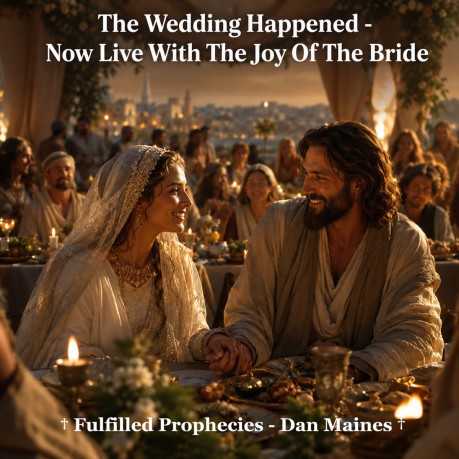
The Wedding Happened - Now
Live With The Joy Of The Bride Introduction Revelation 19:7-9 Revelation 21:2 Revelation 21:9-10 Hebrews 12:22-24 Galatians 4:25-26 Revelation 22:17 Historical References How It Applies To Us Today Q & A Appendix Q: Who is the bride in Revelation? Q: Is New Jerusalem the modern earthly city of
Jerusalem? Q: Does fulfilled prophecy mean Christians have
nothing left to look forward to? Q: What should the fulfillment of the wedding
produce in believers? Q: What should the bride be doing now? † This is the fulfilled perspective we proclaim at
Fulfilled Prophecies † Source Index
By Dan Maines
† Much of
Christianity has been taught to live like a bride who has been
standing at the altar for two thousand years, still waiting for the
Bridegroom to arrive. But the New Testament doesn't leave the wedding
endlessly postponed. Revelation announced that the marriage of the
Lamb had come, the bride had made herself ready, and the covenant
city would be revealed as the Lamb's wife.
†
The fulfilled perspective doesn't remove our hope, it shows us that
Christ accomplished what He promised. The wedding wasn't canceled,
delayed, or moved thousands of years beyond the generation that
received the promise. The old covenant order passed away, the New
Covenant was fully established, and the bride now lives in covenant
union with her Bridegroom (Hebrews 8:13; Revelation 19:7).
†
This changes the emotional center of fulfilled eschatology. We're not
supposed to spend our lives disappointed that Jesus hasn't completed
His prophetic promises. We're invited to rejoice because the
Bridegroom came in judgment against the old covenant city and openly
established the New Jerusalem as His covenant bride (Matthew 24:30,
34; Revelation 21:2, 9-10).
† Fulfilled
prophecy should produce joy. We're not standing outside the wedding
hall listening for footsteps. We're living in the covenant reality
the wedding established.
Let's rejoice and be glad
and give the glory to Him, because the marriage of the Lamb has come,
and His bride has prepared herself. It was given to her to clothe
herself in fine linen, bright and clean; for the fine linen is the
righteous acts of the saints. Then he said to me, "Write:
'Blessed are those who are invited to the wedding feast of the
Lamb.'" And he said to me, "These are the true words of
God."
† Notice the language John was
commanded to write, the marriage of the Lamb "is come."
Revelation presents the wedding as the approaching climax of the
covenantal events revealed to John's original audience (Revelation
1:1, 3).
† The response to the marriage isn't
fear, disappointment, or endless waiting. It's rejoicing. The
prophetic wedding is presented as good news because God's covenant
purposes were reaching their promised fulfillment (Isaiah 62:4-5).
†
The bride making herself ready fits the first-century transition
between the old covenant order and the fully manifested New Covenant
order. The saints were being prepared for what Revelation declared
was near (Revelation 22:6, 10).
† The
marriage supper represents covenant fellowship and celebration. Jesus
had already used wedding and banquet imagery to describe the arrival
of the kingdom and the judgment associated with rejecting its
invitation (Matthew 22:1-14; Matthew 25:1-13).
And I saw the holy city, new
Jerusalem, coming down out of heaven from God, prepared as a bride
adorned for her husband.
† John identifies
the bride through the imagery of the holy city, New Jerusalem. This
isn't modern geopolitical Jerusalem. It's the covenant city from
above, associated with God's redeemed people (Galatians 4:26; Hebrews
12:22-24).
† The direction matters. John
doesn't describe God's people abandoning creation so they can
permanently escape into heaven. He sees New Jerusalem coming down
from God. The great biblical story reaches its covenant goal when
God's dwelling is with His people (Revelation 21:3).
†
The bride is "made ready." Revelation 19 announced that the
wife had made herself ready, and Revelation 21 shows the glorious
covenant reality resulting from that preparation (Revelation 19:7).
†
We aren't waiting for New Jerusalem to become our covenant home.
Hebrews told first-century believers that they had already come to
Mount Zion and the heavenly Jerusalem as they approached the
completion of that covenant transition (Hebrews 12:22-28).
Then one of the seven
angels who had the seven bowls, full of the seven last plagues, came
and spoke with me, saying, "Come here, I will show you the
bride, the wife of the Lamb." And he carried me away in the
Spirit to a great and high mountain, and showed me the holy city,
Jerusalem, coming down out of heaven from God,
†
Scripture interprets the symbol for us. The angel says he'll show
John "the bride, the wife of the Lamb," and then shows him
the holy city Jerusalem. The bride and New Jerusalem belong to the
same covenant picture.
† This stands in
deliberate contrast with the condemned city earlier in Revelation.
One city is judged, while another is revealed in glory. The movement
is from the old covenant order under judgment to the New Covenant
order in Christ (Revelation 18:2, 19-21; Revelation 21:1-2).
†
The Lamb doesn't remain an eternal fiance waiting for a wedding that
never arrives. Revelation calls the New Jerusalem "the wife of
the Lamb." Wife is marriage language, not perpetual engagement
language.
† The joy of fulfilled eschatology
is covenant union. God's people aren't waiting for Christ to someday
establish access to Him. Through Christ we have access to the Father
and belong to God's household now (Ephesians 2:18-22).
But you have come to Mount
Zion and to the city of the living God, the heavenly Jerusalem, and
to myriads of angels, to the general assembly and church of the
firstborn who are enrolled in heaven, and to God, the Judge of all,
and to the spirits of the righteous made perfect, and to Jesus, the
mediator of a new covenant, and to the sprinkled blood, which speaks
better than the blood of Abel.
† Hebrews
doesn't tell these believers that Mount Zion and heavenly Jerusalem
were completely unrelated realities reserved for people thousands of
years later. It says, "you have come." They were already
participating in the heavenly covenant reality while the old order
was approaching removal (Hebrews 8:13; Hebrews 12:26-28).
†
Jesus is the mediator of the New Covenant. The wedding imagery of
Revelation and the heavenly Jerusalem language of Hebrews describe
the same great covenant movement, away from the temporary order and
into the permanent kingdom established through Christ.
†
This is why believers today don't need to search for another covenant
city. Our relationship with God isn't centered on an earthly temple,
earthly priesthood, or earthly Jerusalem. Our access is through Jesus
Christ (Hebrews 10:19-22).
Now this Hagar is Mount
Sinai in Arabia and corresponds to the present Jerusalem, for she is
enslaved with her children. But the Jerusalem above is free; she is
our mother.
† Paul establishes the covenant
contrast clearly. There was a Jerusalem associated with bondage, and
there was a Jerusalem above associated with freedom.
†
This helps interpret Revelation's two-city contrast. The prophetic
story isn't ultimately about rebuilding the old Jerusalem as the
center of God's redemptive program. It's about the triumph of the
Jerusalem above (Revelation 21:2).
† Paul
says the Jerusalem above "is our mother." New Jerusalem
wasn't invented at the end of Revelation. The apostles were already
teaching the church to understand its identity through this heavenly
covenant reality.
† The bride therefore
represents freedom, not bondage. Living as the bride means living in
the liberty of the New Covenant rather than longing for the
restoration of the covenant system that was passing away (Galatians
5:1).
The Spirit and the bride
say, "Come." And let the one who hears say, "Come."
And let the one who is thirsty come; let the one who desires, take
the water of life without cost.
† Look at
what the bride is doing after she's revealed. She's inviting people
to come. She's not sitting silently waiting to become the bride
someday. She participates with the Spirit in extending the invitation
of life.
† This is one of the most beautiful
pictures of our present calling. The fulfilled kingdom isn't closed.
The water of life continues to be offered freely. The nations can
enter the light and life found in Christ (Revelation 21:24-26).
†
Fulfilled eschatology should therefore create evangelistic joy, not
prophetic inactivity. Because Christ fulfilled His covenant promises,
we can confidently tell thirsty people that the water of life is
available now.
† The bride's message isn't
"Wait with us because perhaps someday the wedding will happen."
Her message is "Come." Christ has opened the way, and those
who thirst are invited to receive life freely.
†
Josephus described the catastrophic destruction of Jerusalem and the
temple in AD 70, including famine, warfare, fire, and the collapse of
the city that had stood at the center of the old covenant world. His
account provides important historical background for understanding
the first-century judgment setting surrounding Jesus' warnings about
Jerusalem (Josephus, Wars of the Jews, Books 5-7).
†
Tacitus also recorded the Roman war against Jerusalem and the
destruction associated with the conflict, independently confirming
the historical setting in which the old Jerusalem and its temple fell
(Tacitus, Histories, Book 5).
† Eusebius
later connected the calamities that came upon Jerusalem with the
judgment that followed the rejection of Christ and recorded the
tradition that believers left Jerusalem before the city's destruction
(Eusebius, Ecclesiastical History, Book 3, Chapters 5-7).
†
These historical witnesses don't establish doctrine by themselves,
Scripture does that. But they confirm that the first-century
generation actually experienced the enormous covenantal judgment
Jesus and the apostles had warned was approaching.
†
We can live with joy because we're not waiting for God to finish an
unfinished covenant. Jesus succeeded. The Bridegroom kept His
promise, and the New Covenant kingdom stands.
†
We can live with assurance because our relationship with God isn't
based on an earthly temple, earthly priesthood, or earthly city. Our
access to the Father is through Jesus Christ.
†
We can live with freedom because our Jerusalem is above. We're
children of the free woman, not slaves under the covenant represented
by Sinai and the old Jerusalem (Galatians 4:24-31).
†
We can live with gratitude because the marriage imagery tells us
something deeply personal about salvation. Christ didn't merely
rescue a people from judgment, He brought them into covenant
fellowship with Himself.
† We can stop
treating Christianity like a divine waiting room. The kingdom isn't
perpetually "almost here." The Bridegroom didn't fail to
arrive. The wedding wasn't postponed for thousands of years.
†
We can celebrate fulfilled prophecy instead of fearing it. The end of
the old covenant age meant the full establishment of something
better, an unshakable kingdom, direct covenant access to God, and the
heavenly Jerusalem (Hebrews 12:22-28).
† We
can invite others with confidence. The Spirit and the bride still
say, "Come." The water of life is freely available in
Christ.
† The fulfilled message isn't, "Keep
waiting." It's, "Rejoice." The marriage came, the New
Jerusalem was revealed, the kingdom can't be shaken, and Jesus Christ
reigns.
† We're not abandoned bridesmaids
staring down an empty road wondering when the Bridegroom will finally
appear. We live in the joy of accomplished redemption and covenant
union with Christ.
† The wedding happened.
Now live with the joy of the bride.
Q: Did
Revelation say the marriage of the Lamb would remain future for
thousands of years?
A: No. John was told that
the things revealed in Revelation would shortly come to pass and that
the time was near (Revelation 1:1, 3; 22:6, 10). Revelation 19
announces that the marriage had come.
A:
Revelation identifies the bride with the holy city, New Jerusalem,
the wife of the Lamb (Revelation 21:2, 9-10).
A: No. Paul distinguishes the
Jerusalem in bondage from "the Jerusalem that is above,"
which is free, and Hebrews identifies the heavenly Jerusalem as the
city of the living God (Galatians 4:25-26; Hebrews 12:22).
A: No.
Fulfillment means we live inside the accomplished kingdom rather than
waiting for its prophetic establishment. We enjoy Christ, proclaim
the gospel, drink from the water of life, grow in grace, serve
others, and eventually depart this earthly life to be with Christ
(Revelation 22:17; Philippians 1:21-23).
A: Joy. Revelation itself
says, "Let us rejoice and be exceeding glad" because the
marriage of the Lamb had come (Revelation 19:7).
A:
Inviting others to Christ. Revelation closes with the Spirit and the
bride saying, "Come," and offering the water of life freely
(Revelation 22:17).
© Fulfilled Prophecies - Dan
Maines.
† Revelation
19:7-9; Revelation 21:2; Revelation 21:9-10; Hebrews 12:22-24;
Galatians 4:25-26; Revelation 22:17
†
Josephus, Wars of the Jews, Books 5-7; Tacitus, Histories, Book 5;
Eusebius, Ecclesiastical History, Book 3, Chapters 5-7
Links