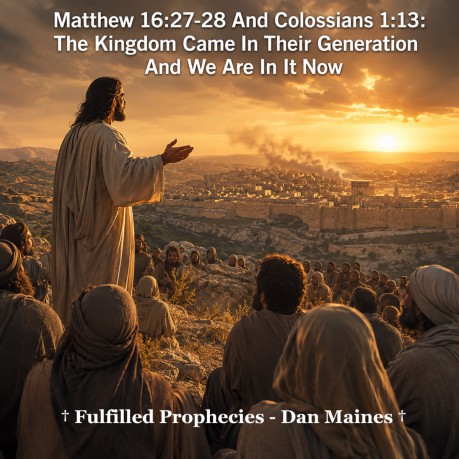
Matthew 16:27-28 And
Colossians 1:13: The Kingdom Came In Their Generation And We Are In
It Now Introduction Matthew 16:27-28 Colossians 1:13 Mark 9:1 Matthew 24:34 Hebrews 12:28 Luke 21:31-32 Revelation 1:1-3 Historical References How It Applies To Us Today Q & A Appendix Q: Could Matthew 16:28 refer only to the
Transfiguration? Q: Did Paul teach that Christians were already in
Christ's kingdom? Q: Are Christians still waiting for Jesus to
become King? Q: Does believing the kingdom has come mean God's
kingdom has stopped growing? Q: What does this mean for Christians living
today? Q: What about those who say a thousand years is
like one day to God, so the time statements don't have to mean
soon? Q: Doesn't God experience time differently than
we do? Q: If the kingdom came in the first century, why
is there still sin and suffering in the world? † This is the fulfilled perspective we proclaim at
Fulfilled Prophecies † Source Index
By Dan Maines
† Matthew
16:27-28 and Colossians 1:13 belong together because one passage
speaks about the coming of the Son of Man in His kingdom, while the
other shows that believers had already been transferred into that
kingdom.
† Jesus placed His coming within the
lifetime of some who were standing in front of Him. Paul later wrote
to living first-century Christians and told them that God had already
transferred them into the kingdom of His beloved Son.
†
These passages create a serious problem for any interpretation that
moves the coming of the kingdom thousands of years beyond Jesus'
original audience.
† Jesus didn't say that
some standing there would have descendants who would see it. He said
that some of the people standing there wouldn't taste death until
they saw the Son of Man coming in His kingdom.
†
Paul didn't tell the Colossians that they were waiting thousands of
years to enter Christ's kingdom. He said God had already delivered
them from darkness and transferred them into the kingdom.
†
The kingdom isn't something Christians are still waiting to begin.
Christ reigns, His people belong to His kingdom, and we live under
His rule today.
For the Son of Man is going
to come in the glory of His Father with His angels, and will then
repay every person according to his deeds. "Truly I say to you,
there are some of those who are standing here who will not taste
death until they see the Son of Man coming in His kingdom."
†
Jesus identified the event as the coming of the Son of Man in the
glory of His Father, accompanied by judgment and the kingdom.
†
Then Jesus gave His audience the time limitation. Some of the people
physically standing before Him would still be alive when this
happened.
† The words some of them that stand
here can't naturally describe people living thousands of years later.
Jesus was speaking directly to His first-century audience.
†
This agrees with Jesus' repeated teaching that judgment and His
coming would occur within that generation (Matthew 10:23; 23:36;
24:30-34).
† If everyone standing there died
and the event still hasn't happened, the plain time statement Jesus
gave them loses its meaning. The fulfilled view allows both the event
and the time statement to stand exactly where Jesus placed them.
For He rescued us from the
domain of darkness, and transferred us to the kingdom of His beloved
Son,
† Paul didn't describe the kingdom as
merely a distant future hope. He told the Colossian believers that
God had already transferred them into Christ's kingdom.
†
Notice the completed actions. God delivered them and transferred
them. They weren't waiting for Christ's kingdom to exist before they
could enter it.
† This helps explain Matthew
16:28. The kingdom was being established through Christ's redemptive
work and would be fully manifested in the covenantal judgment that
brought the old covenant age to its end (Hebrews 8:13; 12:26-28).
†
Christians today don't need to wait for Jesus to become King. Jesus
is King now, and those who belong to Him are citizens of His kingdom
(Ephesians 2:19; Philippians 3:20).
And Jesus was saying to them,
"Truly I say to you, there are some of those who are standing
here who will not taste death until they see the kingdom of God when
it has come with power."
† Mark records
the same unmistakable time limitation. Some standing with Jesus would
remain alive until they saw the kingdom of God come with power.
†
The audience wasn't imaginary. The people standing there were real
first-century people with normal human lifespans.
†
This statement places the coming of the kingdom within their
lifetime, not thousands of years beyond them.
†
Matthew emphasizes the Son of Man coming in His kingdom, while Mark
emphasizes the kingdom coming with power. Together they describe the
same first-century expectation (Matthew 16:27-28; Mark 9:1).
Truly I say to you, this
generation will not pass away until all these things take place.
†
Jesus again established the timeframe. The generation hearing His
prophecy wouldn't pass away until all the things He had described
were accomplished.
† This includes His
description of the Son of Man coming on the clouds and the gathering
of His elect (Matthew 24:30-31).
† Matthew
16:28 says some standing there would still be alive. Matthew 24:34
says that generation wouldn't pass away. These statements reinforce
each other.
† We don't need to redefine this
generation into a generation thousands of years removed from Jesus'
listeners. The first-century fulfillment honors the audience,
context, and time statements.
Therefore, since we receive a
kingdom which cannot be shaken, let's show gratitude, by which we may
offer to God an acceptable service with reverence and awe;
†
The writer of Hebrews said those believers were receiving an
unshakable kingdom.
† The context contrasts
what could be shaken with what would remain. The old covenant order
was ready to disappear, while Christ's kingdom couldn't be shaken
(Hebrews 8:13; 12:26-27).
† This wasn't
describing the destruction of planet Earth. It was describing a
covenantal shaking connected with the removal of what was temporary
and the establishment of what would remain.
†
The kingdom Christ established doesn't need to be replaced by another
earthly system. His kingdom remains because it can't be shaken.
So you too, when you see these
things happening, recognize that the kingdom of God is near. Truly I
say to you, this generation will not pass away until all things take
place.
† Jesus connected the fulfillment of
the signs directly with the nearness of the kingdom of God.
†
He told His disciples that when they saw these things happening, they
would know the kingdom was near.
† He
immediately followed that statement by declaring that their
generation wouldn't pass away until all things were accomplished.
†
The disciples weren't instructed to look thousands of years into the
future. They were told to watch for events they themselves could see
(Luke 21:20, 28, 31).
† Matthew 16:28, Mark
9:1, and Luke 21:31-32 give the same basic message, people then
living would witness the coming of the kingdom.
The Revelation of Jesus
Christ, which God gave Him to show to His bond-servants, the things
which must soon take place; and He sent and communicated it by His
angel to His bond-servant John, who testified to the word of God and
to the testimony of Jesus Christ, everything that he saw. Blessed is
the one who reads, and those who hear the words of the prophecy and
keep the things which are written in it; for the time is near.
†
Revelation begins with two unmistakable time statements. The events
must shortly come to pass, and the time was at hand.
†
Those statements agree perfectly with Jesus' promise that some
standing before Him would live to see the Son of Man coming in His
kingdom (Matthew 16:28).
† Revelation doesn't
begin by telling its first-century readers that the prophecy
concerned events thousands of years beyond them. It tells them that
the events were near.
† The same urgency
appears at the end of Revelation, where the prophecy wasn't to be
sealed because the time was near (Revelation 22:6, 10).
†
Josephus, writing about the Jewish War, recorded the catastrophic
destruction of Jerusalem and the temple in AD 70. His account
provides important historical background for understanding the
judgment Jesus had pronounced upon Jerusalem and His generation
(Josephus, Wars of the Jews, Books 5-7).
†
Josephus described famine, internal violence, Roman armies, the
burning of the temple, and the devastation of Jerusalem. These events
fit the historical setting Jesus described when He warned His
disciples about Jerusalem's coming destruction (Luke 19:41-44;
21:20-24).
† Tacitus, the Roman historian,
also described the Jewish conflict and the Roman campaign against
Jerusalem, providing non-Christian historical testimony concerning
the first-century war (Tacitus, Histories, Book 5).
†
Eusebius later connected Jesus' warnings with the events surrounding
Jerusalem and recorded the tradition that Christians left Jerusalem
before the city's destruction (Eusebius, Ecclesiastical History, Book
3, Chapters 5-7).
† These historical writers
don't establish biblical doctrine, Scripture does. They provide
historical testimony showing that the generation Jesus addressed
experienced an extraordinary covenantal judgment culminating in
Jerusalem's destruction in AD 70.
†
We aren't waiting for Christ to receive His kingdom. Christ reigns
now (1 Corinthians 15:25; Revelation 1:5).
†
We aren't waiting to be transferred into a kingdom that doesn't yet
exist. In Christ, believers belong to the kingdom of God's beloved
Son (Colossians 1:13).
† We don't have to
live as though Christianity is waiting for Jesus to someday become
victorious. His death, resurrection, ascension, reign, and covenant
victory established the reality in which His people now live (Acts
2:32-36; Hebrews 10:12-13).
† Matthew
16:27-28 gives us the timeframe. Some standing with Jesus wouldn't
die before seeing the Son of Man coming in His kingdom.
†
Colossians 1:13 gives us the kingdom reality. God's people had been
delivered from the authority of darkness and transferred into
Christ's kingdom.
† Hebrews 12:28 tells us
what kind of kingdom we've received. It's a kingdom that can't be
shaken.
† We don't live waiting for the
kingdom to arrive. We live in Christ's kingdom now, under the reign
of the King who has already been given all authority in heaven and on
earth (Matthew 28:18).
† Our message isn't
that Jesus failed to come when He said He would. Our message is that
Jesus kept His word, fulfilled His promises, established His kingdom,
and reigns today.
Q: Did
Jesus say people standing with Him would still be alive when He came
in His kingdom?
A: Yes. Jesus specifically said
that some standing there wouldn't taste death until they saw the Son
of Man coming in His kingdom (Matthew 16:27-28; Mark 9:1).
A: The Transfiguration
provided a powerful preview of Christ's glory, but Matthew 16:27
describes the Son of Man coming in His Father's glory with His angels
and rendering to each person according to his deeds. That judgment
language reaches beyond the Transfiguration and agrees with Christ's
first-century judgment statements elsewhere (Matthew 10:23; 23:36;
24:30-34).
A: Yes. Paul said God had
delivered believers from the authority of darkness and transferred
them into the kingdom of His beloved Son (Colossians 1:13).
A: No. The New Testament presents
Jesus as already exalted and reigning. Peter proclaimed that God had
made Jesus both Lord and Christ, and Paul taught that Christ must
reign until His enemies are placed under His feet (Acts 2:32-36; 1
Corinthians 15:25).
A: No. A fulfilled
coming of the kingdom doesn't mean the end of Christ's reign or the
end of the gospel's work. Christ's kingdom is an unshakable kingdom,
and His rule continues (Hebrews 12:28; 1 Corinthians 15:25).
A: It means we're not waiting outside
the kingdom for prophecy to be completed before we can enjoy its
blessings. In Christ we have redemption, citizenship, access to God,
and life under the reign of our King now (Colossians 1:13-14;
Ephesians 2:18-19).
A: That doesn't erase the plain meaning
of Jesus' words. Peter said that with the Lord one day is like a
thousand years, and a thousand years like one day, emphasizing that
God isn't limited by time as humans are (2 Peter 3:8). He didn't say
that when God tells people something will happen soon, near, or
within their generation, those words can mean thousands of years.
Jesus didn't merely say soon in Matthew 16:28. He identified living
people and said some standing there wouldn't taste death until they
saw the Son of Man coming in His kingdom (Matthew 16:27-28). Turning
their lifetime into thousands of years doesn't explain the passage,
it contradicts the time limit Jesus gave.
A: Yes, God is eternal, but He
communicates with people using words they can understand. When Jesus
said some standing before Him wouldn't taste death until they saw His
coming in the kingdom, the timeframe was measured by their human
lifetimes, not God's eternity (Matthew 16:28; Mark 9:1). Otherwise,
time statements in Scripture would become meaningless.
A:
Because the coming of Christ's kingdom never meant the physical earth
would immediately become sinless or that human history would end.
Christ reigns in the midst of His enemies (1 Corinthians 15:25), and
believers have been transferred into His kingdom (Colossians 1:13).
The kingdom is present and unshakable even while the gospel continues
to go into the world (Hebrews 12:28; Matthew 28:18-20).
© Fulfilled Prophecies - Dan
Maines.
† Matthew
16:27-28; Colossians 1:13; Mark 9:1; Matthew 24:34; Hebrews 12:28;
Luke 21:31-32; Revelation 1:1-3
† Josephus,
Wars of the Jews, Books 5-7; Tacitus, Histories, Book 5; Eusebius,
Ecclesiastical History, Book 3, Chapters 5-7
Links