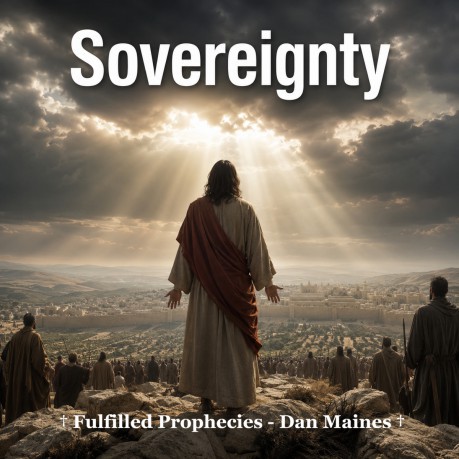
Sovereignty Introduction Psalm 103:19 Daniel 4:35 Isaiah 46:9-10 Acts 2:22-23 Romans 9:20-21 Ephesians 1:20-22 Hebrews 12:28 Revelation 11:15 Historical References How It Applies To Us Today Q & A Appendix Q: If God is sovereign, do human choices still
matter? Q: Does sovereignty mean everything that happens
is good? Q: Is Jesus sovereign and reigning right now? Q: What does fulfilled prophecy teach us about
God's sovereignty? Q: How should God's sovereignty affect the way we
live? † This is the fulfilled perspective we proclaim at
Fulfilled Prophecies † Source Index
By Dan Maines
† The
sovereignty of God means that God is the supreme ruler over His
creation. No power is above Him, no human authority can overthrow His
purpose, and nothing can remove Him from His throne (Psalm 103:19;
Daniel 4:35).
† God's sovereignty doesn't
mean that human choices are imaginary or meaningless. Scripture
repeatedly holds human beings responsible for what they choose while
also showing that God's purpose can't ultimately be defeated (Acts
2:23; Acts 4:27-28).
† God's sovereignty
should give believers confidence rather than fear. We're not living
in a universe abandoned by its Creator. God remains King, Christ
reigns, and His redemptive purpose has been accomplished in Christ (1
Corinthians 15:25; Ephesians 1:20-23).
† The
fulfilled perspective makes this especially powerful. We aren't
waiting for Christ to someday receive His kingdom. Christ has been
exalted, His enemies were judged as promised, and His kingdom
continues under His sovereign reign (Daniel 7:13-14; Hebrews 12:28).
The Lord has established His
throne in the heavens, And His sovereignty rules over all.
†
God's throne isn't established by human permission. His authority
doesn't rise and fall according to governments, elections, armies,
economies, or nations. His kingdom rules over all (Psalm 47:7-8).
†
This doesn't say that everything people do is morally approved by
God. Human beings can rebel against God's revealed will, but their
rebellion can never remove God from His position as sovereign King
(Psalm 2:1-6).
† This is where our confidence
begins. God's sovereignty isn't something He gains when circumstances
improve. He already reigns, even when circumstances appear completely
out of control (Isaiah 46:9-10).
All the inhabitants of the earth
are of no account, But He does according to His will among the army
of heaven And among the inhabitants of earth; And no one can fend off
His hand Or say to Him, 'What have You done?'
†
Nebuchadnezzar learned something every earthly ruler eventually
discovers, human authority is temporary, but God's authority is
absolute. No king, empire, or government can place itself above Him
(Daniel 4:34, 37).
† God's sovereignty means
His ultimate purpose can't be canceled. People may resist Him, reject
Him, and act contrary to His commands, but they can't overthrow what
God has determined to accomplish (Isaiah 14:24, 27).
†
This distinction matters. Scripture doesn't teach that every sinful
act expresses God's moral approval. It teaches that even human
rebellion can't finally frustrate God's redemptive purpose (Genesis
50:20).
Remember the former things
long past, For I am God, and there is no other; I am God, and there
is no one like Me, Declaring the end from the beginning, And from
ancient times things which have not been done, Saying, 'My plan will
be established, And I will accomplish all My good pleasure';
†
God doesn't discover history as it unfolds. He declares His purpose
and brings His counsel to completion. What God promises isn't left
hanging indefinitely (Isaiah 55:10-11).
†
This is extremely important when studying prophecy. If God gave a
prophecy with an appointed time, His sovereignty guaranteed that He
would accomplish what He promised within the framework He revealed
(Habakkuk 2:2-3).
† Fulfilled prophecy is
therefore evidence of God's sovereignty. God promised judgment,
redemption, covenant fulfillment, and the establishment of Christ's
kingdom, and His word didn't fail (Luke 21:20-22, 32-33).
Men of Israel, listen to these
words: Jesus the Nazarene, a Man attested to you by God with miracles
and wonders and signs which God performed through Him in your midst,
just as you yourselves know - this Man, delivered over by the
predetermined plan and foreknowledge of God, you nailed to a cross by
the hands of godless men and put Him to death.
†
The cross gives us one of Scripture's clearest pictures of divine
sovereignty and human responsibility existing together. Jesus was
delivered according to God's predetermined plan, yet the people who
crucified Him were still called lawless and responsible for their
actions (Acts 3:13-15).
† God didn't approve
of their hatred, betrayal, injustice, or murder. Yet their sinful
actions couldn't prevent God's redemptive purpose. God used what
wicked people intended for evil within His greater plan of salvation
(Acts 4:27-28).
† If God's purpose couldn't
be defeated at the cross, we shouldn't imagine that His purpose can
be defeated by the circumstances surrounding our lives. This doesn't
make every painful event good, but it means evil doesn't get the
final word (Romans 8:28).
On the contrary, who are you,
you foolish person, who answers back to God? The thing molded will
not say to the molder, "Why did you make me like this,"
will it? Or does the potter not have a right over the clay, to make
from the same lump one object for honorable use, and another for
common use?
† Paul reminds us that God is the
Creator and we are His creation. We don't sit above God as His
judges. God isn't accountable to creation as though creation were
sovereign over Him (Isaiah 45:9).
† The
potter has authority over the clay. This picture emphasizes God's
right to accomplish His covenant purpose according to His wisdom
rather than according to human expectations (Romans 9:6-18).
†
Romans 9 is deeply connected with God's historical purpose involving
Israel, the promise, and the inclusion of the Gentiles. God's
covenant plan wasn't defeated by unbelief. His promise reached its
intended fulfillment in Christ (Romans 9:24-26; Galatians 3:16,
28-29).
which He brought about in
Christ, when He raised Him from the dead and seated Him at His right
hand in the heavenly places, far above all rule and authority and
power and dominion, and every name that is named, not only in this
age but also in the one to come. And He put all things in subjection
under His feet, and made Him head over all things to the church,
†
Jesus isn't waiting to become King. The Father raised Him from the
dead and seated Him above every rule, authority, power, and dominion.
Christ's sovereignty is a present reality (Colossians 1:13-18).
†
This changes how we view the kingdom. We aren't waiting for Jesus to
leave a defeated position and begin reigning someday. The New
Testament announced His exaltation and enthronement as accomplished
realities (Acts 2:32-36).
† Christ is Head
over all things to His church. Our security isn't based upon earthly
kingdoms remaining stable. It's based upon the authority of the risen
and reigning Christ (Hebrews 1:3, 8).
Therefore, since we receive a
kingdom which cannot be shaken, let's show gratitude, by which we may
offer to God an acceptable service with reverence and awe;
†
The kingdom believers received can't be shaken. Governments can
collapse, nations can disappear, economies can fail, and human
institutions can change, but Christ's kingdom remains (Hebrews
12:26-27).
† This is one of the great
consequences of God's sovereignty. Our hope isn't attached to the
survival of a particular earthly system. Our hope is anchored in the
unshakable kingdom of God (Colossians 1:13).
†
Fulfilled eschatology doesn't leave us with an empty world after
prophecy was fulfilled. It leaves us living under the victorious
reign of Christ, participating in a kingdom that Scripture says can't
be shaken (Revelation 11:15).
Then the seventh angel
sounded; and there were loud voices in heaven, saying, "The
kingdom of the world has become the kingdom of our Lord and of His
Christ; and He will reign forever and ever."
†
Revelation presents the victory of God's kingdom as the fulfillment
of His covenant purpose. The sovereign God wasn't attempting to
establish His reign and hoping history would cooperate. He brought
His declared purpose to completion (Revelation 10:7).
†
The judgment coming upon the old covenant world couldn't stop
Christ's kingdom. Instead, that judgment publicly demonstrated the
truthfulness of Christ's prophetic word and the authority of the
reigning King (Matthew 24:30, 34).
† Christ's
reign isn't temporary. His kingdom didn't end when Jerusalem fell.
The old covenant age reached its appointed conclusion, but the reign
of Christ continues without end (Luke 1:32-33).
†
Josephus recorded the catastrophic destruction of Jerusalem and the
temple in AD 70. Although Josephus wasn't writing Christian theology,
his history provides an important eyewitness-era record of the
judgment that overtook Jerusalem, the very city Jesus had warned
would experience devastating judgment (Josephus, Wars of the Jews,
Books 5-7).
† Tacitus recorded the Roman
campaign against Jerusalem and identified Titus with the final
destruction of the city. His Roman historical account independently
confirms the first-century setting in which Jerusalem and its temple
fell (Tacitus, Histories, Book 5).
† Eusebius
connected the destruction of Jerusalem with the judgment that
followed the rejection of Christ and recorded the Christian tradition
that believers departed from Jerusalem before the catastrophe
(Eusebius, Ecclesiastical History, Book 3, Chapters 5-7).
†
These historical records don't establish God's sovereignty by
themselves. Scripture establishes the doctrine. History is valuable
because it confirms that the first-century events Jesus and the
apostles described occurred in real history.
†
God's sovereignty means we don't have to live as though everything
depends upon our ability to control the future. We make responsible
choices, pray, work, plan, and obey God, while recognizing that God
remains above everything we can't control (James 4:13-15).
†
When life doesn't happen the way we expected, God's throne hasn't
moved. Our circumstances can change overnight, but God's character,
faithfulness, and authority haven't changed (Hebrews 13:8).
†
Sovereignty doesn't mean we call evil good. It means we know evil
can't dethrone God, human rebellion can't overthrow Christ, and
suffering can't separate believers from the love of God in Christ
(Romans 8:35-39).
† We don't need to fear
every political movement, war, government, economic crisis, or rumor
about the future as though Christ might lose control of His kingdom.
Jesus Christ is already reigning (Ephesians 1:20-22).
†
We can live with confidence because fulfilled prophecy demonstrates
God's faithfulness. What He promised concerning the end of the old
covenant age came to pass, just as Jesus said it would (Luke
21:20-22, 32).
† God's sovereignty should
produce humility rather than arrogance, peace rather than panic,
worship rather than fear, and faithfulness rather than speculation.
We're citizens of an unshakable kingdom under an undefeated King
(Hebrews 12:28).
Q: Does
God's sovereignty mean God causes or approves every sinful action?
A:
No. Scripture distinguishes God's holy character from human sin while
showing that sinful human actions can't defeat His ultimate purpose.
The crucifixion demonstrates both truths clearly, wicked men acted
sinfully and were responsible, while God's predetermined redemptive
purpose was accomplished (Acts 2:23; Acts 4:27-28).
A: Yes. Scripture commands people to
believe, repent, obey, choose wisely, and accept responsibility for
their actions. God's sovereignty doesn't erase human responsibility
(Acts 17:30; Romans 2:6-8).
A: No. Scripture openly identifies
suffering, injustice, persecution, and death as enemies and evils.
God's sovereignty means those things can't ultimately overthrow His
redemptive purpose (Romans 8:28, 35-39).
A:
Yes. Christ was raised, exalted, and seated above every rule,
authority, power, and dominion. Scripture doesn't describe Him as
waiting to receive authority someday (Ephesians 1:20-22; Acts
2:32-36).
A: It shows that God's
prophetic word doesn't fail. Jesus gave His first-century disciples
identifiable signs and placed the fulfillment within their
generation. Jerusalem's destruction in AD 70 demonstrated that His
words were trustworthy (Luke 21:20-22, 32-33).
A: We should live with confidence,
humility, obedience, and peace. We don't know everything tomorrow
will bring, but we know the One who reigns over His kingdom, and
we've received a kingdom that can't be shaken (James 4:13-15; Hebrews
12:28).
© Fulfilled Prophecies - Dan
Maines.
† Psalm
103:19; Daniel 4:35; Isaiah 46:9-10; Acts 2:22-23; Romans 9:20-21;
Ephesians 1:20-22; Hebrews 12:28; Revelation 11:15
†
Josephus, Wars of the Jews, Books 5-7; Tacitus, Histories, Book 5;
Eusebius, Ecclesiastical History, Book 3, Chapters 5-7
Links