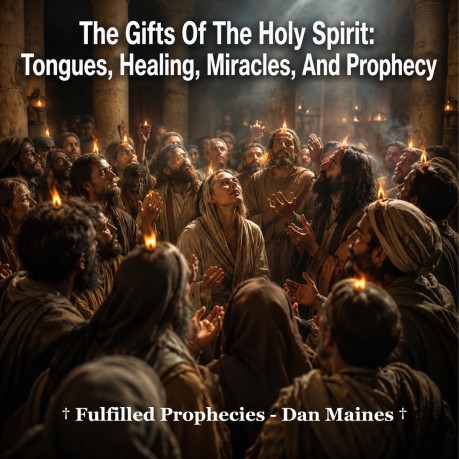
The Gifts Of The Holy Spirit:
Tongues, Healing, Miracles, And Prophecy Introduction Acts 2:1-4 1 Corinthians 14:27-28 1 Corinthians 13:8-10 Ephesians 4:11-13 Hebrews 2:3-4 Acts 8:14-18 1 Corinthians 12:7-11 1 Corinthians 14:29-33 2 Corinthians 12:12 Historical References How It Applies To Us Today Q & A Appendix Q: Are tongues today the same as the tongues in
Acts? Q: Should Christians pray for healing? Q: Can God heal someone today? Q: What about someone who says, God told me to
tell you something? Q: What if someone's personal prophecy later
comes true? Q: Does God still speak to us personally? Q: If miraculous gifts ceased, what do Christians
have now? † This is the fulfilled perspective we proclaim at
Fulfilled Prophecies † Source Index
By Dan Maines
† The gifts
of the Holy Spirit are among the most misunderstood subjects in the
church today. Churches claim tongues, miraculous healing, prophecy,
words of knowledge, visions, and direct personal messages from God.
The important question isn't whether people sincerely believe these
experiences are happening. The question is whether Scripture teaches
that these revelatory and miraculous gifts were intended to continue
throughout the entire Christian age.
† We
need to distinguish between the Holy Spirit Himself and the
miraculous gifts given by the Holy Spirit. The Holy Spirit hasn't
disappeared. God hasn't stopped working in His people. The question
is whether the miraculous signs that authenticated God's messengers
and revealed inspired truth were permanent features of the church.
†
The New Testament places these gifts within a specific period when
the gospel was being revealed, confirmed, and established. Before the
completed revelation of the New Covenant message, God gave apostles,
prophets, tongues, miraculous knowledge, healings, and other signs to
establish His truth (Hebrews 2:3-4).
† This
also means we shouldn't confuse God's providence with miraculous
gifts. We can pray for the sick. We can thank God when someone
recovers. We can trust God to guide our lives through His revealed
truth. None of that requires us to claim that someone possesses the
apostolic gift of healing or receives new revelation directly from
God (James 5:13-16).
When the day of Pentecost had
come, they were all together in one place. And suddenly a noise like
a violent rushing wind came from heaven, and it filled the whole
house where they were sitting. And tongues that looked like fire
appeared to them, distributing themselves, and a tongue rested on
each one of them. And they were all filled with the Holy Spirit and
began to speak with different tongues, as the Spirit was giving them
the ability to speak out.
† Biblical tongues
weren't meaningless sounds produced through emotional excitement.
Acts immediately explains that people from different nations heard
the disciples speaking in their own languages (Acts 2:6-11).
†
The speakers didn't learn these languages through normal study. The
Holy Spirit miraculously enabled them to speak languages they hadn't
previously known. That's what made the event a supernatural sign
(Acts 2:7-8).
† Pentecost was also connected
with the arrival of the last-days outpouring promised by Joel. Peter
didn't tell his audience that Joel's prophecy concerned Christians
thousands of years later. He said this was what had been spoken
through the prophet Joel (Acts 2:16-17).
†
Therefore, when someone today claims the biblical gift of tongues, we
have every right to compare that claim with the biblical example.
Experience doesn't define Scripture. Scripture evaluates experience
(1 John 4:1).
If anyone speaks in a
tongue, it must be by two or at the most three, and each one in turn,
and one is to interpret; but if there is no interpreter, he is to
keep silent in church; and have him speak to himself and to God.
†
Even when tongues were operating in the first-century church, they
weren't uncontrolled. Paul gave strict instructions governing their
use.
† There had to be interpretation.
Without an interpreter, the person speaking in a tongue was commanded
to remain silent in the assembly. That's very different from meetings
where many people speak simultaneously and nobody interprets (1
Corinthians 14:5, 9, 23).
† Paul repeatedly
emphasized understanding and edification. A supernatural gift wasn't
given so someone could display spirituality. Gifts were given for the
benefit and building up of the body (1 Corinthians 12:7).
†
This gives us an objective biblical test. A modern practice shouldn't
automatically be called biblical tongues simply because the people
participating in it are sincere.
Love never fails; but
if there are gifts of prophecy, they will be done away with; if there
are tongues, they will cease; if there is knowledge, it will be done
away with. For we know in part and prophesy in part; but when the
perfect comes, the partial will be done away with.
†
Paul directly says that prophecy, tongues, and miraculous knowledge
weren't permanent. Prophecies would be done away with, tongues would
cease, and supernatural knowledge would be done away with.
†
These gifts belonged to a period Paul described as knowing and
prophesying in part. The early church was living during the
transition from the old covenant age into the fully established New
Covenant order (Hebrews 8:13; 9:8-10).
† From
the fulfilled perspective, this fits the first-century transition
perfectly. The church possessed genuine spiritual gifts while God's
redemptive revelation and covenant transition were moving toward
their appointed completion (1 Corinthians 1:7-8).
†
We don't need continuing prophets to complete what God left
unfinished. The apostolic gospel was delivered, confirmed, and
entrusted to the church (Jude 3).
And He gave some as
apostles, some as prophets, some as evangelists, some as pastors and
teachers, for the equipping of the saints for the work of ministry,
for the building up of the body of Christ; until we all attain to the
unity of the faith, and of the knowledge of the Son of God, to a
mature man, to the measure of the stature which belongs to the
fullness of Christ.
† Apostles and prophets
had a foundational function. Paul had already said that God's
household was built on the foundation of the apostles and prophets,
with Christ Jesus Himself as the cornerstone (Ephesians 2:19-22).
†
A foundation isn't continually laid throughout the life of a
building. Once the foundation has accomplished its purpose, the
building continues on that established foundation.
†
The first-century apostles and prophets revealed and established the
New Covenant message. Christians today don't need another foundation,
another gospel, or another stream of inspired revelation (Galatians
1:8-9).
† Pastors and teachers can teach
God's revealed Word without claiming new inspired revelation.
Teaching what God has revealed isn't the same thing as receiving
additional revelation from God.
how will we escape if we
neglect so great a salvation? After it was at first spoken through
the Lord, it was confirmed to us by those who heard, God also
testifying with them, both by signs and wonders, and by various
miracles and by gifts of the Holy Spirit according to His own will.
†
Notice the purpose of the miraculous gifts. The salvation message was
spoken by the Lord and then confirmed by those who heard Him. God
testified with them through signs, wonders, miracles, and gifts of
the Holy Spirit.
† Miracles were God's
supernatural confirmation that His authorized messengers were
speaking His revelation. The signs confirmed the message and its
messengers (Mark 16:20).
† Once we understand
the purpose of the signs, we can understand why their absence today
doesn't mean God has abandoned His church. We possess the message
that those signs originally confirmed.
† We
don't need the foundation to be laid again in every generation. We
stand on the testimony that God already established through Christ
and His apostles.
Now when the apostles in
Jerusalem heard that Samaria had received the word of God, they sent
them Peter and John, who came down and prayed for them that they
would receive the Holy Spirit. (For He had not yet fallen upon any of
them; they had simply been baptized in the name of the Lord Jesus.)
Then they began laying their hands on them, and they were receiving
the Holy Spirit. Now when Simon saw that the Spirit was given through
the laying on of the apostles' hands, he offered them money,
†
This passage provides an important detail concerning miraculous
gifts. Simon saw that the Holy Spirit was given through the laying on
of the apostles' hands.
† Philip had already
preached in Samaria and performed miracles, yet Peter and John came
from Jerusalem and laid their hands on the believers (Acts 8:5-7,
14-17).
† The text doesn't describe an
endless chain in which every Christian who received a miraculous gift
could then transmit that ability to another generation. It
specifically draws attention to the apostles' hands.
†
Once the apostolic generation passed away, the biblical mechanism
associated with transmitting these gifts disappeared with it. This
fits their temporary foundational purpose.
But to each one is
given the manifestation of the Spirit for the common good. For to one
is given the word of wisdom through the Spirit, and to another the
word of knowledge according to the same Spirit; to another faith by
the same Spirit, and to another gifts of healing by the one Spirit,
and to another the effecting of miracles, and to another prophecy,
and to another the distinguishing of spirits, to another various
kinds of tongues, and to another the interpretation of tongues. But
one and the same Spirit works all these things, distributing to each
one individually just as He wills.
† These
were genuine supernatural gifts. Paul includes healings, miracles,
prophecy, tongues, interpretation, and supernatural knowledge among
manifestations of the Spirit.
† Biblical
healing wasn't simply someone feeling somewhat better after prayer.
Jesus and the apostles demonstrated unmistakable supernatural power.
The lame walked, the blind received sight, and even the dead were
raised (Acts 3:6-8; 9:36-42).
† That doesn't
mean Christians shouldn't pray when someone is sick. We absolutely
should pray. But answered prayer isn't the same thing as possessing
the first-century gift of healing.
† There's
also no biblical justification for blaming a sick Christian because a
supposed healer failed to heal them. The apostles didn't tell a lame
person that the miracle failed because he lacked enough faith. When
God performed these signs through His authorized servants, the
results demonstrated His power.
Have two or three
prophets speak, and have the others pass judgment. But if a
revelation is made to another who is seated, then the first one is to
keep silent. For you can all prophesy one by one, so that all may
learn and all may be exhorted; and the spirits of prophets are
subject to prophets; for God is not a God of confusion, but of peace.
As in all the churches of the saints,
† New
Testament prophecy involved revelation. Paul specifically says, if a
revelation is made to another. That's much stronger than having an
impression, intuition, feeling, or educated guess.
†
This is extremely important when discussing personal prophecy today.
Statements such as God told me to tell you, God showed me who you're
going to marry, God told me you're going to receive money, or God
gave me a word specifically for your future are claims of
revelation.
† If God actually revealed those
things, then God has spoken. The problem isn't solved by calling the
message personal instead of biblical. Revelation from God is
revelation from God.
† Christians should be
very careful about putting God's authority behind their personal
thoughts. We can give advice. We can share wisdom. We can encourage
someone. We can say what we believe would be wise. But we shouldn't
turn our thoughts into divine revelation by saying God told me when
God hasn't revealed it in Scripture (2 Timothy 3:16-17).
†
This protects Christians from spiritual manipulation. Nobody should
be able to control another person's marriage, finances, career,
family, or personal decisions simply by claiming to have received a
private message from God.
The distinguishing marks
of a true apostle were performed among you with all perseverance, by
signs, wonders, and miracles.
† Paul calls
these miraculous works signs of an apostle. That statement loses much
of its meaning if the same authenticating signs were intended to
remain ordinary throughout every generation.
†
The apostles occupied a unique position as eyewitnesses and
authorized representatives of Christ. Their signs helped authenticate
that authority (Acts 1:21-22).
† Today's
church doesn't have another generation of apostles equal to Peter,
John, and Paul. We have their inspired testimony preserved for us.
†
Our faith isn't weaker because we don't reproduce apostolic signs.
Our faith rests on Jesus Christ and the testimony God established
through His authorized witnesses (John 20:30-31).
†
Irenaeus, writing in the second century, described miraculous and
charismatic activity that he believed was still occurring among
Christians. His testimony is important because it shows that claims
of spiritual gifts didn't immediately disappear from Christian
history.
† Tertullian, writing in the late
second and early third centuries, also referred to prophetic and
charismatic experiences among Christians. Historical claims therefore
continued after the apostolic age.
† John
Chrysostom, writing in the fourth century, commented on 1 Corinthians
12 and indicated that the miraculous gifts described by Paul belonged
to an earlier period and were no longer familiar through ordinary
experience in his day.
† Augustine initially
spoke of miracles as belonging particularly to the establishment of
the church, although later in life he reported healings and
extraordinary events that he believed occurred in his own time.
†
History therefore shouldn't be oversimplified. There were
post-apostolic claims of miracles and spiritual manifestations, while
major Christian writers also recognized that the extraordinary
apostolic manifestations weren't operating in the same manner they
had in the New Testament.
† Historical
testimony can help us understand what Christians believed, but it
can't determine doctrine. Scripture remains the standard by which
every historical and modern claim must be tested.
†
We shouldn't deny the Holy Spirit simply because we deny that the
first-century miraculous gifts continue today. Those are two
completely different statements. Christians belong to Christ, walk by
the Spirit, bear the fruit of the Spirit, pray, worship, love, serve,
and grow spiritually (Galatians 5:22-25).
†
We should pray for people who are sick. We should pray with
confidence in God while recognizing that prayer doesn't give an
individual the apostolic gift of healing (James 5:16).
†
We shouldn't condemn every person who claims a spiritual gift as
intentionally dishonest. Many people sincerely interpret powerful
emotional or religious experiences according to what they've been
taught. Sincerity, however, isn't the biblical test of revelation (1
John 4:1).
† When someone claims to speak in
tongues, we should compare the practice with biblical tongues. When
someone claims the gift of healing, we should compare it with
biblical healing. When someone claims prophecy, we should compare it
with biblical prophecy.
† Personal prophecy
is particularly dangerous when someone says, God told me something
about you. That statement places divine authority behind a human
message. Christians shouldn't be pressured into life-changing
decisions because another person claims private revelation from God
(Colossians 2:18-19).
† God has already given
us His revealed truth. We don't need to chase prophets, visions,
secret messages, or new revelations to have a relationship with Him.
We can know Christ, study Scripture, pray, exercise wisdom, encourage
one another, and trust God's providential care.
†
The greatest evidence of the Spirit isn't an emotional display or a
spectacular claim. A life transformed by Christ, characterized by
love, joy, peace, patience, kindness, goodness, faithfulness,
gentleness, and self-control demonstrates the Spirit's work in God's
people (Galatians 5:22-23).
Q: Does
the Holy Spirit still work in Christians today?
A:
Yes. The ending of miraculous revelatory gifts doesn't mean the Holy
Spirit disappeared. Christians belong to Christ and are called to
walk by the Spirit and produce the fruit of the Spirit (Romans
8:9-14; Galatians 5:22-25).
A: The biblical gift was the supernatural
ability to speak actual languages the speaker hadn't learned. Acts
specifically says the listeners heard them speaking in their own
languages (Acts 2:6-11). Any modern claim should be evaluated against
that biblical description.
A:
Yes. Christians can and should pray for the sick (James 5:13-16). But
praying for healing isn't the same thing as possessing the miraculous
gift of healing demonstrated by Christ and the apostles.
A:
God is sovereign and can answer prayer according to His will. The
question isn't whether God has the power to heal. The question is
whether individuals today possess the supernatural gift of healing
that operated through Christ's authorized messengers (1 Corinthians
12:9; 2 Corinthians 12:12).
A: That person is claiming
revelation from God. We shouldn't accept that claim merely because
the person sounds sincere or spiritual. Christians are commanded to
test spiritual claims (1 John 4:1). God's revealed Word provides the
standard (2 Timothy 3:16-17).
A: A correct prediction by itself
doesn't establish someone as God's prophet. Scripture warns against
accepting a spiritual claim merely because something impressive
occurs (Deuteronomy 13:1-3). The message and messenger must be judged
according to God's revealed truth.
A:
God speaks to us through the truth He has revealed in Scripture. The
Holy Spirit can bring Scripture to our attention as we know and
remember it, and biblical truth shapes our wisdom, conscience,
decisions, and prayers. But we shouldn't turn thoughts, feelings,
dreams, impressions, or circumstances into new revelation by
claiming, God told me (2 Timothy 3:16-17; Hebrews 1:1-2).
A: We haven't been left with less
Christianity. We have Christ, the New Covenant, the completed
apostolic testimony, access to God, the indwelling Spirit, prayer,
fellowship, and the revealed gospel. The signs pointed to and
confirmed the reality that God's people now possess in Christ
(Hebrews 2:3-4; Ephesians 2:18-22).
© Fulfilled Prophecies - Dan
Maines.
† Acts
2:1-4; 1 Corinthians 14:27-28; 1 Corinthians 13:8-10; Ephesians
4:11-13; Hebrews 2:3-4; Acts 8:14-18; 1 Corinthians 12:7-11; 1
Corinthians 14:29-33; 2 Corinthians 12:12
†
Historical writers: Irenaeus; Tertullian; John Chrysostom; Augustine
Links