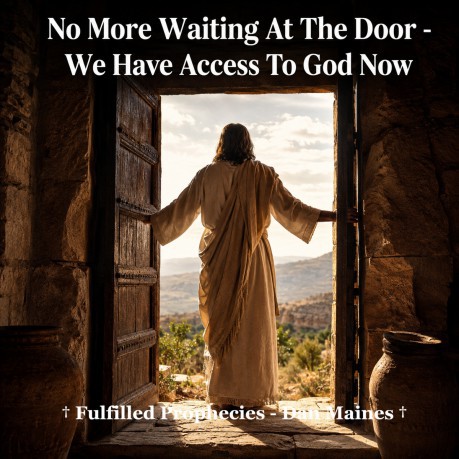
No More Waiting At The Door -
We Have Access To God Now Introduction Hebrews 9:8 Hebrews 9:11-12 Hebrews 9:24 Hebrews 10:19-22 Matthew 27:50-51 Ephesians 2:18 Ephesians 2:19-22 Hebrews 12:22-24 Revelation 21:3 Historical References How It Applies To Us Today Q & A Appendix Q: Didn't the veil tear when Jesus died around AD
30? Q: Do Christians need a rebuilt temple in
Jerusalem? Q: Do we need another priesthood to approach
God? Q: Are believers still waiting to gain access to
God? Q: Where is God's temple today? Q: What is the great message of this fulfilled
reality? † This is the fulfilled perspective we proclaim at
Fulfilled Prophecies † Source Index
By Dan Maines
† Under the
old covenant, access to God's presence was restricted. There were
priests, sacrifices, curtains, holy places, and a Most Holy Place
that ordinary worshipers couldn't enter. Even the high priest entered
the Most Holy Place only once each year, and he couldn't enter
without blood (Hebrews 9:6-7).
† Those
barriers weren't permanent. They were part of a covenant system
designed to point forward to Christ. The restricted sanctuary itself
was a divine object lesson showing that the way into God's presence
hadn't yet been fully revealed while that first tabernacle still had
its standing (Hebrews 9:8-10).
† Jesus didn't
come to renovate the old system. He accomplished what that system
anticipated. Through His sacrifice, believers received confidence to
enter God's presence, not through an earthly priesthood, but through
Jesus Himself (Hebrews 10:19-22).
† This is
one of the greatest blessings of the fulfilled New Covenant. We're
not standing outside waiting for another prophetic event to open the
door. Through Christ, the door has been opened. We have access to the
Father now (Ephesians 2:18).
The Holy Spirit is signifying
this, that the way into the holy place has not yet been disclosed
while the outer tabernacle is still standing,
†
Notice the inspired connection between access to God's presence and
the standing of the first tabernacle. The Holy Spirit was teaching
through the old sanctuary that unrestricted access hadn't yet been
fully revealed while that covenantal system remained in place
(Hebrews 9:8).
† This wasn't primarily about
God's physical location. God has never been confined inside a
building. The tabernacle represented covenantal access, and its
barriers visibly demonstrated the separation associated with the old
order (1 Kings 8:27; Hebrews 9:6-10).
† If
the first tabernacle represented restricted access, then the removal
of that covenantal order meant something tremendous. God's people
weren't destined to remain permanently outside. Christ was bringing
them into the reality toward which the sanctuary had always pointed
(Hebrews 9:11-12, 23-24).
But when Christ appeared as
a high priest of the good things having come, He entered through the
greater and more perfect tabernacle, not made by hands, that is, not
of this creation; and not through the blood of goats and calves, but
through His own blood, He entered the holy place once for all time,
having obtained eternal redemption.
† Jesus
entered the true holy place through His own blood. The repeated
sacrifices of animals couldn't accomplish what Christ accomplished
once for all (Hebrews 9:11-12).
† The
language is deliberate. The old priests repeatedly entered an earthly
sanctuary, but Jesus obtained eternal redemption. What the old
covenant pictured repeatedly, Christ accomplished decisively (Hebrews
9:24-26).
† Our access therefore doesn't
depend on another earthly temple, another Levitical priesthood, or
another animal sacrifice. Our High Priest has already entered, and
our redemption rests upon His completed work (Hebrews 7:24-27; 9:12).
For Christ did not enter a holy
place made by hands, a mere copy of the true one, but into heaven
itself, now to appear in the presence of God for us;
†
Jesus didn't enter another man-made sanctuary. He entered heaven
itself and appeared before God for His people. The earthly sanctuary
had always been a copy pointing toward a greater reality (Hebrews
8:1-5; 9:24).
† This is why rebuilding an
earthly temple could never improve what Christ accomplished. Going
back to shadows after the reality has arrived would be moving
backward, not forward (Colossians 2:16-17; Hebrews 10:1).
†
Our confidence isn't centered on Jerusalem, a temple building, or an
earthly priest. It's centered on Jesus Christ, our heavenly High
Priest and mediator of the New Covenant (Hebrews 8:6; 9:15).
Therefore, brothers and
sisters, since we have confidence to enter the holy place by the
blood of Jesus, by a new and living way which He inaugurated for us
through the veil, that is, through His flesh, and since we have a
great priest over the house of God, let's approach God with a sincere
heart in full assurance of faith, having our hearts sprinkled clean
from an evil conscience and our bodies washed with pure water.
†
The language has completely changed. Hebrews 9 described a system
announcing restricted access. Hebrews 10 tells believers to draw near
with confidence because Jesus opened a new and living way (Hebrews
9:8; 10:19-22).
† Under the old covenant, the
message was essentially stay back. Under Christ, the invitation is
draw near. That's the difference between the shadow and the reality,
between restricted access and access through the Son (Hebrews
4:14-16; 10:19-22).
† We don't approach God
because we're personally worthy. We approach because Christ's blood
is sufficient. Our confidence rests in what Jesus accomplished, not
in our ability to reproduce the old covenant system (Hebrews 9:14;
10:14).
And Jesus cried out again
with a loud voice, and gave up His spirit. And behold, the veil of
the temple was torn in two from top to bottom; and the earth shook
and the rocks were split.
† The tearing of
the temple veil at Jesus' death was a powerful sign. The barrier
associated with the Most Holy Place was torn from top to bottom at
the very moment Christ gave His life (Matthew 27:50-51).
†
The cross established the basis of access through Christ, while
Hebrews explains the covenantal transition during which the old
system was becoming obsolete and approaching its disappearance
(Hebrews 8:13; 9:8).
† The temple continued
physically after the cross, but its covenantal authority had been
surpassed by Christ. In AD 70 the old temple order was removed from
history, leaving no legitimate rival to the heavenly priesthood and
sanctuary established in Christ (Hebrews 8:1-2; 12:18-24).
for through Him we both have
our access in one Spirit to the Father.
†
Paul doesn't say believers will someday receive access after another
prophetic event. He says we have access. Through Christ, both Jew and
Gentile approach the same Father through the same Spirit (Ephesians
2:18).
† This destroys the idea that God's
people are still standing outside waiting for covenantal access to
arrive. Access was already being enjoyed through Christ as the New
Covenant community was being established (Ephesians 2:13-18).
†
There aren't two doors into God's presence, one for Jews and another
for Gentiles. There isn't an earthly route through Jerusalem and a
heavenly route through Christ. There is one access, through Christ,
in one Spirit, to the Father (Ephesians 2:18; John 14:6).
So then you are no longer
strangers and foreigners, but you are fellow citizens with the
saints, and are of God's household, having been built on the
foundation of the apostles and prophets, Christ Jesus Himself being
the cornerstone, in whom the whole building, being fitted together,
is growing into a holy temple in the Lord, in whom you also are being
built together into a dwelling of God in the Spirit.
†
God's people aren't described as waiting outside God's house. They're
members of His household. They're being built together as God's
dwelling place in the Spirit (Ephesians 2:19-22).
†
The New Covenant temple isn't constructed from stone. It's a people
united to Christ. God's presence among His people is therefore
greater than anything the old Jerusalem temple could provide (1
Corinthians 3:16; 1 Peter 2:4-5).
† This is
the movement of the biblical story, from restricted access under the
old covenant to fellowship with God through Christ. God's people
aren't waiting for another physical sanctuary because they themselves
are God's dwelling place in the Spirit (Ephesians 2:21-22).
But you have come to Mount
Zion and to the city of the living God, the heavenly Jerusalem, and
to myriads of angels, to the general assembly and church of the
firstborn who are enrolled in heaven, and to God, the Judge of all,
and to the spirits of the righteous made perfect, and to Jesus, the
mediator of a new covenant, and to the sprinkled blood, which speaks
better than the blood of Abel.
† Hebrews
doesn't tell these believers that someday they might come to Mount
Zion. It says they had come to the heavenly Jerusalem and to Jesus,
the mediator of the New Covenant (Hebrews 12:22-24).
†
This is the destination toward which the old covenant shadows were
pointing. God's people weren't being led toward another earthly
mountain and another earthly sanctuary. They were being brought to
heavenly Zion through Christ (Hebrews 12:18-24).
†
The contrast couldn't be stronger. Sinai represented fear, distance,
and restriction. Zion represents access, fellowship, citizenship, and
the completed mediation of Jesus Christ (Hebrews 12:18-24).
And I heard a loud voice
from the throne, saying, Behold, the tabernacle of God is among the
people, and He will dwell among them, and they shall be His people,
and God Himself will be among them,
† The
Bible's covenantal story reaches its glorious goal with God dwelling
with His people. What the tabernacle foreshadowed becomes the reality
of New Covenant fellowship (Revelation 21:3).
†
Revelation's New Jerusalem isn't a return to old covenant separation.
The city represents the completed covenantal order in which God's
dwelling is with His people and the former order has passed away
(Revelation 21:1-4).
† We aren't waiting
outside the door hoping someday God will invite us inside. In Christ,
God's people have access, citizenship, fellowship, and His presence.
The shadows have given way to the reality (Hebrews 10:19-22;
Ephesians 2:18-22).
†
Josephus described the Jerusalem temple with its successive courts,
restricted areas, priestly boundaries, and sacred sanctuary. His
description demonstrates how visibly the temple system communicated
degrees of access and separation in first-century Jewish worship
(Josephus, The Wars of the Jews, Book 5, Chapter 5).
†
Josephus also recorded the catastrophic destruction of Jerusalem and
the temple in AD 70. The physical center of the old sacrificial
system was consumed and demolished during the Roman siege (Josephus,
The Wars of the Jews, Book 6, Chapters 4-5).
†
Tacitus described the Roman siege of Jerusalem under Titus and
identified the temple as the central stronghold of the city. His
Roman account independently confirms the historical setting in which
Jerusalem and its temple fell (Tacitus, Histories, Book 5).
†
Eusebius later connected Jerusalem's catastrophe with the generation
that rejected Christ and recorded the tradition that believers in
Jerusalem departed before the city's destruction (Eusebius,
Ecclesiastical History, Book 3, Chapters 5-7).
†
These historical witnesses don't establish our doctrine, Scripture
does. They provide historical confirmation that the first-century
temple order that formed the background of Hebrews disappeared in the
catastrophe of AD 70 (Hebrews 8:13; 9:8).
†
We don't have to live as though we're spiritually standing outside a
locked door. Through Jesus Christ, we have access to the Father now
(Ephesians 2:18).
† We don't need an earthly
priest to bring us into God's presence. Jesus is our great High
Priest, and through Him we can draw near with confidence (Hebrews
4:14-16; 10:19-22).
† We don't need another
temple in Jerusalem. God's people are His temple and His dwelling
place in the Spirit (Ephesians 2:19-22).
† We
don't need another animal sacrifice. Jesus offered the sacrifice that
accomplished what the blood of animals never could, and His sacrifice
doesn't need to be repeated (Hebrews 9:11-14; 10:10-14).
†
We don't need to wait for another covenant age to arrive. Christ is
the mediator of the New Covenant, and God's people belong to heavenly
Jerusalem (Hebrews 12:22-24).
† When we pray,
we're not shouting toward a distant God from outside the sanctuary.
We approach our Father through Christ with confidence because the way
has been opened (Hebrews 4:16; 10:19-22).
†
The gospel isn't a message telling God's people to wait at the door.
It's the announcement that through Jesus Christ the barrier has been
removed, reconciliation has been accomplished, and access to the
Father is ours.
† No more waiting at the
door. No more old covenant barriers. No more earthly priest standing
between God's people and their Father. No more wondering when the way
will finally be opened. Through Jesus Christ, we have access to God
now (Ephesians 2:18).
Q: Does
Hebrews 9:8 mean nobody could have any relationship with God before
AD 70?
A: No. Faithful people knew God long
before AD 70. Hebrews is discussing covenantal access represented by
the sanctuary system and the transition from the old covenant order
to the full reality established through Christ (Hebrews 9:8-12).
A: Yes. The tearing of the veil
demonstrated what Christ's sacrifice accomplished and announced the
opening of the way through Him. The old covenant system nevertheless
continued through the transition period until its approaching
disappearance, historically culminating in the temple's destruction
in AD 70 (Matthew 27:50-51; Hebrews 8:13).
A: No. Jesus entered the true
heavenly sanctuary, and believers themselves are God's dwelling place
through the Spirit (Hebrews 9:24; Ephesians 2:19-22).
A: No. Jesus permanently holds His
priesthood and is able to save completely those who approach God
through Him (Hebrews 7:24-25).
A: No. Paul says through Christ we have
access in one Spirit to the Father, and Hebrews tells believers to
draw near with confidence (Ephesians 2:18; Hebrews 10:19-22).
A:
God's people are being built together as His dwelling place in the
Spirit. The New Covenant temple is a people in Christ, not another
stone sanctuary waiting to be constructed in Jerusalem (Ephesians
2:19-22; 1 Peter 2:4-5).
A: The door isn't closed. The way
isn't waiting to be revealed. Jesus has accomplished redemption, He
is our High Priest, and through Him we have access to our Father
(Hebrews 9:12; 10:19-22; Ephesians 2:18).
© Fulfilled Prophecies - Dan
Maines.
† Hebrews
9:8; Hebrews 9:11-12; Hebrews 9:24; Hebrews 10:19-22; Matthew
27:50-51; Ephesians 2:18; Ephesians 2:19-22; Hebrews 12:22-24;
Revelation 21:3
† Josephus, The Wars of the
Jews, Book 5, Chapter 5; Book 6, Chapters 4-5; Tacitus, Histories,
Book 5; Eusebius, Ecclesiastical History, Book 3, Chapters 5-7
Links