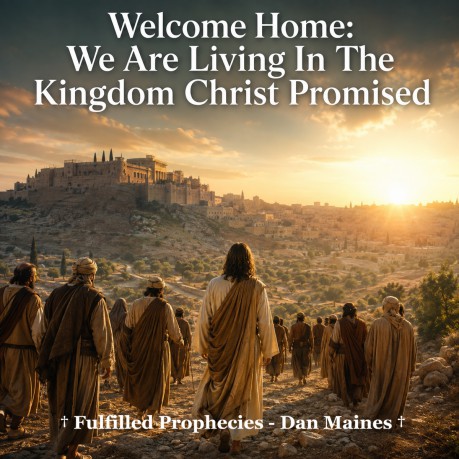
Welcome Home: We Are Living
In The Kingdom Christ Promised Introduction Colossians 1:12-13 Hebrews 12:28 Revelation 1:5-6 Luke 17:20-21 Daniel 7:13-14 1 Corinthians 15:24-25 Hebrews 12:22-24 Historical References How It Applies To Us Today Q & A Appendix Q: Does the Kingdom require Jesus to sit on a
physical throne in modern Jerusalem? Q: Is the Kingdom merely something inside an
individual's heart? Q: If Christ reigns now, why does evil still
exist? Q: Where is the Jerusalem that belongs to the New
Covenant? Q: What should fulfilled prophecy produce in
Christians today? Q: What is the message Christians should hear
about Christ's Kingdom? † This is the fulfilled perspective we proclaim at
Fulfilled Prophecies † Source Index
By Dan Maines
† For
generations, Christians have been told to look toward the future for
the Kingdom of God, as though Christ established a promise that His
people still haven't entered.
† But the New
Testament doesn't describe believers as standing outside the Kingdom
waiting for admission. It describes them as already transferred into
it, receiving it, serving within it, and reigning with Christ.
†
Jesus didn't fail to establish the Kingdom He promised. He received
His Kingdom, defeated His enemies, established the New Covenant, and
brought His people into a Kingdom that can't be shaken.
†
The message of fulfilled prophecy isn't, Keep waiting for the
Kingdom. The message is, Welcome home, the King reigns, the Kingdom
has come, and we're living in what Christ promised.
†
This doesn't mean every person recognizes Christ's authority. It
means Christ possesses all authority and His Kingdom is the present
covenant reality of His people (Matthew 28:18; 1 Corinthians 15:25;
Ephesians 1:20-22).
† We aren't waiting for
Jesus to become King. We're living under the reign of the King who
has already been enthroned.
giving thanks to the
Father, who has qualified us to share in the inheritance of the
saints in light. For He rescued us from the domain of darkness, and
transferred us to the kingdom of His beloved Son,
†
Paul didn't say believers would someday be translated into Christ's
Kingdom. He said God had already delivered them from the authority of
darkness and transferred them into the Kingdom of His Son.
†
The language is accomplished, not postponed. Their citizenship had
changed because their covenant standing had changed (Philippians
3:20; Ephesians 2:19).
† If first-century
Christians were already in Christ's Kingdom, the Kingdom can't be
something that has remained entirely future for the last two thousand
years.
† Salvation isn't merely rescue from
something. It's entrance into something, we've been rescued from
darkness and brought under the gracious reign of God's Son (Acts
26:18; Romans 6:14).
† Christians don't need
to spend their lives searching the prophetic horizon for a Kingdom
God says they've already entered.
Therefore, since we receive a
kingdom which cannot be shaken, let's show gratitude, by which we may
offer to God an acceptable service with reverence and awe;
†
Hebrews doesn't tell believers to wait thousands of years for an
earthly political Kingdom. It says they were receiving a Kingdom that
can't be shaken.
† The surrounding context
contrasts what could be shaken with what would remain. The old
covenant order was being removed while the unshakable Kingdom
remained (Hebrews 12:26-27).
† This Kingdom
doesn't depend upon earthly governments, geographical borders,
military power, temples made with hands, or political control (John
18:36; Acts 17:24).
† That's why the
destruction of Jerusalem couldn't destroy Christ's Kingdom. The
shaking removed the temporary covenant order, but what God
established through Christ remained.
† We're
living in that unshakable Kingdom today. Empires rise and fall,
nations change, governments collapse, but the reign of Christ
continues.
and from Jesus Christ, the
faithful witness, the firstborn of the dead, and the ruler of the
kings of the earth. To Him who loves us and released us from our sins
by His blood - and He made us into a kingdom, priests to His God and
Father-to Him be the glory and the dominion forever and ever. Amen.
†
Revelation begins by identifying Jesus as the ruler of the kings of
the earth. John didn't introduce Jesus as someone waiting to receive
authority at the end of human history.
†
Christ had already made His people a Kingdom and priests. Their
identity wasn't merely a future promise, it was their present
standing in Christ (1 Peter 2:5, 9).
†
Revelation therefore begins with Kingdom reality before describing
the judgments that were soon to take place (Revelation 1:1, 3).
†
The King was reigning while the old covenant world approached
judgment. The Kingdom didn't need Jerusalem's earthly throne because
Christ's throne was heavenly (Acts 2:30-36; Hebrews 8:1).
†
We aren't waiting to become the people of the Kingdom. In Christ, we
already belong to the royal priesthood of the Kingdom He established.
Now He was questioned by the
Pharisees as to when the kingdom of God was coming, and He answered
them and said, “The kingdom of God is not coming with signs that
can be observed; nor will they say, 'Look, here it is!' or, 'There it
is!' For behold, the kingdom of God is in your midst.
†
Jesus directly challenged the expectation that God's Kingdom would
arrive as an observable political revolution.
†
The Pharisees were looking for something that could be identified
through outward political signs, but Jesus explained that God's
Kingdom wasn't arriving according to their expectations.
†
This is why searching for a modern political nation, rebuilt temple,
earthly throne, or future world government misses the nature of the
Kingdom Jesus described (John 4:21-24; John 18:36).
†
Christ's Kingdom is real without being another earthly empire. His
authority is greater than earthly kingdoms precisely because His
reign isn't dependent upon them.
† The
Kingdom advances through the rule of Christ in His people, not
through geographical expansion enforced by human armies (Matthew
28:18-20).
I kept looking in the night
visions, And behold, with the clouds of heaven One like a son of man
was coming, And He came up to the Ancient of Days And was presented
before Him. And to Him was given dominion, Honor, and a kingdom, So
that all the peoples, nations, and populations of all languages Might
serve Him. His dominion is an everlasting dominion Which will not
pass away; And His kingdom is one Which will not be destroyed.
†
Daniel's vision shows the Son of Man coming to the Ancient of Days
and receiving dominion, glory, and a Kingdom.
†
The direction matters. The Son of Man comes to the Ancient of Days.
This is enthronement language, pointing to Christ receiving royal
authority rather than describing Christ leaving heaven to establish a
temporary earthly government (Acts 1:9; Acts 2:33-36).
†
Jesus deliberately used Daniel's Son of Man language concerning His
authority and vindication (Matthew 26:64).
†
Daniel says this Kingdom won't pass away and won't be destroyed.
That's the same unshakable Kingdom described in Hebrews (Hebrews
12:28).
† Christ doesn't need another throne.
He possesses the everlasting dominion promised by Daniel.
then comes the end,
when He hands over the kingdom to our God and Father, when He has
abolished all rule and all authority and power. For He must reign
until He has put all His enemies under His feet.
†
Paul said Christ must reign until His enemies were placed beneath His
feet. The reign wasn't waiting to begin after the enemies were
defeated, the reign was the means through which they were being
subdued.
† Paul wrote about Christ's reign as
an existing reality, not merely as a distant future administration
(Psalm 110:1; Acts 2:34-36).
† This destroys
the idea that Jesus must someday return to earth before He can begin
reigning. The apostles proclaimed an enthroned Christ who was already
exercising royal authority.
† Christ's
Kingdom isn't evidence that the world has become perfect. His Kingdom
means that the rightful King reigns even while His gospel continues
reaching people and transforming lives.
† Our
confidence isn't based on what governments are doing. It's based on
who occupies the throne.
But you have come to Mount
Zion and to the city of the living God, the heavenly Jerusalem, and
to myriads of angels, to the general assembly and church of the
firstborn who are enrolled in heaven, and to God, the Judge of all,
and to the spirits of the righteous made perfect, and to Jesus, the
mediator of a new covenant, and to the sprinkled blood, which speaks
better than the blood of Abel.
† Notice the
words, you have come. Hebrews doesn't say Christians will someday
come to Mount Zion and heavenly Jerusalem. They had already
approached the spiritual reality represented by those things.
†
The destination wasn't another earthly Jerusalem. It was the heavenly
Jerusalem, the city associated with the New Covenant and the reign of
Christ (Galatians 4:26; Revelation 21:2).
†
This means the Christian life isn't a journey toward an unestablished
Kingdom. It's life within the covenant reality Christ opened through
His blood.
† Jesus is already the mediator of
the New Covenant, God's people already belong to heavenly Jerusalem,
and the Kingdom they received can't be shaken.
†
Welcome home isn't sentimental language. It's covenant language.
Through Christ, God's people have been brought home to God.
†
Josephus described the catastrophic destruction of Jerusalem and the
temple in AD 70, recording the collapse of the Jewish city and
sanctuary after the Roman siege (Josephus, Wars of the Jews, Books
5-7).
† That historical destruction is
significant because Jesus had connected Jerusalem's approaching
desolation with judgment upon that generation (Matthew 23:36-38; Luke
21:20-22, 32).
† Eusebius later recorded the
tradition that believers in Jerusalem left the city for Pella before
the war, connecting the early Christian community with the warnings
surrounding Jerusalem's approaching destruction (Eusebius,
Ecclesiastical History, Book 3, Chapter 5).
†
These historical witnesses don't establish doctrine, Scripture does.
But they confirm that Jerusalem and its temple experienced the
first-century catastrophe Jesus had warned His contemporaries
about.
† The temple fell, the city fell, and
the old covenant center disappeared, but Christ's Kingdom didn't
fall. History demonstrated the difference between the kingdom that
could be shaken and the Kingdom that couldn't be shaken (Hebrews
12:27-28).
†
We don't wake up every morning waiting for Jesus to become King. We
wake up knowing Jesus is King.
† We don't
pray as spiritual outsiders hoping someday to become citizens. In
Christ, we're already members of God's household and citizens of His
Kingdom (Ephesians 2:19; Colossians 1:13).
†
We don't need fear-driven prophecy teaching that makes every war,
election, earthquake, technological development, or political crisis
into evidence that Christ's Kingdom still hasn't arrived.
†
Our King isn't nervous about tomorrow. His throne isn't threatened by
elections, nations, economies, armies, or world events (Psalm 2:1-6;
Hebrews 1:8).
† We can live with joy because
the Kingdom isn't hanging in the balance. Christ has already received
everlasting dominion.
† We can serve with
confidence because we're receiving a Kingdom that can't be shaken.
†
We can love people without fear because darkness doesn't possess
ultimate authority. Christ does.
† We can
preach the gospel with hope because Jesus possesses all authority in
heaven and on earth (Matthew 28:18-20).
† We
can stop living like spiritual refugees waiting for God to build us a
home. In Christ, we've come to Mount Zion, heavenly Jerusalem, and
the city of the living God.
† The Christian
message isn't, Hold on until the Kingdom finally gets here.
†
It's, Welcome home.
† The King reigns.
†
The New Covenant stands.
† The Kingdom can't
be shaken.
† We've been transferred into the
Kingdom of God's beloved Son, and we can live today with confidence,
purpose, peace, and great joy.
Q: Are
Christians still waiting to enter the Kingdom?
A:
No. Paul said believers had already been transferred into the Kingdom
of God's Son (Colossians 1:13).
A: No. The
New Testament presents Christ as already enthroned at God's right
hand and reigning over His enemies (Acts 2:33-36; 1 Corinthians
15:25).
A: No. Christ's Kingdom is
His real rule and authority. Believers participate in that Kingdom,
but His reign extends far beyond an individual's feelings or private
spiritual experience (Daniel 7:13-14; Matthew 28:18).
A: Christ's reign doesn't mean every
person voluntarily submits to Him. It means Jesus possesses supreme
authority and His everlasting Kingdom can't be destroyed (Daniel
7:14; Hebrews 12:28).
A: Hebrews identifies it as heavenly
Jerusalem, and Paul calls Jerusalem above our mother (Hebrews 12:22;
Galatians 4:26).
A: Confidence, worship,
service, peace, and joy. We've received a Kingdom that can't be
shaken, so we're called to serve God with gratitude (Hebrews 12:28).
A: Welcome home. Christ
reigns, His New Covenant Kingdom stands, and believers have already
been transferred into the Kingdom of God's beloved Son (Colossians
1:13; Revelation 1:5-6).
© Fulfilled Prophecies - Dan
Maines.
† Colossians
1:12-13; Hebrews 12:28; Revelation 1:5-6; Luke 17:20-21; Daniel
7:13-14; 1 Corinthians 15:24-25; Hebrews 12:22-24
†
Josephus, Wars of the Jews, Books 5-7; Eusebius, Ecclesiastical
History, Book 3, Chapter 5
Links