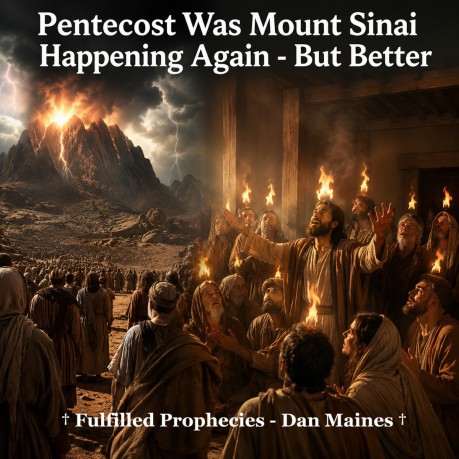
Pentecost Was Mount Sinai
Happening Again - But Better Introduction Exodus 19:16-19 Exodus 24:7-8 Exodus 32:27-28 Jeremiah 31:31-33 Acts 2:1-4 Acts 2:16-18 Acts 2:36-39 Acts 2:41-42 2 Corinthians 3:6-8 Hebrews 12:18-24 Historical References How It Applies To Us Today Q & A Appendix Q: Why is the number 3,000 important? Q: Were the tongues at Pentecost actual
languages? Q: Did Pentecost fulfill Old Testament
prophecy? Q: Did Pentecost mean the Old Covenant had
completely disappeared that same day? Q: Where are God's people gathered now? † This is the fulfilled perspective we proclaim at
Fulfilled Prophecies †
By Dan Maines
† Pentecost
wasn't an isolated miracle dropped into the book of Acts without an
Old Testament background.
† Acts 2
deliberately echoes Mount Sinai, but Pentecost reveals something
greater than what happened at the mountain.
†
At Sinai there was fire, the voice of God, covenant, and a people
being constituted before God. At Pentecost there was fire, inspired
languages, the Holy Spirit, the New Covenant, and a people being
gathered into Christ.
† One of the most
striking contrasts is numerical. After the covenant at Sinai was
violated, about 3,000 people died. At Pentecost, about 3,000 people
received the word and were added.
† The
contrast is powerful. Sinai exposes the judgment associated with
covenant rebellion, while Pentecost announces the life and salvation
found in Christ.
† Pentecost was Mount Sinai
happening again, but better, because everything Sinai anticipated was
reaching its greater reality in Jesus Christ and the New Covenant.
So it came about on the
third day, when it was morning, that there were thunder and lightning
flashes and a thick cloud over the mountain and a very loud trumpet
sound, so that all the people who were in the camp trembled. And
Moses brought the people out of the camp to meet God, and they stood
at the foot of the mountain. Now Mount Sinai was all in smoke
because the Lord descended upon it in fire; and its smoke ascended
like the smoke of a furnace, and the entire mountain quaked
violently. When the sound of the trumpet grew louder and louder,
Moses spoke, and God answered him with thunder.
†
Sinai was a visible manifestation of God's presence. Fire descended,
the mountain shook, and God spoke to the people through Moses.
†
The people were gathered before God as He established His covenant
relationship with Israel (Exodus 19:3-6).
†
Keep those details in mind, gathering, divine presence, fire, God's
voice, and covenant. Acts 2 will bring those themes together again in
a greater way.
Then he took the Book of the
Covenant and read it as the people listened; and they said, "All
that the Lord has spoken we will do, and we will be obedient!"
So Moses took the blood and sprinkled it on the people, and said,
"Behold the blood of the covenant, which the Lord has made with
you in accordance with all these words."
†
Sinai wasn't merely a spectacular display of power. It was covenant
making.
† Israel stood before God as His
covenant people, and the covenant was confirmed with blood.
†
Jesus later identified His own blood with the New Covenant, showing
that something greater than Sinai was being established through Him
(Matthew 26:28; Luke 22:20).
† Pentecost
therefore shouldn't be separated from covenant fulfillment. The
Spirit was being poured out upon the people of the New Covenant
established through Christ.
And he said to them, "This
is what the Lord, the God of Israel says: 'Every man of you put his
sword on his thigh, and go back and forth from gate to gate in the
camp, and kill every man his brother, and every man his friend, and
every man his neighbor.'" So the sons of Levi did as Moses
instructed, and about three thousand men of the people fell that
day.
† Israel broke the covenant almost
immediately through the sin of the golden calf.
†
The result was judgment, and about 3,000 people fell that day.
†
That number becomes extremely important when we arrive at Acts 2.
†
Luke records another event involving about 3,000 people, but this
time they aren't falling under covenant judgment. They're receiving
the word and being added to the community of Christ.
†
The correspondence is difficult to miss. About 3,000 fell in the
aftermath of Sinai's covenant rebellion, while about 3,000 received
the word at Pentecost.
"Behold, days are
coming," declares the Lord, "when I will make a new
covenant with the house of Israel and the house of Judah, not like
the covenant which I made with their fathers on the day I took them
by the hand to bring them out of the land of Egypt, My covenant which
they broke, although I was a husband to them," declares the
Lord. "For this is the covenant which I will make with the house
of Israel after those days," declares the Lord: "I will put
My law within them and write it on their heart; and I will be their
God, and they shall be My people.
† Jeremiah
explicitly contrasted the coming New Covenant with the covenant
associated with the Exodus and Sinai.
† The
problem wasn't God's faithfulness. The people broke the covenant.
†
The promised solution was a New Covenant in which God's work would
reach inward, into the heart of His people.
†
This prepares us for Pentecost. The New Covenant wouldn't simply
place commands before people externally. God would give His Spirit to
His people (Ezekiel 36:26-27).
† What Sinai
anticipated externally, the New Covenant brought to its greater
spiritual reality through Christ.
When the day of Pentecost had
come, they were all together in one place. And suddenly a noise like
a violent rushing wind came from heaven, and it filled the whole
house where they were sitting. And tongues that looked like fire
appeared to them, distributing themselves, and a tongue rested on
each one of them. And they were all filled with the Holy Spirit and
began to speak with different tongues, as the Spirit was giving them
the ability to speak out.
† The similarities
with Sinai are remarkable. God's people were assembled, heaven acted,
supernatural sound accompanied the event, fire appeared, and God
communicated His message.
† But there was an
important difference. At Sinai the fire descended upon the mountain.
At Pentecost the fire rested upon the people.
†
God's presence was no longer being pictured as centered upon a
physical mountain or sanctuary. His people were becoming His dwelling
through the Spirit (Ephesians 2:21-22).
† The
languages weren't meaningless noise. People from different nations
heard the mighty works of God in their own languages (Acts 2:5-11).
†
Sinai had God's voice associated with the formation of Old Covenant
Israel. Pentecost had Spirit-empowered proclamation associated with
the formation of the New Covenant people in Christ.
but this is what has been
spoken through the prophet Joel: 'And it shall be in the last days,'
God says, 'That I will pour out My Spirit on all mankind; And your
sons and your daughters will prophesy, And your young men will see
visions, And your old men will have dreams; And even on My male and
female servants I will pour out My Spirit in those days, And they
will prophesy.
† Peter didn't tell his
audience that Joel's prophecy concerned people thousands of years in
their future. He said, this is that.
†
Pentecost was fulfillment taking place before their eyes.
†
The Spirit was being poured out during the last days of the Old
Covenant age as the New Covenant order was being revealed and
established (Hebrews 1:1-2; Hebrews 8:13).
†
The people standing before Peter were witnessing the promised
transition from the covenant centered upon Moses to the covenant
centered upon Christ.
Therefore let all the house of
Israel know for certain that God has made Him both Lord and
Christ-this Jesus whom you crucified." Now when they heard this,
they were pierced to the heart, and said to Peter and the rest of the
apostles, "Brothers, what are we to do?" Peter said to
them, "Repent, and each of you be baptized in the name of Jesus
Christ for the forgiveness of your sins; and you will receive the
gift of the Holy Spirit. For the promise is for you and your children
and for all who are far away, as many as the Lord our God will call
to Himself."
† Notice where the message
struck them, they were pierced in their hearts.
†
Jeremiah had promised a New Covenant involving the heart, and
Pentecost displays that covenant transformation.
†
Peter's message centered completely upon Jesus as Lord and Christ.
†
Moses was the mediator at Sinai, but Jesus is the mediator of the
better covenant (Hebrews 8:6; Hebrews 9:15).
†
The promise of the Spirit confirmed that the promised New Covenant
age was arriving through Christ.
So then, those who had received
his word were baptized; and that day there were added about three
thousand souls. They were continually devoting themselves to the
apostles' teaching and to fellowship, to the breaking of bread and to
prayer.
† Here is the stunning contrast with
Exodus 32. About 3,000 fell after Israel's covenant rebellion at
Sinai, while about 3,000 received the word and were added at
Pentecost.
† At Sinai, about 3,000
experienced judgment. At Pentecost, about 3,000 received the
gospel.
† The parallel highlights the
superiority of what God was accomplishing through Christ.
†
Pentecost wasn't simply the birthday of an institution disconnected
from Israel's story. It was part of the fulfillment of Israel's
covenant promises through Jesus Christ.
† God
was gathering the faithful remnant of Israel first, and the gospel
would then continue outward to the nations (Acts 1:8; Romans 1:16).
†
The New Covenant people were being gathered around Jesus, filled with
the Spirit, instructed by the apostles, and joined together in
fellowship.
who also made us
adequate as servants of a new covenant, not of the letter but of the
Spirit; for the letter kills, but the Spirit gives life. But if the
ministry of death, engraved in letters on stones, came with glory so
that the sons of Israel could not look intently at the face of Moses
because of the glory of his face, fading as it was, how will the
ministry of the Spirit fail to be even more with glory?
†
Paul gives us the theological contrast behind Sinai and the New
Covenant.
† The covenant written on stones
had glory, but that glory was temporary and passing away.
†
The ministry of the Spirit possessed greater glory because it
belonged to the New Covenant reality established through Christ.
†
This makes the contrast between the two groups of about 3,000 even
more meaningful. The old ministry exposed sin and brought
condemnation, while the New Covenant ministry proclaimed
righteousness and life (2 Corinthians 3:9).
†
Pentecost wasn't God repairing Sinai. It was God bringing His
covenant purpose to its intended fulfillment in Christ.
For you have not come to a
mountain that can be touched and to a blazing fire, and to darkness
and gloom and whirlwind, and to the blast of a trumpet and the sound
of words, which sound was such that those who heard begged that no
further word be spoken to them. For they could not cope with the
command, "If even an animal touches the mountain, it shall be
stoned." And so terrible was the sight, that Moses said, "I
am terrified and trembling." But you have come to Mount Zion and
to the city of the living God, the heavenly Jerusalem, and to myriads
of angels, to the general assembly and church of the firstborn who
are enrolled in heaven, and to God, the Judge of all, and to the
spirits of the righteous made perfect, and to Jesus, the mediator of
a new covenant, and to the sprinkled blood, which speaks better than
the blood of Abel.
† Hebrews makes the
contrast unmistakable. Christians haven't come to the physical
mountain of Sinai. We've come to Mount Zion and the heavenly
Jerusalem.
† Sinai could be touched. The Zion
of the New Covenant is heavenly.
† Sinai
produced fear and separation. Through Jesus, God's people have access
to the heavenly assembly and the presence of God.
†
Moses stood as mediator at Sinai. Jesus stands as mediator of the New
Covenant.
† Everything is better, the
mountain is better, the city is better, the mediator is better, the
blood is better, and the covenant is better.
†
Pentecost belongs to this movement from Sinai to Zion, from Moses to
Christ, and from the Old Covenant order to the New Covenant kingdom.
†
Josephus describes Pentecost as one of the great Jewish pilgrimage
festivals when large numbers of Jews gathered at Jerusalem, helping
explain why Acts records Jews from many regions present when the
Spirit was poured out. Josephus, Antiquities of the Jews, Book 14,
Chapter 13.
† Josephus also records the
importance of the Jewish pilgrimage festivals and the enormous
gatherings associated with them. This historical setting agrees with
Acts 2, where Jews from many nations were gathered in Jerusalem.
Josephus, Wars of the Jews, Book 2, Chapter 3.
†
Philo of Alexandria associated the giving of the Law at Sinai with
extraordinary divine communication and described God's voice in
striking supernatural terms. His description shows that Jewish
readers already connected Sinai with God's powerful public
revelation. Philo, On the Decalogue, 32-35.
†
Early Christian writer Irenaeus connected the giving of the Holy
Spirit with the gathering of people from many nations into unity
through Christ. Irenaeus, Against Heresies, Book 3, Chapter 17.
†
These historical witnesses don't establish the doctrine, Scripture
does. They help us understand the Jewish festival setting and how
ancient Jewish and Christian writers understood Sinai, Pentecost, and
the gathering of God's people.
†
We don't stand trembling at the base of Sinai waiting for another
covenant. We belong to the New Covenant established by Jesus
Christ.
† We don't need another Pentecost.
The Spirit was poured out exactly as the prophets promised, and the
New Covenant kingdom was established through Christ.
†
We don't approach God through Moses, the Levitical priesthood, an
earthly temple, or a physical mountain. We come to God through Jesus,
the mediator of the New Covenant (Hebrews 12:22-24).
†
Pentecost reminds us that Christianity isn't God's backup plan after
Israel failed. Christ was the destination toward which the covenant
story was moving.
† Sinai pointed forward.
Pentecost announced fulfillment. The approximately 3,000 who fell and
the approximately 3,000 who received the word form a powerful picture
of judgment giving way to the life announced through the gospel.
†
We now live on the fulfilled side of that covenant transition. Our
citizenship is in the heavenly Jerusalem, our mediator is Jesus
Christ, and our access to God is through Him.
Q: Was
Pentecost literally another Mount Sinai?
A: No.
Pentecost wasn't a second geographical Sinai. Acts 2 intentionally
contains themes that strongly echo Sinai, including gathering, divine
manifestation, fire, God's communication, and covenant formation. The
New Testament then explicitly contrasts Sinai with the New Covenant
Mount Zion (Hebrews 12:18-24).
A:
Exodus records about 3,000 falling after the golden calf rebellion,
while Acts records about 3,000 receiving the word and being added at
Pentecost (Exodus 32:28; Acts 2:41). The contrast fits the New
Testament distinction between the ministry associated with death and
the greater ministry of the Spirit (2 Corinthians 3:6-8).
A: Yes. The people heard the
disciples speaking in their own languages about the mighty works of
God (Acts 2:6-11).
A: Yes. Peter directly identified
what was happening by saying, this is that which had been spoken
through Joel (Acts 2:16-18).
A: No.
The New Covenant had been established through Christ, but the Old
Covenant order was still growing old and approaching its final
disappearance during that first-century transition (Hebrews 8:13).
Its earthly temple system remained until Jerusalem and the temple
were destroyed in AD 70.
A:
Hebrews says believers have come to Mount Zion, the city of the
living God, the heavenly Jerusalem, and to Jesus the mediator of the
New Covenant (Hebrews 12:22-24).
© Fulfilled Prophecies - Dan
Maines.
Source Index
†
Exodus 19:16-19; Exodus 24:7-8; Exodus 32:27-28; Jeremiah 31:31-33;
Acts 2:1-4; Acts 2:16-18; Acts 2:36-39; Acts 2:41-42; 2 Corinthians
3:6-8; Hebrews 12:18-24
† Josephus,
Antiquities of the Jews, Book 14, Chapter 13; Josephus, Wars of the
Jews, Book 2, Chapter 3; Philo, On the Decalogue, 32-35; Irenaeus,
Against Heresies, Book 3, Chapter 17
Links