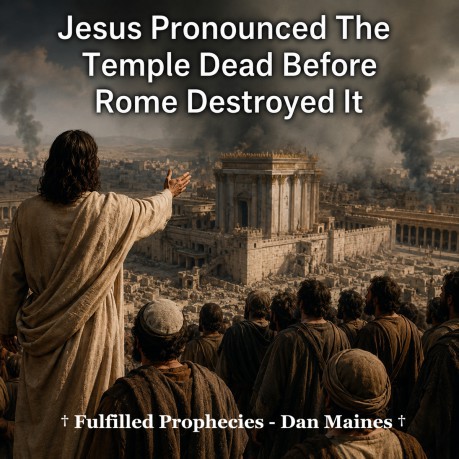
Jesus Pronounced The Temple
Dead Before Rome Destroyed It Introduction Matthew 23:37-39 Matthew 24:1-2 Luke 19:41-44 Matthew 21:42-44 John 2:19-21 Hebrews 8:13 Hebrews 9:8-10 Historical References How It Applies To Us Today Q & A Appendix Q: Why did the Temple continue operating after
Jesus pronounced judgment upon it? Q: Was Jesus talking about the actual first
century Temple in Matthew 24? Q: Did the destruction of Jerusalem happen
because Rome was stronger than Israel's God? Q: Does God need another physical Temple in
Jerusalem to complete His plan? Q: What is the major point of Matthew 23 flowing
directly into Matthew 24? Q: What is the wow moment in this teaching? † This is the fulfilled perspective we proclaim at
Fulfilled Prophecies † Source Index
By Dan Maines
† Rome
destroyed the Temple in AD 70, but Rome didn't make the Temple
obsolete. Jesus had already pronounced judgment upon it.
†
Before a Roman soldier entered Jerusalem, before the Temple burned,
and before one stone was thrown down, Jesus declared, your house is
left unto you desolate.
† That distinction
matters. Rome wasn't the author of the Temple's rejection. Rome
became the historical instrument through which Christ's already
pronounced judgment was carried out.
†
Matthew 23 flows directly into Matthew 24. Jesus pronounced the house
desolate, walked out of it, and then foretold its physical
destruction.
† The Temple was still standing
physically, but its covenantal judgment had already been announced by
Israel's Messiah.
† This is the wow moment.
The Temple didn't become rejected because Rome destroyed it. Rome
destroyed it because judgment had already been pronounced upon it.
"Jerusalem, Jerusalem,
who kills the prophets and stones those who have been sent to her!
How often I wanted to gather your children together, the way a hen
gathers her chicks under her wings, and you were unwilling. Behold,
your house is being left to you desolate! For I say to you, from now
on you will not see Me until you say, 'Blessed is the One who comes
in the name of the Lord!'"
† Notice the
change in ownership. Jesus didn't call it My Father's house here. He
called it your house. The covenantal significance of that change is
enormous.
† Earlier Jesus had called the
Temple My Father's house (John 2:16). Now, after exposing Jerusalem's
rejection of God's messengers and its coming judgment, He called it
your house.
† Jesus pronounced the sentence
before Rome carried it out. The declaration came from Christ, not
Caesar.
† The physical building remained
standing, but Jesus had announced its desolation and immediately
began describing the judgment that would bring that declaration to
its historical conclusion (Matthew 24:1-2).
Jesus left the temple area
and was going on His way when His disciples came up to point out the
temple buildings to Him. But He responded and said to them, "Do
you not see all these things? Truly I say to you, not one stone here
will be left upon another, which will not be torn down."
†
The movement of the text is powerful. Jesus pronounced the house
desolate, then He went out from the Temple.
†
The disciples were impressed by the buildings, but Jesus directed
their attention away from their beauty and toward their approaching
destruction.
† He didn't predict the
destruction of some distant temple thousands of years later. He
pointed to the buildings directly in front of them and said that
those stones would be thrown down.
† Matthew
23 and Matthew 24 belong together. First came the covenantal
sentence, then came the prophecy describing how that sentence would
be historically executed.
When He approached Jerusalem,
He saw the city and wept over it, saying, "If you had known on
this day, even you, the conditions for peace! But now they have been
hidden from your eyes. For the days will come upon you when your
enemies will put up a barricade against you, and surround you and hem
you in on every side, and they will level you to the ground, and
throw down your children within you, and they will not leave in you
one stone upon another, because you did not recognize the time of
your visitation."
† Jesus connected
Jerusalem's destruction directly with its failure to recognize the
time of its visitation.
† The siege wasn't an
unrelated Roman political event. Jesus presented it as judgment upon
the city that rejected Him.
† He described
enemies surrounding Jerusalem, enclosing it, destroying its people,
and tearing down its stones.
† Rome later
supplied the armies, but Jesus had already explained why the judgment
was coming and what it would accomplish.
Jesus said to them, "Did
you never read in the Scriptures, 'A stone which the builders
rejected, This has become the chief cornerstone; This came about from
the Lord, And it is marvelous in our eyes'? Therefore I say to you,
the kingdom of God will be taken away from you and given to a people
producing its fruit. And the one who falls on this stone will be
broken to pieces; and on whomever it falls, it will crush him."
†
The judgment of the Temple can't be separated from the rejection of
Christ. The builders rejected the very stone God established as the
cornerstone.
† Jesus said the kingdom would
be taken from those rejecting leaders and given to a people producing
its fruit.
† The center of God's redemptive
purpose wasn't going to remain a stone building in Jerusalem. Christ
Himself was the cornerstone of what God was building (Ephesians
2:19-22).
† This is why the destruction of
the Temple wasn't God's plan failing. It was judgment upon a system
whose leaders rejected the Messiah to whom that system pointed.
Jesus answered them, "Destroy
this temple, and in three days I will raise it up." The Jews
then said, "It took forty-six years to build this temple, and
yet You will raise it up in three days?" But He was speaking
about the temple of His body.
† Jesus
redirected attention from the physical Temple to Himself.
†
The Jewish leaders were thinking about Herod's building, but Jesus
was speaking about His body.
† The true
meeting place between God and humanity wasn't ultimately a building
made of stone. It was Christ.
† Once the
reality had come, the shadow couldn't remain the center of covenant
life forever (Colossians 2:16-17).
When He said, "A new
covenant," He has made the first obsolete. But whatever is
becoming obsolete and growing old is about to disappear.
†
Hebrews shows the same transition from another direction. The old
covenant had become obsolete and was approaching its final
disappearance.
† The writer didn't say Rome
had the authority to make God's covenant obsolete. God established
the new covenant through Christ, making the former covenant old.
†
The Temple continued functioning during this transition, but
continued activity didn't mean continued covenantal authority.
†
AD 70 publicly and historically removed the Temple order that
Christ's finished work had already surpassed.
The Holy Spirit is signifying
this, that the way into the holy place has not yet been disclosed
while the outer tabernacle is still standing, which is a symbol for
the present time. Accordingly both gifts and sacrifices are offered
which cannot make the worshiper perfect in conscience, since they
relate only to food, drink, and various washings, regulations for the
body imposed until a time of reformation.
†
The earthly sanctuary belonged to a temporary arrangement that
pointed beyond itself.
† Its sacrifices
couldn't perfect the conscience. They were signs pointing toward the
greater work accomplished through Christ.
†
The text speaks of a time of reformation. The old sanctuary wasn't
God's final destination for His people.
† The
physical Temple could continue operating for a time after the cross
without reversing what Christ had accomplished. Its continued
existence during the transition didn't restore its former covenantal
purpose.
†
Josephus describes the Roman siege of Jerusalem under Titus, the
famine inside the city, the burning of the Temple, and the
devastation that followed in AD 70. His account gives historical
detail to the catastrophe Jesus had foretold decades earlier
(Josephus, Wars of the Jews, Books 5-6).
†
Josephus reports that Titus initially wanted the sanctuary preserved,
yet the Temple was consumed during the fighting. Whatever the
intentions of individual Roman commanders, the destruction Jesus had
predicted came to pass (Josephus, Wars of the Jews 6.4).
†
Josephus describes Jerusalem's destruction as so extensive that later
observers could scarcely believe the city had once been inhabited.
The physical devastation matched the seriousness of the judgment
Jesus had announced (Josephus, Wars of the Jews 7.1).
†
Tacitus also records the Roman campaign against Jerusalem and the
siege under Titus, providing a Roman historical witness to the first
century conflict that ended with Jerusalem's fall (Tacitus, Histories
5.10-13).
† Eusebius later connected
Jerusalem's catastrophe with the judgment that followed the rejection
of Christ, preserving the early Christian understanding that the
destruction of the city belonged to the consequences Jesus had
foretold (Eusebius, Ecclesiastical History 3.5-7).
†
We don't need another earthly Temple to restore something Christ
fulfilled. Our access to God is through Jesus Christ, not through a
building in Jerusalem (Hebrews 10:19-22).
†
We shouldn't look at modern events and expect God to rebuild the
covenant system Christ surpassed. The New Testament directs believers
toward Christ and His everlasting kingdom.
†
God's dwelling isn't centered in one geographical sanctuary. His
people are being built together as a dwelling of God in the Spirit
(Ephesians 2:19-22).
† We don't stand outside
an earthly sanctuary waiting for access to God. Through Christ we
have access to the Father (Ephesians 2:18).
†
The lesson of AD 70 isn't that Rome defeated God's Temple. The lesson
is that God's judgment removed the old order after Christ established
the better covenant.
† Rome didn't make the
Temple obsolete. Jesus had already pronounced the house desolate, the
new covenant had already been established, and the old order was
approaching its appointed end.
† The Roman
army destroyed the stones. Christ had already pronounced the
sentence.
Q: Did
Rome make the Temple obsolete?
A: No. Jesus
pronounced the house desolate before its destruction, and Hebrews
says the establishment of the new covenant made the former covenant
old (Matthew 23:38; Hebrews 8:13).
A: Because
there was a transition between the establishment of the new covenant
through Christ and the historical removal of the old Temple order.
Its continued physical operation didn't mean that Christ's finished
work had failed (Hebrews 8:13; 9:8-10).
A: Yes. The
disciples pointed out the Temple buildings directly in front of them,
and Jesus said those stones would be thrown down (Matthew 24:1-2).
A:
No. Jesus foretold the siege and destruction before it happened and
connected it with Jerusalem's failure to recognize the time of its
visitation (Luke 19:41-44).
A: No. Christ
is the foundation and cornerstone of God's covenant dwelling, and
believers are built together in Him as God's dwelling in the Spirit
(Ephesians 2:18-22).
A: Jesus first
pronounced the house desolate, then left the Temple and predicted the
destruction of its buildings. The sentence came before the
destruction (Matthew 23:38; 24:1-2).
A:
Rome didn't make the Temple obsolete. Christ had already pronounced
judgment upon it. Rome destroyed the stones in AD 70, but Jesus had
already declared what was coming and why it was coming (Matthew
23:38; 24:1-2; Luke 19:41-44).
© Fulfilled Prophecies - Dan
Maines.
† Matthew
23:37-39; Matthew 24:1-2; Luke 19:41-44; Matthew 21:42-44; John
2:19-21; Hebrews 8:13; Hebrews 9:8-10
†
Josephus, Wars of the Jews, Books 5-7; Tacitus, Histories 5.10-13;
Eusebius, Ecclesiastical History 3.5-7
Links