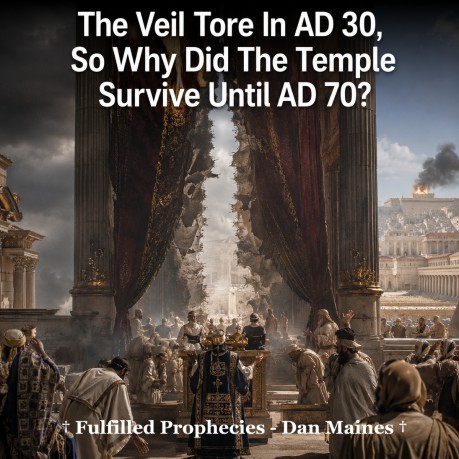
The Veil Tore In AD 30, So
Why Did The Temple Survive Until AD 70? Introduction Matthew 27:50-51 Hebrews 8:13 Hebrews 9:8-10 Hebrews 10:9-14 Acts 6:13-14 Luke 21:20-22 Matthew 24:1-2 John 4:21-24 Historical References Why Forty Years? The Veil And The Temple Tell Two Parts Of The Same Story How It Applies To Us Today Q & A Appendix Q: Does the temple continuing after the cross
mean the Old Covenant was still God's saving system? Q: Then what was happening between AD 30 and AD
70? Q: Why is Hebrews 8:13 so important to this
discussion? Q: Was AD 70 another sacrifice or another act of
redemption? Q: Should Christians expect a rebuilt temple and
restored animal sacrifices to complete God's prophetic plan? Q: So what did AD 30 and AD 70 each signify? † This is the fulfilled perspective we proclaim at
Fulfilled Prophecies † Source Index
By Dan Maines
† When Jesus
died, the veil of the temple was torn from top to bottom. God didn't
wait until AD 70 to announce that access to Him had changed. The
tearing of the veil declared that the old system had lost its
exclusive place before God.
† Yet the temple
didn't disappear that afternoon. Priests continued serving,
sacrifices continued being offered, and the temple remained standing
for approximately another forty years. This raises an important
question. If Christ fulfilled the sacrificial system at the cross,
why did God allow the temple to remain until AD 70?
†
The answer is found in the New Testament itself. The cross
accomplished the redemptive work, the New Covenant was established
through Christ, and the old system entered its final period of
passing away. What was accomplished through Christ was then
historically demonstrated in the judgment that brought the old temple
order to its irreversible end.
† This is why
the New Testament can speak of something already accomplished in
Christ while also speaking of the Old Covenant as ready to disappear
(Hebrews 8:13).
† The forty-year period
wasn't evidence that the cross failed to end the old sacrificial
order. It was the transition between Christ's finished sacrifice and
the historical removal of the covenant system that had rejected Him.
And Jesus cried out again
with a loud voice, and gave up His spirit. And behold, the veil of
the temple was torn in two from top to bottom; and the earth shook
and the rocks were split.
† Notice who tore
the veil. The text says it was torn from top to bottom. The symbolism
is unmistakable. Access to God was no longer centered in the earthly
sanctuary and its priestly system (Hebrews 10:19-22).
†
Jesus had just died when the veil tore. The theological meaning of
the temple system had been fulfilled through the sacrifice to which
it had always pointed (Hebrews 9:11-12).
†
Yet the physical temple was still standing. That distinction matters.
A covenant institution could lose its divine function before the
building associated with it was physically destroyed (John
4:21-24).
† The torn veil announced what
Christ had accomplished. AD 70 would publicly demonstrate the
consequences for the covenant order that continued after its
fulfillment in Christ (Matthew 23:36-38).
When He said, "A new
covenant," He has made the first obsolete. But whatever is
becoming obsolete and growing old is about to disappear.
†
This verse gives us the language needed to understand the period
between the cross and AD 70. The writer says the first covenant had
been made old, yet he also says it was becoming old and was near
disappearing.
† There was an accomplished
reality and an approaching historical conclusion. The New Covenant
wasn't waiting for AD 70 to become valid, but the old covenantal
world was still approaching its visible removal (Hebrews 9:8-10).
†
The words near disappearing are extremely important. The writer
wasn't describing something that would remain alongside the New
Covenant for thousands of years. He described something approaching
its end (Hebrews 10:37).
† The temple's
continued existence didn't prove that the Old Covenant remained God's
continuing redemptive system. It showed that the historical structure
associated with that covenant hadn't yet been removed.
The Holy Spirit is signifying
this, that the way into the holy place has not yet been disclosed
while the outer tabernacle is still standing, which is a symbol for
the present time. Accordingly both gifts and sacrifices are offered
which cannot make the worshiper perfect in conscience, since they
relate only to food, drink, and various washings, regulations for the
body imposed until a time of reformation.
†
Hebrews directly connects the standing sanctuary with the old order.
The writer was living during the period when the temple system still
operated, yet he called it a figure connected with the time then
present.
† Those sacrifices couldn't perfect
the conscience. Their continuation didn't mean they still possessed
the redemptive significance they once had. Christ had already entered
the greater and more perfect tabernacle and obtained eternal
redemption (Hebrews 9:11-12).
† Notice the
word until. The ordinances belonged to a system imposed until the
time of reformation. They were temporary shadows pointing toward the
reality found in Christ (Colossians 2:16-17).
†
The physical continuation of sacrifice after the cross doesn't mean
Christ's sacrifice was incomplete. It means people continued
practicing a system whose fulfillment had already arrived.
then He said, "Behold,
I have come to do Your will." He takes away the first in order
to establish the second. By this will, we have been sanctified
through the offering of the body of Jesus Christ once for all time.
Every priest stands daily ministering and offering time after time
the same sacrifices, which can never take away sins; but He, having
offered one sacrifice for sins for all time, sat down at the right
hand of God, waiting from that time onward until His enemies are made
a footstool for His feet. For by one offering He has perfected for
all time those who are sanctified.
† Here is
the theological end of the sacrificial system. Jesus offered one
sacrifice. Nothing performed afterward in the earthly temple could
improve, repeat, or complete His work.
†
Hebrews deliberately contrasts the priests who continued standing and
offering sacrifices with Christ, who offered one sacrifice and sat
down. The old priests kept working because their sacrifices could
never accomplish what Christ accomplished (Hebrews 7:27).
†
This explains how temple sacrifices could continue after the cross
without possessing continuing covenant authority. Human beings
continued performing them, but God had provided the final
sacrifice.
† The first was taken away so that
the second could be established. The temple could remain physically
standing without remaining the divinely appointed means of
approaching God (Ephesians 2:18).
They put forward false
witnesses who said, "This man does not stop speaking against
this holy place and the Law; for we have heard him say that this
Nazarene, Jesus, will destroy this place and change the customs which
Moses handed down to us."
† Even after
the cross, Jerusalem remained intensely attached to the temple and
Mosaic customs. The conflict recorded in Acts shows that the old
religious establishment continued operating during the apostolic
generation.
† Stephen's preaching challenged
the idea that God could be confined to a temple made with human hands
(Acts 7:48-50).
† The continued existence of
the temple therefore became part of the first-century conflict
between the fading covenant order and the reality revealed in
Christ.
† God gave that generation time in
which the gospel was preached throughout the world of their day
before Jerusalem's judgment arrived (Matthew 24:14, Colossians 1:23).
But when you see Jerusalem
surrounded by armies, then recognize that her desolation is near.
Then those who are in Judea must flee to the mountains, and those who
are inside the city must leave, and those who are in the country must
not enter the city; because these are days of punishment, so that all
things which have been written will be fulfilled.
†
Jesus Himself identified the historical event that would bring
Jerusalem's desolation. He told His disciples what they would see,
Jerusalem surrounded by armies.
† He didn't
describe an event thousands of years beyond His audience. He gave
instructions to people in Judea to flee when they saw the approaching
armies (Luke 21:21).
† Jesus called these the
days of vengeance and connected them with fulfillment. Jerusalem's
destruction wasn't an unrelated political accident. It was the
covenant judgment Jesus had repeatedly announced (Matthew
23:34-38).
† The temple survived from the
cross until AD 70 because its physical destruction belonged to the
coming judgment upon that generation. Jesus had already declared that
judgment before His death (Matthew 24:1-2, 34).
Jesus left the temple area
and was going on His way when His disciples came up to point out the
temple buildings to Him. But He responded and said to them, "Do
you not see all these things? Truly I say to you, not one stone here
will be left upon another, which will not be torn down."
†
Jesus didn't say the temple would disappear the moment He died. He
specifically prophesied its coming physical destruction.
†
The cross and the destruction of Jerusalem therefore shouldn't be
forced into the same moment. The cross fulfilled the sacrificial
reality, while the destruction Jesus predicted removed the old temple
structure within that generation (Matthew 24:34).
†
This helps explain the forty-year period. The veil could tear at the
cross because Christ had opened the way to God, while the building
could remain until the judgment Jesus had pronounced arrived.
†
The standing temple during those years became a visible reminder of
an order that had reached its fulfillment but hadn't yet experienced
its announced historical destruction.
Jesus said to her, "Believe
Me, woman, that a time is coming when you will worship the Father
neither on this mountain nor in Jerusalem. You Samaritans worship
what you do not know; we worship what we do know, because salvation
is from the Jews. But a time is coming, and even now has arrived,
when the true worshipers will worship the Father in spirit and truth;
for such people the Father seeks to be His worshipers. God is spirit,
and those who worship Him must worship in spirit and truth."
†
Jesus announced the end of location-centered worship before the
temple was destroyed. Worship wouldn't remain tied to Jerusalem.
†
Notice His words, the hour comes, and now is. The transformation had
already begun in His ministry, even though the Jerusalem temple was
still physically standing.
† This
demonstrates the same pattern we see throughout the New Testament.
Spiritual and covenant realities could arrive before the physical
structures associated with the former order disappeared.
†
After Christ, God's dwelling wasn't defined by a building in
Jerusalem. God's people themselves were being built together as His
dwelling in the Spirit (Ephesians 2:19-22).
†
Josephus was an eyewitness to the Jewish-Roman War and described the
destruction of Jerusalem and the burning of the temple in AD 70. His
account confirms that the temple continued functioning during the
decades after Jesus' crucifixion and was finally destroyed during the
Roman siege (Josephus, Wars of the Jews, Book 6).
†
Josephus described the temple being set on fire during the Roman
assault and the devastation that followed. Whatever theological
meaning people continued assigning to that sanctuary, its physical
existence came to a catastrophic end in the very generation to which
Jesus had spoken (Josephus, Wars of the Jews, 6.4).
†
Josephus also recorded extraordinary signs and warnings associated
with the period leading to Jerusalem's destruction. His descriptions
show how deeply the coming catastrophe affected the Jewish religious
world centered upon the temple (Josephus, Wars of the Jews, 6.5.3).
†
Eusebius later recorded the tradition that believers in Jerusalem
left the city before the war and went to Pella. This fits the
historical setting of Jesus' warning that those in Judea should flee
when the danger approached (Eusebius, Ecclesiastical History, 3.5).
†
These historical writers don't establish our theology, Scripture
does. Their value is historical. They confirm that the temple
continued after the cross and that Jerusalem and its sanctuary were
devastated in the first-century Roman war.
† The
approximately forty years between the cross and AD 70 shouldn't be
treated as an embarrassing gap. The New Testament was written within
this transition and repeatedly reflects it.
†
Christ's sacrifice was complete. The gospel was going throughout the
nations. The apostles were announcing the New Covenant reality while
the old temple establishment continued operating (Romans 15:18-19).
†
During those years, believers were being taught to leave confidence
in the earthly system and come to Christ. Hebrews eventually told its
readers to go outside the camp to Him (Hebrews 13:13-14).
†
The forty-year period also parallels Israel's earlier wilderness
transition in an important way. Israel left Egypt before entering the
promised land. Deliverance had occurred, yet a historical transition
followed before the former generation and its wilderness period were
completely behind them (1 Corinthians 10:1-11).
†
We shouldn't make every detail of the Exodus identical to the AD 30
to AD 70 period, but the biblical pattern is clear. God can
accomplish a decisive act and then bring His people through a period
in which the implications of that act unfold historically.
†
The torn veil said access to God had been opened through Christ
(Hebrews 10:19-22).
† The continuing temple
showed that the old historical structure hadn't yet experienced the
judgment Jesus predicted (Luke 19:41-44).
†
The one sacrifice of Christ said the sacrificial shadows had reached
their reality (Hebrews 10:11-14).
† The
destruction in AD 70 said the temple age that rejected its Messiah
wouldn't continue indefinitely (Matthew 23:36-38).
†
There is no contradiction. The veil and the destruction of the temple
belong to the same covenant story, but they mark different moments
within that story.
† At the cross, Christ
accomplished what animal sacrifices could never accomplish. During
the following generation, the gospel announced that reality. In AD
70, the temple system that had continued operating after its
fulfillment met the judgment Jesus had foretold.
†
We don't need an earthly temple to approach God. Through Christ we
have access to the Father (Ephesians 2:18).
†
We don't need another priesthood offering animal sacrifices. Jesus'
sacrifice was once for all and doesn't need repetition (Hebrews
10:10-14).
† We don't need Jerusalem to
become the center of worship again. Jesus said true worship isn't
defined by an earthly mountain or city but by worship in spirit and
truth (John 4:21-24).
† We shouldn't rebuild
prophetically what Christ fulfilled covenantally. The New Testament
directs our attention toward Christ, not backward toward the shadows
that pointed to Him (Colossians 2:16-17).
†
The torn veil tells us that access has been opened. The destroyed
temple tells us that the former covenant order wasn't coming back.
Christ is the reality to which the entire system pointed.
†
We live on the fulfilled side of that transition. Our confidence
isn't in an earthly sanctuary, an earthly priesthood, or repeated
sacrifices. Our confidence is in Jesus Christ and His completed work.
Q: If
the veil tore when Jesus died, why didn't the temple fall
immediately?
A: Because the tearing of the veil
and the physical destruction of the temple communicated related but
distinct realities. The veil announced what Christ's sacrifice had
accomplished. Jesus had separately predicted that the temple itself
would be destroyed within that generation (Matthew 24:1-2, 34).
A:
No. Hebrews says Christ offered the effective sacrifice once for all,
while priests were still standing daily and offering sacrifices that
could never take away sins (Hebrews 10:9-14). The activity continued,
but Christ had fulfilled what those sacrifices represented.
A: It was the apostolic transition in which
the New Covenant reality accomplished by Christ was being proclaimed
while the old covenantal structure was approaching its announced
disappearance (Hebrews 8:13).
A: Because it describes the first
covenant as made old while also saying it was becoming old and near
disappearing. That language perfectly explains why the New Covenant
could already be established while the old temple structure still
physically existed.
A: No. Jesus' sacrifice was once
for all (Hebrews 10:10). AD 70 didn't add anything to the cross. It
was the historical judgment Jesus had already announced against
Jerusalem and the temple establishment (Matthew 23:36-38, Luke
21:20-22).
A:
No. That would move backward from the reality to the shadow. Christ
is the final sacrifice, believers have access to God through Him, and
worship is no longer centered in Jerusalem (Hebrews 10:19-22, John
4:21-24).
A:
AD 30 points us to Christ's completed sacrifice and the opening of
access to God. AD 70 marks the historical destruction of Jerusalem
and its temple exactly as Jesus had foretold. The first accomplished
redemption, the second brought the announced judgment upon the old
temple order (Matthew 27:50-51, Matthew 24:1-2, 34).
© Fulfilled Prophecies - Dan
Maines.
† Matthew
27:50-51; Hebrews 8:13; Hebrews 9:8-10; Hebrews 10:9-14; Acts
6:13-14; Luke 21:20-22; Matthew 24:1-2; John 4:21-24
†
Historical writers: Josephus, Wars of the Jews, Book 6, 6.4, 6.5.3;
Eusebius, Ecclesiastical History, 3.5
Links