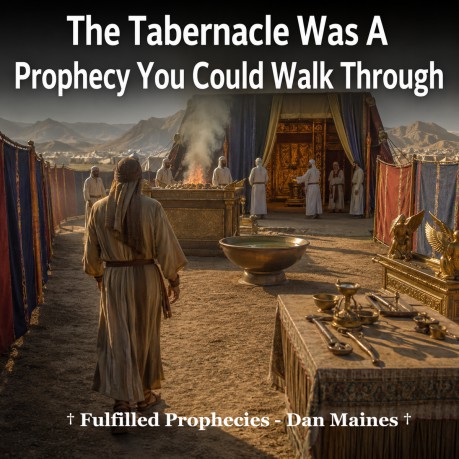
The Tabernacle Was A Prophecy
You Could Walk Through Introduction Exodus 27:16 Exodus 27:1-2 Exodus 30:18-20 Exodus 26:33 Leviticus 16:2 Hebrews 8:4-5 Hebrews 9:6-9 Hebrews 9:11-12 Hebrews 9:23-24 Hebrews 10:1 Hebrews 10:19-22 Historical References How It Applies To Us Today Q & A Appendix Q: Why was there a veil separating the Most Holy
Place? Q: Did Jesus simply become another priest within
the Old Covenant system? Q: Why don't Christians need animal sacrifices
today? Q: What was the ultimate message of the
tabernacle? † This is the fulfilled perspective we proclaim at
Fulfilled Prophecies † Source Index
By Dan Maines
† The
tabernacle wasn't simply Israel's portable place of worship. It was a
physical prophecy that Israel could enter, see, touch, and
experience.
† From the gate to the altar,
from the laver to the Holy Place, from the veil to the Most Holy
Place, every movement taught that sinful humanity couldn't approach
God's presence apart from sacrifice, cleansing, priesthood, and
mediation.
† Hebrews gives us the inspired
interpretation. The earthly sanctuary, priesthood, sacrifices, and
ordinances weren't the final reality. They were copies, shadows, and
symbols pointing beyond themselves to Christ and the New Covenant
(Hebrews 8:5; 9:9; 9:23-24; 10:1).
† The
tabernacle was theology built with wood, linen, gold, bronze, blood,
water, and priestly service. God turned His redemptive plan into
something Israel could literally walk through.
†
When Christ completed what those symbols anticipated, God's people
weren't called back into the shadows. They were brought into the
reality to which the shadows had always pointed (Colossians 2:16-17;
Hebrews 10:19-22).
And for the gate of the
courtyard there shall be a curtain of twenty cubits, of violet,
purple, and scarlet material and fine twisted linen, the work of a
weaver, with their four pillars and their four bases.
†
The journey began at the gate. There wasn't an entrance wherever
someone wanted one. Access to God's sanctuary was through the
entrance God provided.
† The pattern pointed
forward to Christ. Jesus identified Himself as the door and said that
no one comes to the Father except through Him (John 10:9; 14:6).
†
The tabernacle therefore began with a lesson that remained central in
the New Covenant, access to God isn't created by human effort,
religious systems, or personal merit. God provides the way of
approach.
Now you shall make the altar
of acacia wood, five cubits long and five cubits wide; the altar
shall be square, and its height shall be three cubits. You shall make
its horns on its four corners; its horns shall be of one piece with
it, and you shall overlay it with bronze.
†
After entering the court, the worshiper encountered the altar. Before
moving toward the sanctuary, there was sacrifice.
†
This taught Israel that approach to a holy God involved the shedding
of blood. Hebrews explains that the sacrificial system anticipated
the greater sacrifice accomplished by Christ (Hebrews 9:11-14;
10:10-14).
† Jesus didn't merely become
another sacrifice in an endless succession of sacrifices. He offered
Himself once, accomplishing what the repeated animal sacrifices could
never accomplish permanently.
† The altar
pointed beyond itself. Once the perfect sacrifice came, the shadow
didn't need to continue because the reality had arrived.
You shall also make a basin
of bronze, with its base of bronze, for washing; and you shall put it
between the tent of meeting and the altar, and you shall put water in
it. Aaron and his sons shall wash their hands and their feet from it;
when they enter the tent of meeting, they shall wash with water, so
that they do not die; or when they approach the altar to minister, by
offering up in smoke a fire sacrifice to the Lord.
†
Beyond the altar stood the laver. Sacrifice and cleansing stood
together on the path toward God's presence.
†
The priests couldn't simply walk from the altar into sacred service
without washing. The physical cleansing pictured the necessity of
purification before God.
† Hebrews connects
New Covenant access with hearts cleansed from an evil conscience and
bodies washed with pure water (Hebrews 10:19-22).
†
The laver wasn't the destination. Like the other furnishings, it
participated in a larger symbolic system that pointed toward the
cleansing and access accomplished through Christ.
You shall hang up the veil
under the clasps, and bring in the ark of the testimony there within
the veil; and the veil shall serve as a partition for you between the
Holy Place and the Most Holy Place.
† The
veil preached one of the strongest messages in the entire tabernacle.
There was a barrier between the people and the Most Holy Place.
†
God's presence was there, but unrestricted access wasn't. Even the
priests couldn't freely enter the Most Holy Place whenever they
chose.
† Hebrews tells us exactly what this
arrangement meant. The Holy Spirit was showing that the way into the
holy place hadn't yet been manifested while the first tabernacle was
still standing as the operative covenantal system (Hebrews 9:7-9).
†
The veil therefore wasn't merely decoration. It testified that the
Old Covenant arrangement hadn't brought God's people into the
completed access that Christ would establish.
†
When Jesus died, the temple veil was torn from top to bottom,
dramatically announcing what His sacrifice was accomplishing (Matthew
27:50-51).
The Lord said to Moses: Tell
your brother Aaron that he shall not enter at any time into the Holy
Place inside the veil, before the atoning cover which is on the ark,
or he will die; for I will appear in the cloud over the atoning
cover.
† The Most Holy Place represented
God's presence, but under the Old Covenant that presence was
approached under severe restrictions.
† Only
the high priest entered beyond the veil, and he didn't enter whenever
he wanted. He entered according to God's command and with sacrificial
blood (Leviticus 16:14-17; Hebrews 9:7).
†
This makes the message of Hebrews extraordinary. What was once
restricted became the basis for New Covenant confidence because
believers were invited to draw near through the work of Christ
(Hebrews 4:14-16; 10:19-22).
† The goal of
the tabernacle wasn't endless distance from God. Its entire structure
anticipated the day when the true High Priest would accomplish
genuine access to God's presence.
Now if He were on earth, He
would not be a priest at all, since there are those who offer the
gifts according to the Law; who serve a copy and shadow of the
heavenly things, just as Moses was warned by God when he was about to
erect the tabernacle; for, "See," He says, "that you
make all things by the pattern which was shown to you on the
mountain."
† Hebrews removes any doubt
about how we're supposed to understand the tabernacle. The priests
served a copy and shadow of heavenly things.
†
A shadow isn't meaningless, but it isn't the substance either. Its
importance comes from the reality to which it points.
†
Moses had to follow God's pattern because the sanctuary was
communicating something greater than architecture. The entire system
had prophetic significance.
† This is why
returning to the Old Covenant sanctuary system would be moving
backward. Christ brought the better covenant, better priesthood,
better sacrifice, and better access that the earthly pattern
anticipated (Hebrews 7:22; 8:6).
Now when these things have
been so prepared, the priests are continually entering the outer
tabernacle, performing the divine worship, but into the second, only
the high priest enters once a year, not without taking blood which he
offers for himself and for the sins of the people committed in
ignorance. The Holy Spirit is signifying this, that the way into the
holy place has not yet been disclosed while the outer tabernacle is
still standing, which is a symbol for the present time. Accordingly
both gifts and sacrifices are offered which cannot make the worshiper
perfect in conscience,
† Hebrews interprets
the tabernacle as a figure belonging to that covenantal time. Its
divisions, priestly movements, sacrifices, and restricted access were
communicating a spiritual reality.
† The
priests continually entered the first section, but the high priest
alone entered the second, and only according to the prescribed
sacrificial arrangement.
† The Holy Spirit
was teaching through the architecture itself. The restricted
sanctuary demonstrated that the way into God's presence hadn't yet
been fully manifested under that system.
†
Those gifts and sacrifices couldn't perfect the conscience. They were
temporary signs pointing toward something greater.
†
Christ didn't come to renovate the shadow. He came to accomplish the
reality the shadow had been announcing.
But when Christ appeared as
a high priest of the good things having come, He entered through the
greater and more perfect tabernacle, not made by hands, that is, not
of this creation; and not through the blood of goats and calves, but
through His own blood, He entered the holy place once for all time,
having obtained eternal redemption.
† Here
the prophecy embodied in the tabernacle reaches its fulfillment in
Christ.
† Jesus is the greater High Priest.
His sanctuary is greater. His blood is greater. His entrance is
greater. His redemption is eternal.
† The
contrast couldn't be stronger. The Old Covenant priest entered
repeatedly with animal blood. Christ entered once for all through His
own blood.
† The earthly tabernacle pointed
beyond itself to a greater sanctuary not made with human hands. The
physical structure was never God's final destination for His
people.
† What Israel watched symbolically
through generations of priestly service was accomplished decisively
through Jesus Christ.
Therefore it was necessary
for the copies of the things in the heavens to be cleansed with these
things, but the heavenly things themselves with better sacrifices
than these. For Christ did not enter a holy place made by hands, a
mere copy of the true one, but into heaven itself, now to appear in
the presence of God for us;
† Hebrews
explicitly calls the earthly holy places copies. The physical
sanctuary was patterned after a greater reality.
†
Christ didn't enter an earthly sanctuary to continue the Levitical
system. He entered heaven itself and appeared before God for His
people.
† The earthly priesthood dealt with
patterns. Christ dealt with the reality.
†
This is the interpretive key to the entire tabernacle. Gate, altar,
laver, priesthood, sacrifice, veil, sanctuary, and divine presence
all belonged to a prophetic pattern that found its meaning in Christ.
For the Law, since it has only
a shadow of the good things to come and not the form of those things
itself, can never, by the same sacrifices which they offer
continually every year, make those who approach perfect.
†
The law had a shadow of the coming good things, not their final
form.
† Repetition revealed incompleteness.
Sacrifices continued because those sacrifices couldn't permanently
accomplish what Christ's sacrifice accomplished.
†
Once the substance arrived, God's people weren't supposed to build
their theology around the continuation of the shadow.
†
The tabernacle was magnificent because of what it predicted, but
Christ is greater because He's the reality it predicted.
Therefore, brothers and
sisters, since we have confidence to enter the holy place by the
blood of Jesus, by a new and living way which He inaugurated for us
through the veil, that is, through His flesh, and since we have a
great priest over the house of God, let’s approach God with a
sincere heart in full assurance of faith, having our hearts sprinkled
clean from an evil conscience and our bodies washed with pure
water.
† The journey that began outside the
tabernacle now reaches its intended destination. God's people are
told to draw near.
† The gate pointed toward
access. The altar pointed toward sacrifice. The laver pictured
cleansing. The priesthood pointed toward mediation. The veil
demonstrated separation. The Most Holy Place represented God's
presence.
† In Christ these themes come
together. Through His blood there is a new and living way, and
through the great High Priest God's people have access to His
presence.
† The tabernacle was a prophecy you
could walk through because every step moved the worshiper through a
symbolic story of redemption.
† Hebrews
announces that the story reached its reality in Christ and the New
Covenant.
†
Josephus described the sanctuary, its priestly ministry, its veil,
and its sacred furnishings as central features of Jewish worship,
showing how visible and tangible this religious system remained in
the first century.
† Philo of Alexandria
wrote extensively about the tabernacle and priestly furnishings,
recognizing that the sanctuary carried meaning beyond ordinary
construction and decoration.
† The Epistle of
Barnabas, an early Christian writing, demonstrates how early
Christians interpreted Old Covenant institutions through the work of
Christ rather than treating those institutions as God's final
arrangement.
† These historical witnesses
help us understand the world in which Hebrews was written, but
Scripture itself gives us the authoritative interpretation, the
sanctuary and its services were copies and shadows pointing toward
the greater reality in Christ.
†
We don't need an earthly tabernacle to approach God. Our access isn't
dependent upon a physical sanctuary, Levitical priesthood, animal
sacrifice, or earthly Most Holy Place.
† We
don't stand outside waiting for another priest to enter God's
presence for us. Jesus is our great High Priest, and through Him we
draw near with confidence (Hebrews 4:14-16).
†
We don't need the shadow restored because we have the substance.
Christ accomplished what the tabernacle anticipated (Hebrews 9:11-12;
10:19-22).
† Every time we study the
tabernacle, we should see more than ancient furniture and ceremonies.
We should see God's carefully constructed preview of redemption.
†
The tabernacle said there is a way to God. The altar said sacrifice
is necessary. The laver said cleansing is necessary. The priesthood
said a mediator is necessary. The veil said access isn't yet
complete. The Most Holy Place said God's presence is the goal.
†
Jesus Christ brought those pictures together in Himself. The prophecy
that Israel could walk through became the New Covenant reality God's
people now enjoy.
Q: Was
the tabernacle only a literal place of worship for ancient Israel?
A:
No. It was certainly a real sanctuary, but Hebrews says its priestly
service was a copy and shadow of heavenly things and that the
tabernacle arrangement was symbolic for its time (Hebrews 8:5; 9:9).
A: The veil demonstrated restricted
access to God's presence. Hebrews says the Holy Spirit was signifying
through that arrangement that the way into the holy place hadn't yet
been manifested while the first tabernacle system remained operative
(Hebrews 9:7-9).
A: No. Jesus is the
greater High Priest associated with a better covenant and a greater
and more perfect tabernacle not made with hands (Hebrews 8:6;
9:11-12).
A: Because Christ offered the effective
sacrifice once for all. The repeated sacrifices belonged to the
shadow, but Jesus accomplished what those sacrifices couldn't
accomplish permanently (Hebrews 10:1-14).
A: The ultimate message was access
to God's presence through God's appointed sacrifice and priest. What
appeared in symbolic form under the Old Covenant reached its reality
through Jesus Christ in the New Covenant (Hebrews 9:11-12; 10:19-22).
© Fulfilled Prophecies - Dan
Maines.
† Exodus
27:16; Exodus 27:1-2; Exodus 30:18-20; Exodus 26:33; Leviticus 16:2;
Hebrews 8:4-5; Hebrews 9:6-9; Hebrews 9:11-12; Hebrews 9:23-24;
Hebrews 10:1; Hebrews 10:19-22
† Historical
writers: Josephus; Philo of Alexandria; Epistle of Barnabas
Links