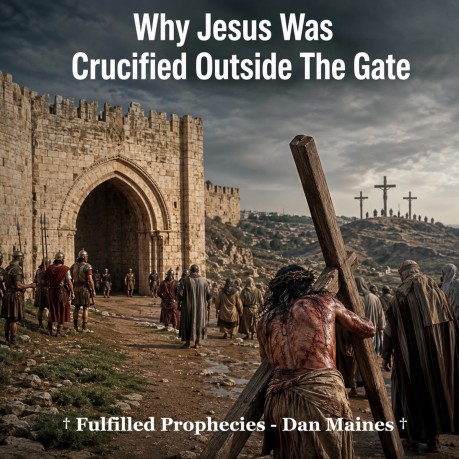
Why Jesus Was Crucified
Outside The Gate Introduction Hebrews 13:11-14 Leviticus 16:27 John 19:17-18 Hebrews 8:13 Hebrews 12:22-24 Hebrews 9:8-10 Hebrews 10:19-22 Matthew 23:37-38 Historical References How It Applies To Us Today Q & A Appendix † This is the fulfilled perspective we proclaim at
Fulfilled Prophecies † Source Index
By Dan Maines
† Jesus
being crucified outside Jerusalem wasn't an accidental detail. The
location itself carried covenant meaning.
†
Under the Law of Moses, certain sacrificial animals were taken
outside the camp and burned. Jesus fulfilled that pattern when He
suffered outside the gate of Jerusalem.
†
Hebrews doesn't stop with the location of Jesus' suffering. It
immediately calls its first-century readers to go out to Him outside
the camp.
† The camp represented more than a
physical location. It represented the covenant order centered in
Jerusalem, the earthly sanctuary, the Levitical priesthood, and the
sacrifices that were becoming obsolete (Hebrews 8:13).
†
Jesus went outside the gate first, then His people were called to
follow Him out. They weren't being called to abandon God. They were
being called to leave an obsolete covenant system and identify
completely with Christ.
† This is the wow
moment in Hebrews 13. The cross stood outside the gate, and the New
Covenant people were told to go outside the camp because the lasting
city they were seeking wasn't earthly Jerusalem.
For the bodies of those
animals whose blood is brought into the Holy Place by the high priest
as an offering for sin are burned outside the camp. Therefore Jesus
also suffered outside the gate, that He might sanctify the people
through His own blood. So then, let us go out to Him outside the
camp, bearing His reproach. For here we do not have a lasting city,
but we are seeking the city which is to come.
†
Hebrews deliberately connects Jesus' death with the Old Covenant
sacrifices whose bodies were burned outside the camp. Jesus fulfilled
the pattern by suffering outside Jerusalem.
†
Then comes the command to go to Jesus outside the camp. The readers
weren't merely being taught where Jesus died. They were being told
where they now belonged.
† Their loyalty
could no longer remain with the covenant order centered in earthly
Jerusalem. They were to identify with Jesus even when doing so
brought rejection and reproach (Hebrews 10:32-34).
†
The statement, For we have not here an abiding city, is especially
powerful. Hebrews was written to people living while earthly
Jerusalem still stood, yet they were told that city wasn't their
lasting city.
† They were seeking the city
that was coming, the heavenly Jerusalem and unshakable kingdom
already described earlier in Hebrews (Hebrews 12:22-28).
But the bull of the sin
offering and the goat of the sin offering, whose blood was brought in
to make atonement in the Holy Place, shall be taken outside the camp,
and they shall burn their hides, their flesh, and their refuse in the
fire.
† The background of Hebrews 13 is found
directly in the Day of Atonement. The blood entered the holy place,
but the bodies of the sin offerings were carried outside the camp.
†
Jesus fulfilled what those sacrifices pictured. His blood
accomplished what animal blood could never accomplish permanently
(Hebrews 10:1-4).
† The pattern is striking.
What happened symbolically under the Old Covenant happened finally in
Christ.
† The place outside the camp was
associated with rejection and removal, yet that became the place
where God's final sacrifice for sin was accomplished.
They took Jesus, therefore,
and He went out, carrying His own cross, to the place called the
Place of a Skull, which in Hebrew is called, Golgotha. There they
crucified Him, and with Him two other men, one on either side, and
Jesus in between.
† John specifically tells
us that Jesus went out to the place where He was crucified. Hebrews
gives that geographical fact its covenant significance.
†
Jesus was rejected by the leadership of the very covenant nation to
which He came, and He suffered outside the city associated with that
covenant administration (John 1:11).
† The
Messiah was outside the gate while the religious establishment
continued inside. That contrast becomes even more significant when
Hebrews later tells believers to go out to Him.
†
Following Jesus meant choosing Him over the system that rejected Him.
They couldn't cling to the old order while refusing the reproach
associated with Christ.
When He said, "A new
covenant," He has made the first obsolete. But whatever is
becoming obsolete and growing old is about to disappear.
†
This verse establishes the covenant setting of Hebrews. The first
covenant had become obsolete and was near disappearance.
†
Hebrews wasn't describing an Old Covenant system that would remain
alongside the New Covenant forever. It was aging and approaching its
historical removal.
† This explains the
urgency behind the command to go outside the camp. Why remain
attached to an order that God declared obsolete and near its end?
†
The destruction of Jerusalem and the temple in AD 70 visibly ended
the sacrificial and priestly order that had defined Israel's covenant
life for centuries.
† Going outside the camp
was therefore a decisive covenant separation. Their confidence was no
longer in Jerusalem, the temple, animal sacrifices, or the Levitical
priesthood. Their confidence was in Christ alone (Hebrews 10:19-23).
But you have come to Mount
Zion and to the city of the living God, the heavenly Jerusalem, and
to myriads of angels, to the general assembly and church of the
firstborn who are enrolled in heaven, and to God, the Judge of all,
and to the spirits of the righteous made perfect, and to Jesus, the
mediator of a new covenant, and to the sprinkled blood, which speaks
better than the blood of Abel.
† Hebrews had
already identified the city to which believers truly belonged. They
had come to Mount Zion, the city of the living God, the heavenly
Jerusalem.
† Notice the contrast. They were
being called out of the camp associated with earthly Jerusalem
because they had already come to the heavenly Jerusalem.
†
Their covenant identity had changed. Jesus was the mediator of the
New Covenant, and His blood spoke better things than the blood
associated with the former system.
† The
movement in Hebrews isn't from earth to another geographical
location. It's from the temporary covenant order to the permanent
kingdom established through Christ.
† This is
why losing earthly Jerusalem wasn't the loss of God's city. God's
people had received something greater.
The Holy Spirit is signifying
this, that the way into the holy place has not yet been disclosed
while the outer tabernacle is still standing, which is a symbol for
the present time. Accordingly both gifts and sacrifices are offered
which cannot make the worshiper perfect in conscience, since they
relate only to food, drink, and various washings, regulations for the
body imposed until a time of reformation.
†
The first tabernacle represented a temporary covenant arrangement.
Its regulations were imposed until the time of reformation.
†
Jesus brought the reality to which that system pointed. The shadows
couldn't remain the governing covenant order after the substance had
arrived (Hebrews 10:1).
† Hebrews
consistently moves its readers away from dependence upon the earthly
sanctuary and toward the finished work of Christ.
†
The call to go outside the camp fits this entire argument. The
temporary order had served its purpose, and God's people were being
gathered around Christ rather than the earthly sanctuary.
Therefore, brothers and
sisters, since we have confidence to enter the holy place by the
blood of Jesus, by a new and living way which He inaugurated for us
through the veil, that is, through His flesh, and since we have a
great priest over the house of God, let's approach God with a sincere
heart in full assurance of faith, having our hearts sprinkled clean
from an evil conscience and our bodies washed with pure water.
†
Under the former system, access to the holy place was restricted.
Through Jesus, God's people received direct covenant access through
His blood.
† They didn't need to return to
the earthly priesthood because they already had the greater High
Priest over the house of God.
† They didn't
need another animal sacrifice because Jesus had opened the new and
living way.
† Going outside the camp wasn't
walking away from God's presence. It was drawing nearer to God
through the only sacrifice and priesthood that could actually provide
complete access.
Jerusalem, Jerusalem, who
kills the prophets and stones those who have been sent to her! How
often I wanted to gather your children together, the way a hen
gathers her chicks under her wings, and you were unwilling. Behold,
your house is being left to you desolate!
†
Jesus had already pronounced judgment upon Jerusalem and its house.
The city that rejected the prophets would also reject the Son.
†
Notice the change in language. Jesus called the temple your house as
He announced its coming desolation.
† Hebrews
later tells believers not to treat that earthly city as their lasting
city. Jesus had already announced what was coming upon it (Matthew
24:1-2).
† The call to leave the camp
therefore fits the approaching judgment upon the Old Covenant center.
God's people weren't to place their hope in a house that Jesus had
declared desolate.
†
Josephus described the destruction of Jerusalem and the temple in AD
70 in The Wars of the Jews. His account records the catastrophic end
of the city and sanctuary that had stood at the center of Jewish
national and religious life.
† Josephus also
described the Roman siege, famine, internal conflict, and eventual
burning of the temple, providing an important first-century
historical witness to Jerusalem's destruction.
†
Eusebius later reported that believers in Jerusalem departed from the
city before the war and went to Pella. His account is significant
because early Christians understood that their security wasn't found
by remaining attached to Jerusalem.
† These
historical witnesses don't establish the meaning of Scripture, but
they show the historical setting in which the warnings of Jesus and
the covenant argument of Hebrews reached their dramatic conclusion.
†
We don't need to go outside a literal first-century Jerusalem today.
The original command belonged to believers facing the transition from
the Old Covenant order to the fully established New Covenant age.
†
But the truth behind the passage remains powerful. Our relationship
with God isn't centered in an earthly temple, human priesthood,
geographical holy city, or sacrificial system.
†
We come to God through Jesus Christ. He is our sacrifice, our High
Priest, our mediator, and our access to the Father (Hebrews 7:25).
†
We don't need to rebuild what Christ fulfilled. We don't need another
temple, another Levitical priesthood, or another animal sacrifice.
†
The first-century believers were called outside the camp because
something better had arrived. We live in the reality of that better
covenant today.
† Jesus suffered outside the
gate, the believers were called outside the camp, and earthly
Jerusalem wasn't their lasting city. Those statements belong
together.
† The cross wasn't merely outside
Jerusalem geographically. It marked the transition away from the
shadows and toward the covenant reality found in Christ.
Q: Why
does Hebrews emphasize that Jesus suffered outside the gate?
A:
Because His location fulfilled the pattern of the sin offerings taken
outside the camp and became the basis for calling believers to go
outside the camp to Him (Leviticus 16:27; Hebrews 13:11-13).
Q:
What did the camp represent in Hebrews 13?
A:
In the argument of Hebrews, it represented the covenant order from
which these believers were being separated, including its earthly
sanctuary, priesthood, sacrifices, and identification with Jerusalem
(Hebrews 8:13; 9:8-10; 13:13-14).
Q: Why did
Hebrews say they had no lasting city there?
A:
Because earthly Jerusalem wasn't the permanent city of God's New
Covenant people. They had come to the heavenly Jerusalem and were
receiving an unshakable kingdom (Hebrews 12:22-28; 13:14).
Q:
Was going outside the camp a rejection of God?
A:
No. It was exactly the opposite. They were going out to Jesus because
access to God was now through Him and His blood rather than through
the obsolete covenant system (Hebrews 10:19-22; 13:13).
Q:
Does Hebrews 13 teach Christians today to physically leave
Jerusalem?
A: No. The command addressed
believers in that first-century covenant transition. We live in the
New Covenant reality to which they were being called (Hebrews 8:13;
12:22-24).
Q: What is the great covenant
picture in this passage?
A: Jesus went outside
the gate, then His followers were called outside the camp. The
sacrifice had been completed, the first covenant was becoming
obsolete, and God's people were being identified with Christ and the
heavenly Jerusalem rather than the earthly covenant order (Hebrews
8:13; 13:11-14).
© Fulfilled Prophecies - Dan
Maines.
† Hebrews
13:11-14; Leviticus 16:27; John 19:17-18; Hebrews 8:13; Hebrews
12:22-24; Hebrews 9:8-10; Hebrews 10:19-22; Matthew 23:37-38
†
Historical writers: Josephus, The Wars of the Jews; Eusebius,
Ecclesiastical History
Links