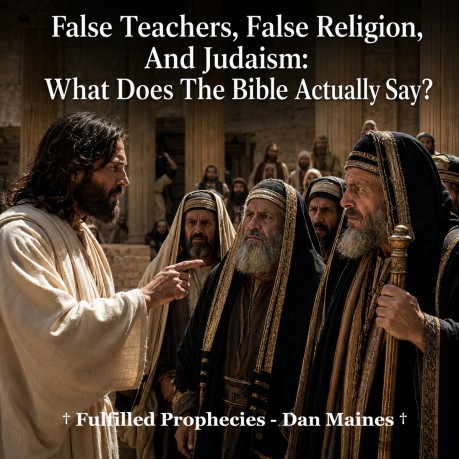
False Teachers, False
Religion, And Judaism: What Does The Bible Actually Say? Introduction Deuteronomy 18:20-22 Matthew 7:15-20 Matthew 23:13-15 Matthew 15:7-9 John 5:39-40 John 8:42-44 Revelation 2:9 Revelation 3:9 Galatians 1:6-9 2 Peter 2:1-3 1
John 2:22-23 1 John 4:1-3 Hebrews 8:13 Historical References How It Applies To Us Today Q & A Appendix Q: Is modern Judaism identical to biblical Old
Covenant Judaism? Q: Does modern Judaism accept Jesus as the
Messiah? Q: Does that mean Christians should call every
Jewish person a false teacher? Q: Does Revelation call all Jewish people the
synagogue of Satan? Q: Can Christians say another religion is
false? Q: Is every Christian who teaches something
incorrectly a false teacher? Q: What's the safest biblical standard? † This is the fulfilled perspective we proclaim at
Fulfilled Prophecies † Source Index
By Dan Maines
† The words
false teacher and false religion are used very freely today.
Sometimes they're applied to anyone who disagrees with us on
prophecy, baptism, spiritual gifts, church government, or another
secondary doctrine. The Bible gives us a much more serious
standard.
† A false teacher isn't simply
someone who's mistaken about something. Scripture repeatedly connects
false teaching with denying Christ, corrupting the gospel, leading
people away from God, exploiting believers, or claiming divine
authority for something God didn't say (Galatians 1:6-9; 2 Peter
2:1-3; 1 John 4:1-3).
† This distinction
matters because Christians can disagree and still belong to Christ.
If every doctrinal disagreement makes someone a false teacher, then
nearly every Christian would have to call nearly every other
Christian a false teacher.
† The same care is
necessary when discussing religion. We shouldn't condemn people
merely because of their ethnicity, ancestry, nationality, or culture.
Scripture judges beliefs and teachings by their relationship to God
and Christ.
† Judaism requires particular
care because biblical Judaism, first-century Judaism, and modern
Rabbinic Judaism aren't identical things. The Old Covenant given
through Moses came from God. It wasn't a false religion. The New
Testament controversy concerned those who continued relying upon the
Old Covenant system while rejecting its Messiah and fulfillment in
Christ.
† This is why Christians sometimes
reach different conclusions when asked whether Judaism should be
called a false religion. Some focus upon its Old Testament origin and
hesitate to use that label. Others focus upon modern Judaism's
rejection of Jesus as Messiah and conclude that its present
theological claims contradict the New Testament. We need to define
exactly what we're talking about instead of using labels carelessly.
But the prophet who
speaks a word presumptuously in My name, a word which I have not
commanded him to speak, or which he speaks in the name of other gods,
that prophet shall die.' And if you say in your heart, 'How will we
recognize the word which the Lord has not spoken?' When the prophet
speaks in the name of the Lord, and the thing does not happen or come
true, that is the thing which the Lord has not spoken. The prophet
has spoken it presumptuously; you are not to be afraid of him.
†
False teachers aren't something Christianity invented. Israel itself
was warned about people claiming to speak for God when God hadn't
sent them.
† The test wasn't personality,
popularity, education, or religious appearance. The question was
whether the message actually came from God (Deuteronomy 13:1-5).
†
This principle remains important today. A person claiming God told me
something doesn't make that claim true. Scripture gives us no reason
to accept someone's supposed divine authority simply because that
person claims it.
Beware of the false
prophets, who come to you in sheep's clothing, but inwardly are
ravenous wolves. You will know them by their fruits. Grapes are not
gathered from thorn bushes, nor figs from thistles, are they? So
every good tree bears good fruit, but the bad tree bears bad fruit. A
good tree cannot bear bad fruit, nor can a bad tree bear good fruit.
Every tree that does not bear good fruit is cut down and thrown into
the fire. So then, you will know them by their fruits.
†
Jesus warned His own disciples that false prophets could look
religious on the outside. The danger wasn't always obvious.
†
Notice that Jesus didn't tell His disciples to label everyone who
misunderstood something as a false prophet. He described people whose
character and fruit exposed what they really were (Matthew
7:21-23).
† That's an important distinction
today. Error should be corrected, but error alone doesn't
automatically prove deliberate deception or make every mistaken
Christian a wolf.
But woe to you, scribes and
Pharisees, hypocrites, because you shut the kingdom of heaven in
front of people; for you do not enter it yourselves, nor do you allow
those who are entering to go in. Woe to you, scribes and Pharisees,
hypocrites, because you travel around on sea and land to make one
proselyte; and when he becomes one, you make him twice as much a son
of hell as yourselves.
† Jesus' strongest
condemnations were often directed toward religious leaders within
first-century Judaism, but we need to identify His target correctly.
Jesus wasn't condemning Jewish ethnicity. Jesus Himself was Jewish
according to the flesh, as were His apostles.
†
He condemned scribes and Pharisees who claimed religious authority
while preventing people from recognizing the kingdom standing before
them in Christ (Matthew 23:23-28).
† Their
problem wasn't that the Law of Moses had been false. Their problem
was that they had corrupted God's truth and were rejecting the One to
whom the Law and the Prophets pointed (John 5:39-40, 45-47).
†
This is one reason we shouldn't say that Old Covenant Judaism was
originally a false religion. God established that covenant. The
problem came when men corrupted it, elevated their traditions,
rejected Christ, and attempted to remain in an order that was
reaching its appointed fulfillment.
You hypocrites, rightly did
Isaiah prophesy about you, by saying: 'This people honors Me with
their lips, But their heart is far away from Me. And in vain do they
worship Me, Teaching as doctrines the commandments of men.'
†
Jesus identified one of the clearest marks of corrupted religion,
human tradition being elevated into religious doctrine.
†
The controversy wasn't Moses versus Jesus. Jesus was confronting
traditions that religious authorities had placed alongside or above
God's commandment (Matthew 15:3-6).
† This
principle reaches far beyond Judaism. Christianity can do exactly the
same thing. Whenever our denomination, creed, tradition, preacher,
prophecy system, or theological school becomes untouchable, we need
to ask whether we're defending Scripture or merely defending what
we've inherited.
You examine the Scriptures
because you think that in them you have eternal life; and it is those
very Scriptures that testify about Me; and yet you are unwilling to
come to Me so that you may have life.
† These
words go directly to the heart of the New Testament controversy with
Jewish leaders who rejected Jesus.
† They
possessed the Scriptures, studied the Scriptures, and claimed the
Scriptures, yet Jesus said those very Scriptures testified about
Him.
† According to Jesus, possessing
biblical writings isn't enough if those writings are interpreted in a
way that refuses the Messiah to whom they point (Luke 24:25-27,
44-47).
† This is central to the Christian
evaluation of modern Judaism. From the New Testament perspective, the
Hebrew Scriptures reach their intended destination in Jesus Christ.
Jesus said to them, If God were
your Father, you would love Me, for I came forth from God and am
here; for I have not even come on My own, but He sent Me. Why do you
not understand what I am saying? It is because you cannot listen to
My word. You are of your father the devil, and you want to do the
desires of your father. He was a murderer from the beginning, and
does not stand in the truth because there is no truth in him.
Whenever he tells a lie, he speaks from his own nature, because he is
a liar and the father of lies.
† Jesus said
this to specific opponents who were rejecting Him and seeking His
death. It must never be turned into an ethnic condemnation of Jewish
people.
† Jesus challenged their claim that
physical descent automatically proved their spiritual standing before
God. Their actions contradicted their claim (John 8:37-41).
†
This same principle appears throughout the New Testament. Physical
ancestry doesn't determine someone's standing in God's kingdom
(Romans 2:28-29; 9:6-8; Galatians 3:26-29).
†
Using this passage as an excuse for hostility toward Jewish people
would misuse Jesus' words. His argument concerned spiritual
allegiance, not race.
I know your tribulation and
your poverty (but you are rich), and the slander by those who say
they are Jews, and are not, but are a synagogue of Satan.
†
This is one of the strongest passages in the New Testament, and it's
also one of the easiest to misuse.
† Jesus
wasn't declaring every Jewish person throughout history a member of a
synagogue of Satan. He was addressing a specific first-century
situation affecting the church at Smyrna.
†
The issue was covenant identity and opposition to Christ's people.
They claimed the covenant name while opposing the Messiah and
persecuting those who belonged to Him.
† In
the fulfilled perspective, Revelation must first be heard by the
seven churches that actually received it. Turning this first-century
judgment into a permanent racial description of Jewish people goes
beyond the text (Revelation 1:4, 11).
Behold, I will make those of
the synagogue of Satan, who say that they are Jews and are not, but
lie-I will make them come and bow down before your feet, and make
them know that I have loved you.
† Again, the
context is first-century conflict, this time involving the church at
Philadelphia.
† The words say they are Jews,
and they are not show that Revelation was dealing with something
deeper than physical ancestry. The controversy concerned true
covenant identity in the Messianic age.
†
Paul taught the same basic principle when he distinguished outward
identity from inward covenant reality (Romans 2:28-29).
†
These passages can't responsibly be ripped from their historical
setting and used as a blanket insult against Jewish people living two
thousand years later.
I am amazed that you are so
quickly deserting Him who called you by the grace of Christ, for a
different gospel, which is not just another account; but there are
some who are disturbing you and want to distort the gospel of Christ.
But even if we, or an angel from heaven, should preach to you a
gospel contrary to what we have preached to you, he is to be
accursed! As we have said before, even now I say again: if anyone is
preaching to you a gospel contrary to what you received, he is to be
accursed!
† Here we find a much stronger
biblical basis for identifying false religion and false teaching.
Paul wasn't discussing minor disagreements. The gospel itself was
being changed.
† The Galatian controversy
involved people attempting to place believers under requirements
associated with the Mosaic covenant, particularly circumcision
(Galatians 5:1-6).
† Paul didn't treat this
as a harmless theological difference because making covenant
membership depend upon those requirements undermined the sufficiency
of Christ.
† The standard remains valuable
today. The closer an error gets to changing who Christ is, what
Christ accomplished, and how people are reconciled to God, the more
serious that error becomes.
But false prophets also
appeared among the people, just as there will also be false teachers
among you, who will secretly introduce destructive heresies, even
denying the Master who bought them, bringing swift destruction upon
themselves. Many will follow their indecent behavior, and because of
them the way of the truth will be maligned; and in their greed they
will exploit you with false words; their judgment from long ago is
not idle, and their destruction is not asleep.
†
Peter gives us another biblical description of false teachers. They
brought destructive teachings, denied the Master, exploited people,
and damaged the reputation of the truth.
†
Notice how much stronger this description is than someone simply
interpreting a difficult passage differently.
†
We should expose destructive teaching, but we shouldn't cheapen the
biblical term false teacher by using it for everyone who disagrees
with us.
† Christians can correct one another
strongly while still recognizing the difference between
misunderstanding Scripture and intentionally leading people away from
Christ.
Who is the liar except the one who denies
that Jesus is the Christ? This is the antichrist, the one who denies
the Father and the Son. Whoever denies the Son does not have the
Father; the one who confesses the Son has the Father also.
†
John makes the issue unmistakably Christ-centered. Denying Jesus as
the Christ wasn't a secondary disagreement.
†
This passage is especially important when discussing whether a
religious system that rejects Jesus as Messiah can be considered true
from a Christian perspective.
† According to
John, someone can't separate acceptance of the Father from acceptance
of the Son. That creates an unavoidable theological conflict between
Christianity and any religious system that explicitly denies Jesus as
the Christ.
† Christians therefore don't need
hatred, insults, or ethnic hostility to say that Judaism's rejection
of Jesus as Messiah contradicts the New Testament. We can disagree
with a religious system while treating the people within it with
dignity and love.
Beloved, do not believe every
spirit, but test the spirits to see whether they are from God,
because many false prophets have gone out into the world. By this you
know the Spirit of God: every spirit that confesses that Jesus Christ
has come in the flesh is from God; and every spirit that does not
confess Jesus is not from God; this is the spirit of the antichrist,
which you have heard is coming, and now it is already in the world.
†
John didn't tell Christians to believe every religious claim simply
because it sounded spiritual. He told them to test what they heard.
†
Again, Jesus Christ stands at the center of the test. Christianity
can't treat denial of Christ as merely another equally valid
interpretation while remaining faithful to John's words.
†
John also located this antichrist controversy in his own time. He
said it was already in the world, which fits the first-century
setting of his warning (1 John 2:18).
† We
should preserve both truths. We don't need to pretend contradictory
religious claims are equally true, and we don't have permission to
mistreat people who believe differently from us.
When He said, "A new
covenant," He has made the first obsolete. But whatever is
becoming obsolete and growing old is about to disappear.
†
This verse helps explain why calling biblical Old Covenant Judaism a
false religion is historically and biblically inaccurate. God
established that covenant, but Hebrews says it had become old and was
near its disappearance.
† Something can be
genuinely established by God for a particular covenant purpose and
still reach the end God appointed for it.
†
The fulfilled perspective sees the first-century transition
culminating in AD 70 when Jerusalem and the temple system were
destroyed, permanently removing the functioning center of the Old
Covenant order (Hebrews 9:8-10; 10:9).
†
Modern Rabbinic Judaism therefore shouldn't simply be treated as
though the Mosaic covenant continued unchanged from Sinai to today.
The destruction of the temple profoundly changed Jewish religious
life.
†
Josephus described the first-century Jewish world, its priesthood,
temple, sects, internal conflicts, and finally the catastrophic
destruction of Jerusalem and the temple in AD 70. His account
demonstrates how completely the historical world surrounding the New
Testament judgment texts was transformed (Josephus, Wars of the Jews,
Books 5-7).
† Josephus recorded the burning
and destruction of the temple under Titus, followed by Jerusalem's
devastation. Whatever theological interpretation someone gives those
events, the physical center of sacrificial Judaism was gone
(Josephus, Wars of the Jews 6.4-6; 7.1).
†
Tacitus independently described the Roman siege of Jerusalem and the
Jewish resistance during the first-century war, providing
non-Christian historical testimony concerning the conflict that ended
with Jerusalem's destruction (Tacitus, Histories 5.10-13).
†
Eusebius later connected Jerusalem's catastrophe with Jesus' warnings
and recorded the Christian tradition that believers left Jerusalem
before the city's destruction (Eusebius, Ecclesiastical History
3.5-7).
† The Mishnah, compiled around AD 200
from earlier traditions, demonstrates the development of Rabbinic
Judaism after the temple period. Without the temple and functioning
sacrificial system, Jewish religious practice increasingly centered
upon Torah study, prayer, synagogue life, and rabbinic interpretation
(Mishnah, especially Berakhot, Avot, and sections preserving temple
traditions).
† Justin Martyr's Dialogue with
Trypho, written in the second century, shows that Christians and Jews
were already debating whether Jesus fulfilled Israel's Scriptures and
whether the Mosaic covenant remained binding after Christ (Justin
Martyr, Dialogue with Trypho).
† These
historical sources help us distinguish ancient Israel under the
Mosaic covenant, the competing forms of Judaism existing during
Jesus' generation, and Rabbinic Judaism that developed after the
destruction of the temple. Treating all three as though they're
exactly the same creates unnecessary confusion.
†
We shouldn't call someone a false teacher merely because that person
disagrees with our interpretation of prophecy, resurrection, baptism,
spiritual gifts, church government, or another disputed subject.
†
We should ask more serious questions. Does the teaching deny Christ?
Does it replace or corrupt the gospel? Does it claim divine authority
falsely? Does it exploit people? Does it knowingly lead people away
from what Scripture teaches? Those are much closer to the biblical
tests (Galatians 1:6-9; 2 Peter 2:1-3; 1 John 2:22-23).
†
We also need to distinguish between people and religious systems. A
Jewish person isn't our enemy because that person is Jewish. An
individual's ethnicity tells us nothing about that person's
character.
† Christianity and modern Judaism
do, however, make incompatible claims about Jesus. Christianity says
Jesus is the promised Messiah, Son of God, and fulfillment of
Israel's hope. Rabbinic Judaism doesn't accept those claims. Both
positions can't be true in the same sense.
†
From a New Testament Christian perspective, any religious system that
denies Jesus as the Christ is wrong at its most important theological
point (1 John 2:22-23). Saying that isn't hatred. It's simply
acknowledging what the New Testament teaches.
†
At the same time, phrases such as synagogue of Satan must remain
anchored in their first-century contexts. They aren't permission to
condemn an ethnicity or attach Satanic identity to every Jewish
synagogue or Jewish person today (Revelation 2:9; 3:9).
†
We should apply the same standard to ourselves. Christianity written
on a church sign doesn't guarantee that everything taught inside that
building is true. Jesus condemned religious hypocrisy wherever
religious authority was being used to hide corruption or obstruct
truth (Matthew 7:15-20; 23:13-15).
† The
question shouldn't be, What label can I put on these people? The
better question is, Does this teaching agree with Jesus Christ and
the gospel revealed in Scripture?
† Truth
doesn't require hatred. Love doesn't require pretending every belief
is true. We can reject false doctrine without hating the person who
believes it.
Q: Was
Old Covenant Judaism a false religion?
A: No.
God Himself established the Mosaic covenant with Israel. The New
Testament teaches that it reached its intended fulfillment in Christ
and became old as the New Covenant arrived (Hebrews 8:13; 10:9).
A: No. There are historical
continuities, but modern Rabbinic Judaism developed significantly
after the destruction of Jerusalem and the temple in AD 70. The
biblical sacrificial system required a sanctuary, priesthood, altar,
and sacrifices that no longer function as they did under the Mosaic
covenant (Hebrews 9:1-10).
A: Mainstream Judaism doesn't accept
Jesus as the promised Messiah or divine Son of God. Christianity
does, and the New Testament places confession of the Son at the
center of knowing the Father (1 John 2:22-23).
A: No. A person
isn't a false teacher merely because of Jewish ancestry or identity.
False teacher describes someone teaching falsehood, particularly
destructive teaching presented with religious authority (2 Peter
2:1-3).
A: No. Revelation addressed
specific first-century opponents of the churches at Smyrna and
Philadelphia who claimed covenant status while opposing Christ's
people (Revelation 2:9; 3:9).
A: Yes, when its fundamental claims
contradict what Scripture teaches about God, Christ, and the gospel.
But Christians should identify the specific false teaching rather
than using labels carelessly or treating people with contempt
(Galatians 1:6-9; 1 John 4:1-3).
A: No. Scripture
distinguishes between error that needs correction and destructive
teaching that denies foundational truth. Even sincere believers can
misunderstand Scripture and need correction (Acts 18:24-26).
A:
Test the teaching by Scripture, examine what it says about Jesus
Christ and the gospel, look at its fruit, and don't make accusations
that go beyond the evidence (Matthew 7:15-20; 1 John 4:1-3).
© Fulfilled Prophecies - Dan
Maines.
†
Deuteronomy 18:20-22; Matthew 7:15-20; Matthew 23:13-15; Matthew
15:7-9; John 5:39-40; John 8:42-44; Revelation 2:9; Revelation 3:9;
Galatians 1:6-9; 2 Peter 2:1-3; 1 John 2:22-23; 1 John 4:1-3; Hebrews
8:13
† Josephus, Wars of the Jews, Books 5-7;
Tacitus, Histories 5.10-13; Eusebius, Ecclesiastical History 3.5-7;
Mishnah, Berakhot and Avot; Justin Martyr, Dialogue with Trypho
Links