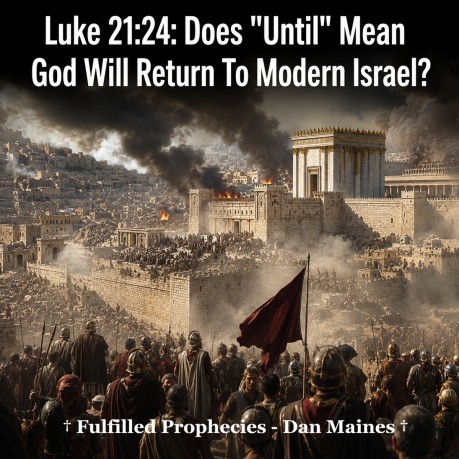
Luke 21:24: Does "Until"
Mean God Will Return To Modern Israel? Introduction Luke 21:20-22 Luke 21:23-24 Luke 21:29-32 Romans 11:25-27 Galatians 3:26-29 Ephesians 2:14-16 Hebrews 8:13 Hebrews 12:22-24 Historical References How It Applies To Us Today Q & A Appendix † This is the fulfilled perspective we proclaim at
Fulfilled Prophecies †
By Dan Maines
† Many read
the word "until" in Luke 21:24 and immediately assume Jesus
was describing a temporary Gentile period that would eventually end
with God turning His prophetic attention back to the modern state of
Israel.
† But the word "until"
doesn't automatically prove that whatever existed before the stated
event will begin again afterward.
† The
question isn't whether Jesus said "until." He clearly did.
The question is what event Jesus said would continue until its
appointed limit, and whether He ever said national Israel would
afterward be restored to a special prophetic position.
†
Luke 21 answers that question within its own context. Jesus was
describing the coming destruction of Jerusalem, the judgment of that
generation, and the fulfillment of what had been written (Luke
21:20-22, 32).
† We can't take one word from
verse 24, detach it from the surrounding prophecy, and build an
entirely new prophetic program thousands of years beyond the
generation Jesus was addressing.
But when you see Jerusalem
surrounded by armies, then recognize that her desolation is near.
Then those who are in Judea must flee to the mountains, and those who
are inside the city must leave, and those who are in the country must
not enter the city; because these are days of punishment, so that all
things which have been written will be fulfilled.
†
Jesus identified the event plainly. Jerusalem would be surrounded by
armies, and its desolation would be near.
†
These were the days of vengeance connected directly with Jerusalem,
not a prophecy about events thousands of years later (Luke
21:20-21).
† Jesus even said these were the
days in which all things written concerning this judgment would be
fulfilled (Luke 21:22).
Woe to those women who are
pregnant, and to those who are nursing babies in those days; for
there will be great distress upon the land, and wrath to this people;
and they will fall by the edge of the sword, and will be led captive
into all the nations; and Jerusalem will be trampled underfoot by the
Gentiles until the times of the Gentiles are fulfilled.
†
Notice exactly what Jesus said. The distress would be upon the land,
and the wrath would come upon this people.
†
The people would fall by the sword, others would be taken captive,
and Jerusalem would be trampled by the Gentiles. This is judgment
language directed toward first-century Jerusalem (Luke 21:20-23).
†
The word "until" places a limit on the trampling. It
doesn't say that when the trampling ended, God would restore national
Israel to its former covenant status.
† Jesus
didn't say, "Jerusalem will be trampled until the times of the
Gentiles are fulfilled, and then Israel will again become My covenant
nation." That conclusion has been added to the text.
†
The verse tells us when the trampling reaches its appointed
completion. It doesn't establish a future Jewish prophetic age
afterward.
And He told them a parable:
Look at the fig tree and all the trees: as soon as they put forth
leaves, you see for yourselves and know that summer is now near. So
you too, when you see these things happening, recognize that the
kingdom of God is near. Truly I say to you, this generation will not
pass away until all things take place.
†
Jesus gave the timing of the prophecy Himself. The generation hearing
Him wouldn't pass away until all these things were accomplished.
†
Notice another use of "till." Jesus said that generation
wouldn't pass away till all things were accomplished. The time
limitation belongs to His first-century audience and the events they
were told to watch for (Luke 21:28, 31).
† If
Luke 21:24 is removed from this generation and extended thousands of
years, the natural time boundary Jesus gave in the same discourse
loses its force.
† The modern state of Israel
didn't exist when Jesus spoke these words, and nothing in this
passage tells His disciples to look thousands of years into the
future for its establishment.
For I do not want you,
brothers and sisters, to be uninformed of this mystery-so that you
will not be wise in your own estimation-that a partial hardening has
happened to Israel until the fullness of the Gentiles has come in;
and so all Israel will be saved; just as it is written: "The
Deliverer will come from Zion, He will remove ungodliness from
Jacob." "This is My covenant with them, When I take away
their sins."
† Romans 11 contains
another important "until." Paul said a partial hardening
had happened to Israel until the fullness of the Gentiles came in.
†
Paul was explaining a redemptive process already taking place in his
own ministry, not announcing that God would stop saving Gentiles and
later restart an Old Covenant arrangement with national Israel
(Romans 11:5, 11-15).
† The salvation Paul
described was centered in Christ and the removal of sins. He didn't
describe the creation of a modern political state as the fulfillment
of this promise (Romans 11:26-27).
† The
covenant promise reaches its goal in the Deliverer and His saving
work, not in returning to the covenant order that Christ fulfilled.
For you are all sons and
daughters of God through faith in Christ Jesus. For all of you who
were baptized into Christ have clothed yourselves with Christ. There
is neither Jew nor Greek, there is neither slave nor free, there is
neither male nor female; for you are all one in Christ Jesus. And if
you belong to Christ, then you are Abraham’s descendants, heirs
according to promise.
† Paul tells us where
covenant identity is found under the New Covenant. It's found in
Christ.
† The distinction between Jew and
Greek doesn't establish two separate covenant peoples with two
separate prophetic destinies (Ephesians 2:14-18).
†
Those who belong to Christ are Abraham's seed and heirs according to
promise. Paul doesn't tell believers to expect God to reverse this
and return to a flesh-based covenant identity.
For He Himself is our
peace, who made both groups into one and broke down the barrier of
the dividing wall, by abolishing in His flesh the hostility, which is
the Law composed of commandments expressed in ordinances, so that in
Himself He might make the two one new person, in this way
establishing peace; and that He might reconcile them both in one body
to God through the cross, by it having put to death the hostility.
†
Christ made Jew and Gentile one. The New Covenant doesn't divide
God's people back into separate covenant programs.
†
Jesus created one new humanity in Himself and reconciled both to God
in one body (Ephesians 2:18-22).
† A theology
that expects God eventually to reverse this unity and restore a
separate national covenant program must demonstrate that from
Scripture. Luke 21:24 doesn't say it.
When He said, "A new
covenant," He has made the first obsolete. But whatever is
becoming obsolete and growing old is about to disappear.
†
The Old Covenant wasn't waiting to be temporarily suspended so that
it could return thousands of years later.
†
Hebrews describes it as old, aging, and near disappearance. The
direction of redemptive history was from the Old Covenant into the
New Covenant, not from the Old Covenant to the New Covenant and
eventually back again.
† The destruction of
Jerusalem and the temple in AD 70 visibly removed the old covenantal
order that had already been declared obsolete through Christ (Hebrews
8:6-12).
But you have come to Mount
Zion and to the city of the living God, the heavenly Jerusalem, and
to myriads of angels, to the general assembly and church of the
firstborn who are enrolled in heaven, and to God, the Judge of all,
and to the spirits of the righteous made perfect, and to Jesus, the
mediator of a new covenant, and to the sprinkled blood, which speaks
better than the blood of Abel.
† The New
Covenant destination isn't a return to the old earthly Jerusalem.
Hebrews points believers to Mount Zion and the heavenly Jerusalem.
†
The writer says believers had come to this reality through Jesus, the
mediator of the New Covenant.
† This is why
Luke 21:24 shouldn't be interpreted as though the goal of prophecy is
eventually to restore the old covenantal importance of earthly
Jerusalem.
†
Josephus describes Jerusalem surrounded by Roman forces, the terrible
famine within the city, enormous loss of life, captivity, and the
final destruction of Jerusalem and its temple in AD 70. His account
provides a powerful historical parallel to the conditions Jesus
described in Luke 21:20-24. Josephus, Wars of the Jews, Books 5-7.
†
Tacitus also records the Roman campaign against Jerusalem, the siege,
the conditions within the city, and the eventual destruction
associated with the Jewish war. Tacitus, Histories, Book 5.
†
Eusebius records the early Christian tradition that believers in
Jerusalem departed before the city's destruction, connecting the
first-century Christian community with the approaching judgment upon
Jerusalem. Eusebius, Ecclesiastical History, Book 3, chapters 5-7.
†
These historical accounts place the trampling of Jerusalem in the
very first-century setting Jesus described. We don't need to move
Luke 21:24 thousands of years beyond its stated context to find its
historical setting.
†
We need to let "until" mean what its context allows it to
mean. A word by itself can't establish an entire prophetic system.
†
Luke 21:24 says Jerusalem would be trampled until the appointed times
of the Gentiles reached their fulfillment. It doesn't say that
afterward God would return to an Old Covenant relationship with
national Israel.
† Our covenant standing
today isn't determined by ethnicity, geography, an earthly temple, or
citizenship in a particular nation. It's found in Christ (Galatians
3:26-29).
† We aren't waiting for God to
rebuild what Christ fulfilled. We've come to Mount Zion, the heavenly
Jerusalem, through Jesus and the New Covenant (Hebrews 12:22-24).
†
The modern state of Israel should be understood as a modern nation.
Luke 21:24 doesn't identify its establishment as a prophetic event or
say that God would someday resume a separate covenant program with
it.
Q:
Doesn't the word "until" prove something changes
afterward?
A: It proves that the condition
being discussed has an appointed limit. It doesn't automatically tell
us what happens afterward. The context must supply that information.
Luke 21:24 limits Jerusalem's trampling, but it never says Israel
afterward returns to its former covenant status (Luke 21:20-24).
Q:
Doesn't "the times of the Gentiles" mean a Gentile age
lasting thousands of years?
A: Jesus doesn't
say that. His subject is Jerusalem's coming judgment, and He places
the events of the discourse within the generation He was addressing
(Luke 21:20-24, 29-32).
Q: Does Romans 11:25
teach that God will eventually turn away from Gentiles and back to
national Israel?
A: Paul says a partial
hardening had happened to Israel while God's saving purpose was
bringing Gentiles in. Salvation remained centered in Christ, and Paul
doesn't say God would later restore the Old Covenant system (Romans
11:25-27).
Q: Is modern Israel the fulfillment
of Luke 21:24?
A: Luke 21:24 never mentions a
modern political state. Jesus was discussing first-century Jerusalem,
its siege, its inhabitants, its captivity, and its trampling by
Gentile forces (Luke 21:20-24).
Q: Where is
God's covenant people found today?
A: In
Christ. Those who belong to Christ are Abraham's seed and heirs
according to promise, and Jew and Gentile have been made one in Him
(Galatians 3:26-29; Ephesians 2:14-16).
Q: Are
we waiting for earthly Jerusalem to regain its former covenant
position?
A: No. The New Testament directs
God's people to Mount Zion and the heavenly Jerusalem under Jesus,
the mediator of the New Covenant (Hebrews 12:22-24).
© Fulfilled Prophecies - Dan
Maines.
Source Index
†
Luke 21:20-22; Luke 21:23-24; Luke 21:29-32; Romans 11:25-27;
Galatians 3:26-29; Ephesians 2:14-16; Hebrews 8:13; Hebrews
12:22-24
† Josephus, Wars of the Jews, Books
5-7; Tacitus, Histories, Book 5; Eusebius, Ecclesiastical History,
Book 3, chapters 5-7
Links