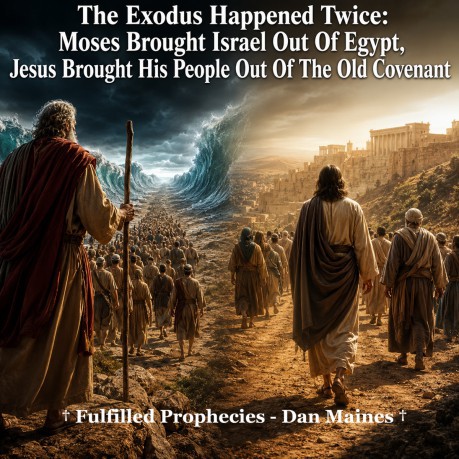
The Exodus Happened Twice:
Moses Brought Israel Out Of Egypt, Jesus Brought His People Out Of
The Old Covenant Introduction Exodus 12:11-13 1 Corinthians 5:7 1 Corinthians 10:1-4 1 Corinthians 10:5-6 1 Corinthians 10:11-12 Hebrews 3:7-11 Hebrews 3:12-14 Hebrews 4:1-3 Hebrews 8:6-8 Hebrews 8:13 Hebrews 10:36-39 Hebrews 12:22-24 Hebrews 12:28 The Forty-Year Pattern Historical References How It Applies To Us Today Q & A Appendix Q: Was the forty-year period from Christ to AD 70
exactly the same as Israel's wilderness journey? Q: What was the greater Egypt from which Christ
delivered His people? Q: What was the promised inheritance of the
greater Exodus? Q: Why is AD 70 important to this pattern? Q: Are Christians today still waiting to complete
this forty-year wilderness? † This is the fulfilled perspective we proclaim at
Fulfilled Prophecies † Source Index
By Dan Maines
† The Bible
tells the story of two great exodus events. The first was physical
and national, when God brought Israel out of Egypt under Moses. The
second was covenantal and redemptive, when Jesus brought His people
out of the bondage of the Old Covenant age and into the inheritance
of the New Covenant kingdom.
† The first
Exodus established the pattern. There was bondage, a Passover lamb,
deliverance through water, a wilderness journey, bread from heaven, a
covenant, judgment on the unbelieving generation, and finally
entrance into the promised inheritance.
† The
New Testament deliberately uses that Exodus pattern to explain what
was happening in the first century. Jesus is the greater deliverer,
Christ is the Passover Lamb, baptism corresponds to the passage
through the sea, Christ is the spiritual food and drink, and the
first-century believers were warned not to fall in the wilderness of
unbelief (1 Corinthians 5:7; 10:1-12).
† This
is especially important because Paul said Israel's wilderness
experiences were examples written as warnings for the believers who
were living at the end of the ages (1 Corinthians 10:11). He didn't
place the fulfillment thousands of years beyond his readers.
†
Hebrews develops the same pattern. The first-century church had been
delivered, but they were still awaiting the completed entrance into
the promised rest. Like Israel between Egypt and Canaan, they were
living during a covenant transition.
†
Israel's first wilderness period lasted forty years. The New Covenant
transition also unfolded across approximately forty years, from the
ministry, death, resurrection, and ascension of Christ to the
judgment of Jerusalem and the removal of the Old Covenant order in AD
70.
† The Exodus wasn't merely an ancient
story for the first-century believers. It was the prophetic pattern
through which they could understand their own generation.
Now you shall eat it in this
way: with your garment belted around your waist, your sandals on your
feet, and your staff in your hand; and you shall eat it in a hurry-it
is the Lord's Passover. For I will go through the land of Egypt on
that night, and fatally strike all the firstborn in the land of
Egypt, from the human firstborn to animals; and against all the gods
of Egypt I will execute judgments-I am the Lord. The blood shall be a
sign for you on the houses where you live; and when I see the blood I
will pass over you, and no plague will come upon you to destroy you
when I strike the land of Egypt.
† The first
Exodus began with Passover. Israel's deliverance wasn't based upon
its own strength, but upon the blood of the sacrificial lamb.
†
The Passover separated those protected by the blood from those who
remained under judgment. Deliverance and judgment occurred together
on the same night.
† The New Testament
identifies Christ as the fulfillment of this Passover pattern. Paul
wrote that Christ our Passover had been sacrificed (1 Corinthians
5:7). Jesus wasn't simply another lamb in a long succession of
sacrifices, He was the reality to which Passover had been pointing.
Clean out the old leaven
so that you may be a new lump, just as you are in fact unleavened.
For Christ our Passover also has been sacrificed.
†
Paul doesn't leave the Passover connection to speculation. He
directly identifies Christ as the Passover sacrifice.
†
Moses led Israel from slavery under Pharaoh, but Jesus accomplished
the greater deliverance from sin, condemnation, and the covenant
administration that could expose sin but couldn't bring perfection
(Hebrews 7:19; 10:1).
† The first Passover
began Israel's journey out of Egypt. Christ's sacrifice began the
climactic New Covenant Exodus that would bring His people out of the
old age and into the fully established kingdom.
For I do not want you
to be unaware, brothers and sisters, that our fathers were all under
the cloud and they all passed through the sea; and they all were
baptized into Moses in the cloud and in the sea; and they all ate the
same spiritual food, and all drank the same spiritual drink, for they
were drinking from a spiritual rock which followed them; and the rock
was Christ.
† Paul explicitly connects the
Exodus with baptism. Israel passed through the sea and was baptized
into Moses, while believers were identified with Christ in the
greater redemptive reality (Romans 6:3-4).
†
Israel came out of Egypt before entering Canaan. Their deliverance
began a journey. In the same way, the first-century believers had
been redeemed by Christ while still moving toward the consummation of
the covenant transition.
† Paul also connects
the wilderness manna and water with Christ. The Exodus pattern wasn't
accidental. Christ stood at the center of what those wilderness signs
anticipated.
† Passover, water, spiritual
food, spiritual drink, wilderness testing, and inheritance form one
continuous pattern. Paul expects his readers to recognize themselves
within that pattern.
Nevertheless, with most
of them God was not pleased; for their dead bodies were spread out in
the wilderness. Now these things happened as examples for us, so
that we would not crave evil things as they indeed craved them.
†
The generation that left Egypt wasn't automatically guaranteed
entrance into the land. Many fell during the wilderness because of
unbelief and rebellion.
† Paul tells
first-century Christians that these events were their examples. His
warning only makes sense if they were passing through a comparable
period of testing.
† The danger was covenant
apostasy. Just as Israelites wanted to turn back toward Egypt, some
first-century believers were tempted to turn back toward the Old
Covenant system they had been called to leave behind (Hebrews
10:26-39).
† The message was clear, don't go
back. The greater Moses had come, the greater Passover had been
sacrificed, and the greater inheritance was ahead.
Now these things
happened to them as an example, and they were written for our
instruction, upon whom the ends of the ages have come. Therefore let
the one who thinks he stands watch out that he does not fall.
†
This passage establishes the timing. Paul says the wilderness events
were written for "our admonition," speaking to his
first-century audience.
† Even more
importantly, Paul says the ends of the ages had come upon them. He
doesn't say the ends would come upon people thousands of years
later.
† The first-century church was
standing at the end of an age. The Old Covenant world was passing
away while the New Covenant order was being established in its
fullness (Hebrews 8:13).
† That's why
Israel's forty-year wilderness experience was so relevant. Their
history provided the pattern for the generation living through the
end of the Old Covenant age.
Therefore, just as the Holy
Spirit says, "Today if you hear His voice, Do not harden your
hearts as when they provoked Me, As on the day of trial in the
wilderness, Where your fathers put Me to the test, And saw My works
for forty years. Therefore I was angry with this generation, And
said, 'They always go astray in their heart, And they did not know My
ways'; As I swore in My anger, 'They certainly shall not enter My
rest.'"
† Hebrews brings the forty-year
wilderness directly into its warning to first-century Jewish
believers.
† Israel saw God's works for forty
years, yet an unbelieving generation failed to enter the promised
rest. The writer warns his own generation not to repeat that
rebellion.
† The language of "today"
makes the warning immediate. Those believers weren't being instructed
primarily about Christians living thousands of years later. They
faced a present covenant decision.
† The
parallel is powerful. The first generation experienced deliverance
from Egypt followed by forty years of wilderness testing. The
generation of Jesus and the apostles experienced the beginning of the
greater Exodus and then lived through the transition leading to the
end of the Old Covenant age.
Take care, brothers and
sisters, that there will not be in any one of you an evil,
unbelieving heart that falls away from the living God. But encourage
one another every day, as long as it is still called "today,"
so that none of you will be hardened by the deceitfulness of sin. For
we have become partakers of Christ if we keep the beginning of our
commitment firm until the end,
† The writer
addresses living people who could fall away during their own covenant
wilderness. The warning was urgent because they were approaching the
end.
† They were told to hold their
confidence firm "to the end." In the context of Hebrews,
that end belongs to the covenant transition already underway, not the
destruction of the physical universe.
†
Returning to the Old Covenant system would have been comparable to
Israel wanting to return to Egypt. They were being called forward
into Christ, not backward into the system that was becoming obsolete
(Hebrews 8:13).
Therefore, we must fear if,
while a promise remains of entering His rest, any one of you may seem
to have come short of it. For indeed we have had good news preached
to us, just as they also did; but the word they heard did not benefit
them, because they were not united with those who listened with
faith. For we who have believed enter that rest, just as He has said,
"As I swore in My anger, They certainly shall not enter My
rest," although His works were finished from the foundation of
the world.
† Hebrews moves directly from
Israel's failed wilderness generation to the New Covenant promise of
entering God's rest.
† Canaan was never the
ultimate reality. It was the earthly pattern. The greater rest is
found in Christ and His completed kingdom.
†
The first-century believers had already begun entering that rest by
faith, yet Hebrews still urged them forward toward the completed
covenant reality.
† This already-and-not-yet
condition makes sense during the transition between the covenants.
They had left the old realm, but the old system hadn't yet
disappeared completely.
But now He has obtained a more
excellent ministry, to the extent that He is also the mediator of a
better covenant, which has been enacted on better promises. For if
that first covenant had been free of fault, no circumstances would
have been sought for a second. For in finding fault with the people,
He says, "Behold, days are coming, says the Lord, When I will
bring about a new covenant With the house of Israel and the house of
Judah,
† The greater Exodus wasn't merely an
escape from political oppression. It was movement from one covenant
administration into another.
† Moses mediated
the covenant associated with the first Exodus. Jesus mediates the
better covenant associated with the greater Exodus.
†
The destination wasn't another geographical Canaan. It was the better
covenant, the better promises, the better priesthood, the better
sacrifice, and the better heavenly country revealed throughout
Hebrews (Hebrews 7:22; 9:23; 11:16).
†
Everything about the second Exodus is greater because everything
centers upon Christ.
When He said, "A new
covenant," He has made the first obsolete. But whatever is
becoming obsolete and growing old is about to disappear.
†
This verse gives us the covenant setting of Hebrews. The first
covenant was old, aging, and near to disappearing when Hebrews was
written.
† Notice the transition language.
The Old Covenant had been made obsolete by the establishment of the
New Covenant, yet its visible institutional order was still awaiting
its final removal.
† That explains why the
wilderness imagery is so appropriate. They were living between the
decisive redemptive work of Christ and the historical removal of the
Old Covenant system.
† AD 70 brought the
destruction of Jerusalem and the temple, ending the functioning
priesthood, sacrifices, and temple order that represented the former
covenant age.
For you have need of
endurance, so that when you have done the will of God, you may
receive what was promised. For yet in a very little while, He who is
coming will come, and will not delay. But My righteous one will live
by faith; And if he shrinks back, My soul has no pleasure in him.
But we are not among those who shrink back to destruction, but of
those who have faith for the safekeeping of the soul.
†
The wilderness generation needed endurance before entering Canaan.
Hebrews says these believers also needed endurance before receiving
the promise.
† The writer says it would
happen in "a very little while." That language belongs to
the expectations of the original audience.
†
Once again the warning is not to shrink back. Egypt was behind
ancient Israel, and the obsolete covenant order was behind the
followers of Christ.
† They weren't to return
to the shadows when the reality had arrived in Christ (Hebrews 10:1).
But you have come to Mount
Zion and to the city of the living God, the heavenly Jerusalem, and
to myriads of angels, to the general assembly and church of the
firstborn who are enrolled in heaven, and to God, the Judge of all,
and to the spirits of the righteous made perfect, and to Jesus, the
mediator of a new covenant, and to the sprinkled blood, which speaks
better than the blood of Abel.
† Here we see
the destination of the greater Exodus. It wasn't earthly Jerusalem,
but heavenly Jerusalem. It wasn't Sinai, but Mount Zion.
†
Moses brought Israel to a mountain where the Old Covenant was given.
Jesus brought His people to the heavenly Zion of the New Covenant.
†
The contrast running through Hebrews reaches its climax here. Sinai
gives way to Zion, the earthly city gives way to the heavenly
Jerusalem, the old mediation gives way to Jesus, and animal blood
gives way to the blood of Christ.
† The
Exodus pattern has reached its greater fulfillment. God's people
haven't been brought into another temporary national arrangement.
They've been brought into the everlasting kingdom of Christ.
Therefore, since we receive a
kingdom which cannot be shaken, let's show gratitude, by which we may
offer to God an acceptable service with reverence and awe;
†
The inheritance of the greater Exodus is an unshakable kingdom.
†
Ancient Israel inherited a physical land that could be invaded,
conquered, and lost. The kingdom received through Christ can't be
shaken or removed.
† This is why the
destruction of the Old Covenant world wasn't the destruction of God's
kingdom. It revealed the permanence of the kingdom that couldn't be
shaken.
† The first Exodus ended with Israel
established in a land. The greater Exodus culminated in God's people
established in the everlasting New Covenant kingdom.
†
Israel's first Exodus produced a forty-year transition between
deliverance from Egypt and entrance into the inheritance.
†
Jesus' ministry began the climactic covenant transition in the first
century, followed by approximately forty years before Jerusalem and
the temple fell in AD 70.
† During both
periods there were signs, miracles, divine provision, opposition,
unbelief, apostasy, and warnings against turning back.
†
During both periods an old world stood behind God's people while an
inheritance stood before them.
† In the first
Exodus, Egypt was behind them and Canaan was ahead. In the greater
Exodus, the Old Covenant age was passing away while the fully
established New Covenant kingdom stood before that generation.
†
Paul explicitly tells us to read Israel's wilderness history as an
example for his generation, and Hebrews repeatedly builds its
warnings around exactly the same wilderness pattern.
†
This doesn't require inventing a forty-year pattern and forcing it
onto Scripture. The New Testament writers themselves establish the
Exodus framework and apply it to their first-century audience.
†
Josephus described the catastrophic destruction of Jerusalem in AD
70, including famine, internal conflict, Roman siege, the burning of
the temple, and the collapse of the city. His account provides
important historical testimony concerning the judgment that ended the
temple-centered Jewish order.
† Eusebius
later recorded the early Christian tradition that believers in
Jerusalem left the city before the war and went to Pella. This fits
the New Testament emphasis upon believers recognizing the approaching
judgment and refusing to remain attached to Jerusalem.
†
These historical witnesses don't establish the doctrine, Scripture
does. They help confirm the historical setting in which the
first-century warnings concerning Jerusalem reached their
fulfillment.
†
We aren't wandering through the Old Covenant wilderness waiting for
another AD 70. That transition belonged to the first-century
generation.
† We live on the fulfilled side
of the greater Exodus. Christ has accomplished redemption, the Old
Covenant age has passed away, and the kingdom that can't be shaken
has been established.
† We don't need another
Moses, another Passover, another wilderness period, another temple,
or another covenant transition. Jesus completed the greater work.
†
Our calling today is to live faithfully in the kingdom we've
received, trusting the finished work of Christ and proclaiming the
good news of His reign.
† The Exodus story
becomes even more powerful when we see where it was pointing. Moses
brought Israel out of Egypt. Jesus brought His people out of the Old
Covenant age and into the everlasting New Covenant kingdom.
†
The first Exodus was the shadow. Christ accomplished the greater
reality.
Q: Why
should we connect the Exodus with the first-century church?
A:
Because Paul does it himself. He says Israel's passage through the
sea, wilderness experiences, spiritual food, spiritual drink,
rebellion, and judgment were examples written as warnings for his
first-century audience, who were living at the end of the ages (1
Corinthians 10:1-12).
A:
No, it was a typological fulfillment, not a repetition of every
historical detail. Israel's forty years established the pattern,
while the New Testament applies that wilderness pattern to the
first-century covenant transition (Hebrews 3:7-19; 4:1-11).
A: The New Testament's
emphasis is greater than geographical Egypt. Christ delivered His
people from sin, death, condemnation, and the obsolete covenant order
that couldn't perfect the worshiper (Hebrews 8:6-13; 10:1-18).
A: It wasn't another piece of
earthly territory. God's people came to Mount Zion, the heavenly
Jerusalem, Jesus the mediator of the New Covenant, and the kingdom
that can't be shaken (Hebrews 12:22-28).
A:
AD 70 brought the historical destruction of Jerusalem and the temple
system that represented the Old Covenant order. Hebrews had already
said that covenant was old, aging, and about to disappear (Hebrews
8:13).
A: No. Paul's "ends
of the ages" belonged to his audience, and Hebrews described the
Old Covenant as already near disappearance (1 Corinthians 10:11;
Hebrews 8:13). We live in the kingdom that can't be shaken (Hebrews
12:28).
© Fulfilled Prophecies - Dan
Maines.
† Exodus
12:11-13; 1 Corinthians 5:7; 1 Corinthians 10:1-4; 1 Corinthians
10:5-6; 1 Corinthians 10:11-12; Hebrews 3:7-11; Hebrews 3:12-14;
Hebrews 4:1-3; Hebrews 8:6-8; Hebrews 8:13; Hebrews 10:36-39; Hebrews
12:22-24; Hebrews 12:28
† Historical writers:
Flavius Josephus; Eusebius of Caesarea
Links