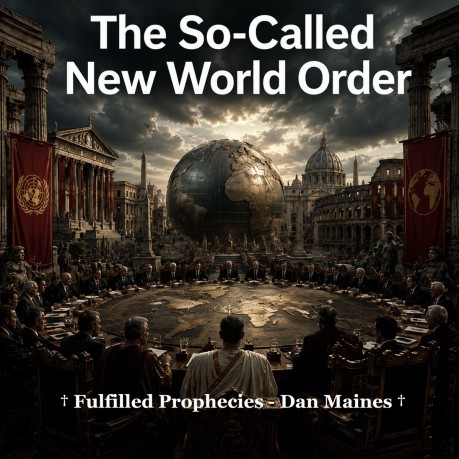
The So-Called New World Order
Introduction Matthew 24:33-34 Luke 21:20-22 Revelation 1:1-3 Revelation 13:16-18 1 John 2:18 Daniel 2:44 Colossians 1:13 Hebrews 12:28 Revelation 22:6-7 Revelation 22:10 Historical References How It Applies To Us Today Q & A Appendix Q: Does a one-world government have to exist
before Jesus returns? Q: Is the New World Order the beast of
Revelation? Q: Could digital currency become the mark of the
beast? Q: Should Christians be concerned about
government corruption today? Q: What should Christians fear if prophecy has
been fulfilled? Q: Can any future government defeat the kingdom
of Christ? † This is the fulfilled perspective we proclaim at
Fulfilled Prophecies † Source Index
By Dan Maines
† The phrase
New World Order has become one of the most powerful fear-producing
expressions in modern Christianity. For decades, Christians have been
told that a coming world government will fulfill Bible prophecy,
produce the Antichrist, establish the mark of the beast, trigger the
Great Tribulation, and prepare the world for the physical return of
Jesus Christ.
† But there's an important
question that must be asked. Where does the Bible actually say New
World Order?
† It doesn't. The phrase New
World Order doesn't appear anywhere in Scripture.
†
Governments can become corrupt. Nations can cooperate. Political
leaders can seek greater power. Financial systems can become
increasingly interconnected. None of those realities automatically
make them fulfillments of Bible prophecy.
†
The problem begins when modern political events are placed into
prophetic passages while the inspired time statements, original
audience, and historical setting of those passages are ignored.
†
Jesus didn't tell Christians living thousands of years later to
recognize the fulfillment of His Olivet prophecy. He spoke directly
to His first-century disciples and placed the fulfillment within
their generation (Matthew 24:3, 34).
†
Revelation didn't tell its original readers that its prophecies
concerned events thousands of years in their future. They were told
that the things revealed must shortly come to pass and that the time
was at hand (Revelation 1:1-3).
† Fulfilled
prophecy doesn't teach us to ignore modern governments. It teaches us
not to turn every modern government, war, treaty, economic system,
technological development, or political movement into an unfulfilled
Bible prophecy.
so you too, when you see
all these things, recognize that He is near, right at the door. Truly
I say to you, this generation will not pass away until all these
things take place.
† Jesus identified the
generation that would see all these things. He didn't say that
generation would begin thousands of years later. He said this
generation (Matthew 24:34).
† The disciples
who heard Jesus were given observable signs because the judgment
concerned their world and their generation (Matthew 24:15-16, 33).
†
When modern teachers move Matthew 24 into our century, they must move
the time statement with it. The text doesn't permit separating the
predicted events from the generation Jesus identified (Matthew
24:33-34).
"But when you see
Jerusalem surrounded by armies, then recognize that her desolation is
near. Then those who are in Judea must flee to the mountains, and
those who are inside the city must leave, and those who are in the
country must not enter the city; because these are days of
punishment, so that all things which have been written will be
fulfilled.
† Jesus gave the location of the
coming crisis. Jerusalem would be surrounded by armies. He told
people in Judea to flee (Luke 21:20-21).
†
This wasn't a prediction about a twenty-first-century global
government. It concerned Jerusalem, Judea, and the approaching days
of vengeance (Luke 21:20-22).
† Jesus made an
extraordinary statement, these were the days in which all things
written concerning that judgment would be fulfilled. That doesn't
leave the prophecy waiting for a modern New World Order (Luke 21:22).
The Revelation of Jesus
Christ, which God gave Him to show to His bond-servants, the things
which must soon take place; and He sent and communicated it by His
angel to His bond-servant John, who testified to the word of God and
to the testimony of Jesus Christ, everything that he saw. Blessed is
the one who reads, and those who hear the words of the prophecy and
keep the things which are written in it; for the time is near.
†
Revelation begins by establishing its own time frame. The events must
shortly come to pass, and the time was at hand (Revelation 1:1, 3).
†
We don't have the authority to change shortly into thousands of years
or at hand into a distant age (Revelation 1:1-3).
†
The original churches receiving Revelation were expected to hear,
understand, and keep its message because the prophetic crisis
concerned them (Revelation 1:3-4).
† Reading
every modern international organization, banking system, computer
network, or political alliance back into Revelation ignores the time
frame that Revelation itself provides (Revelation 1:1-3).
And he causes all, the
small and the great, the rich and the poor, and the free and the
slaves, to be given a mark on their right hands or on their
foreheads, and he decrees that no one will be able to buy or to sell,
except the one who has the mark, either the name of the beast or the
number of his name. Here is wisdom. Let him who has understanding
calculate the number of the beast, for the number is that of a man;
and his number is six hundred and sixty-six.
†
This passage is frequently removed from its first-century setting and
connected to whatever technology happens to frighten people at the
time.
† Over the years, people have
identified the mark with Social Security numbers, barcodes, credit
cards, computer chips, digital identification, vaccines, biometric
systems, and digital currency. The proposed fulfillment keeps
changing because the interpretation begins with current events
instead of the original context.
† John told
his original readers to calculate the number. That instruction had
meaning for the people receiving Revelation (Revelation 13:18).
†
The beast belonged to Revelation's own prophetic setting. We
shouldn't turn every new method of identification or commerce into
the mark of the beast simply because technology changes (Revelation
13:16-18).
Children, it is the last hour;
and just as you heard that antichrist is coming, even now many
antichrists have appeared; from this we know that it is the last
hour.
† John didn't tell his readers that the
Antichrist would appear thousands of years later. He said many
antichrists had already arisen (1 John 2:18).
†
John even used their presence as evidence that it was already the
last hour (1 John 2:18).
† The New Testament
never presents one future twenty-first-century political ruler called
the Antichrist who takes control of a New World Order. John defines
antichrist in relation to denying Christ (1 John 2:22; 4:3; 2 John
7).
† Combining the beast, the man of sin,
and John's antichrists into one future world dictator may create an
impressive prophecy chart, but Scripture itself doesn't call those
figures one individual named the Antichrist.
And in the days of those kings
the God of heaven will set up a kingdom which will never be
destroyed, and that kingdom will not be left for another people; it
will crush and put an end to all these kingdoms, but it will itself
endure forever.
† Daniel didn't predict that
God's kingdom would wait until after a future New World Order. God's
kingdom was established in the historical setting identified by
Daniel's prophecy (Daniel 2:31-44).
† Jesus
announced that the kingdom of God had drawn near, and He connected
its arrival with His own ministry and authority (Matthew 4:17;
12:28).
† The kingdom isn't fragile. It
doesn't survive only when earthly governments allow it to survive.
Daniel said God's kingdom would never be destroyed (Daniel 2:44).
†
Political systems rise and fall, but Christ's kingdom isn't waiting
for the final political system before it can become victorious
(Daniel 2:44).
For He rescued us from the
domain of darkness, and transferred us to the kingdom of His beloved
Son,
† Paul didn't tell Christians that they
were waiting thousands of years to enter Christ's kingdom. He said
they had already been transferred into it (Colossians 1:13).
†
The kingdom of Christ was already a present spiritual reality for
believers in the first century (Colossians 1:12-13).
†
That means Christians shouldn't live as though Christ's kingdom is
waiting helplessly for the political kingdoms of this world to finish
some prophetic timetable.
Therefore, since we receive a
kingdom which cannot be shaken, let's show gratitude, by which we may
offer to God an acceptable service with reverence and awe;
†
The writer of Hebrews described believers as receiving a kingdom that
cannot be shaken (Hebrews 12:28).
†
Governments can be shaken. Economies can be shaken. Nations can be
shaken. Empires can collapse. Christ's kingdom cannot be shaken
(Hebrews 12:26-28).
† This completely changes
the Christian perspective. Our hope isn't that human governments will
never become corrupt. Our hope is that no human government can
destroy the kingdom we've received.
And he said to me, "These
words are faithful and true"; and the Lord, the God of the
spirits of the prophets, sent His angel to show His bond-servants the
things which must soon take place. "And behold, I am coming
quickly. Blessed is the one who keeps the words of the prophecy of
this book."
† Revelation ends with the
same urgency with which it begins. The things revealed must shortly
come to pass (Revelation 22:6).
† Jesus said
He was coming quickly. Those words were addressed to the original
recipients of Revelation, not secretly redirected to Christians
thousands of years later (Revelation 22:6-7).
†
If shortly meant shortly at the beginning of Revelation, it still
meant shortly at the end. The book provides its own inspired time
frame (Revelation 1:1-3; 22:6-7).
And he said to me, Do not
seal up the words of the prophecy of this book, for the time is
near.
† Daniel was told to seal his prophecy
because its fulfillment wasn't near to him, but John was specifically
told not to seal Revelation because the time was at hand (Daniel
12:4, 9; Revelation 22:10).
† That contrast
matters. If Revelation primarily concerned events more than two
thousand years later, telling John not to seal the book because the
time was at hand would lose its natural meaning.
†
We shouldn't take a prophecy John was forbidden to seal because
fulfillment was near and then move its fulfillment into our century
(Revelation 22:10).
†
Josephus, in The Wars of the Jews, described the Roman siege of
Jerusalem, the internal factions within the city, famine, violence,
and the destruction that culminated in AD 70. His account provides
important historical background for understanding the first-century
judgment upon Jerusalem.
† Tacitus, in The
Histories, Book 5, also recorded the Roman conflict with Jerusalem
and the siege under Titus. His Roman perspective independently
confirms the historical setting of the Jewish-Roman war.
†
Eusebius, in Ecclesiastical History, Book 3, Chapter 5, reported the
tradition that believers in Jerusalem departed before the war and
went to Pella. This is historically significant when compared with
Jesus' warning for those in Judea to flee when the approaching
judgment became recognizable (Luke 21:20-21).
†
These historical witnesses direct our attention toward the world of
the first century, not toward a political system supposedly forming
thousands of years afterward.
†
We don't need to deny that powerful people sometimes seek more
political, economic, or social control. Scripture never requires
Christians to pretend governments can't become corrupt.
†
We can examine modern political movements on their own merits without
calling them fulfilled or unfulfilled Bible prophecy.
†
If governments violate justice, Christians can recognize it as wrong
without claiming Revelation 13 is happening again.
†
If nations create international organizations, that doesn't
automatically make those organizations the beast.
†
If financial systems become digital, that doesn't automatically make
digital currency the mark of the beast.
† If
identification systems become more advanced, that doesn't
automatically make them 666.
† If a political
leader becomes powerful, that doesn't automatically make that person
the Antichrist.
† We must stop allowing every
generation to rewrite Bible prophecy around its own headlines.
†
Christians during World War I thought they were watching the end.
Christians during World War II identified political leaders with
prophetic figures. The Cold War produced another generation of
prophecy predictions. The European Union, barcodes, credit cards,
computers, the internet, implanted chips, vaccines, artificial
intelligence, biometric identification, and digital currencies have
all been placed into end-times scenarios.
†
The technology changes, the political figures change, and the
predictions change, but the inspired time statements of Scripture
haven't changed.
† Our responsibility is to
interpret Scripture through Scripture, respecting its original
audience, historical setting, and stated time frame.
†
There's no reason for Christians to live terrified of a New World
Order as though some future political organization can overthrow what
Jesus Christ accomplished.
† Christ is King
now. His kingdom is here now. His covenant is established. His people
have access to God through Him, and His kingdom cannot be shaken
(Hebrews 12:22-28).
† The world may continue
experiencing wars, political corruption, oppression, economic
problems, and powerful governments. Those things are serious human
problems, but they aren't proof that first-century prophecy has
suddenly become unfulfilled again.
† Don't
trade the fear of one end-times system for the fear of another. Our
confidence isn't in earthly governments behaving perfectly. Our
confidence is in Jesus Christ and His everlasting kingdom.
Q: Is
there going to be a New World Order?
A: There
may be attempts at greater international political, economic, or
technological cooperation and control. Scripture doesn't promise that
governments will always remain free or righteous. But there's no
biblical basis for automatically identifying a modern global
political system as the fulfillment of Revelation's first-century
prophecy (Revelation 1:1-3; 22:6, 10).
A: No. Scripture never
states that a future New World Order must arise before a future
physical return of Christ. Jesus placed the fulfillment of His
judgment prophecy within His own generation (Matthew 24:33-34).
A: No biblical passage says that.
Revelation's original readers were told that its events must shortly
come to pass and that the time was at hand (Revelation 1:1-3). We
shouldn't ignore those inspired time statements and move the beast
thousands of years into the future.
A: A government could potentially misuse
any financial system, but that doesn't make it the mark of Revelation
13. John's original readers were told about the beast and were
instructed to calculate its number within Revelation's own historical
and prophetic setting (Revelation 13:16-18).
A: Yes. Fulfilled
prophecy doesn't mean governments can't become corrupt or oppressive.
It means we shouldn't label every modern political development as the
fulfillment of a prophecy that Scripture placed within its original
prophetic time frame (Romans 13:1-7; 1 Peter 2:13-17).
A: Our lives shouldn't be
controlled by prophetic fear. We've received a kingdom that cannot be
shaken, and our confidence belongs in Christ rather than in
predictions about earthly political systems (Hebrews 12:28).
A: No. Daniel said God's kingdom
would never be destroyed, and Hebrews describes it as a kingdom that
cannot be shaken (Daniel 2:44; Hebrews 12:28). Governments will come
and go, but the reign of Christ remains.
© Fulfilled Prophecies - Dan
Maines.
† Matthew
24:33-34; Luke 21:20-22; Revelation 1:1-3; Revelation 13:16-18; 1
John 2:18; Daniel 2:44; Colossians 1:13; Hebrews 12:28; Revelation
22:6-7; Revelation 22:10
† Historical
writers: Josephus, The Wars of the Jews; Tacitus, The Histories, Book
5; Eusebius, Ecclesiastical History, Book 3, Chapter 5
Links