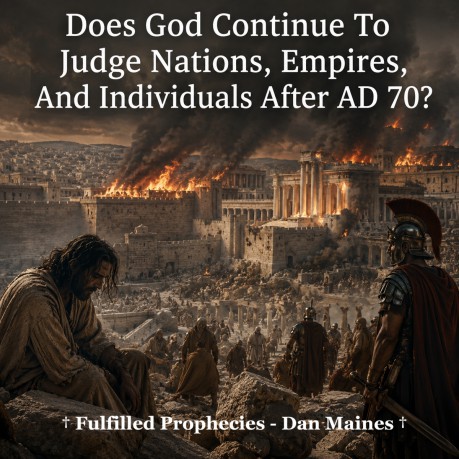
Does God Continue To Judge
Nations, Empires, And Individuals After AD 70? Introduction Daniel 4:17 Psalm 22:28 Isaiah 9:7 Psalm 9:7-8 Romans 13:1-4 Galatians 6:7-8 Romans 8:1 Hebrews 12:28-29 Hebrews 12:5-6 1 Corinthians 15:25 Acts 17:26-27 The Important Distinction Does This Create Prophecy Beyond AD 70? Historical References How It Applies To Us Today Q & A Appendix Q: Can we say a modern disaster was God's
judgment? Q: Does continuing judgment mean prophecy
continues after AD 70? Q: If all prophecy was fulfilled, what is Christ
doing now? Q: Did God stop judging individuals after AD
70? Q: Then what exactly changed in AD 70? † This is the fulfilled perspective we proclaim at
Fulfilled Prophecies †
By Dan Maines
† The
fulfillment of biblical prophecy in AD 70 doesn't mean God stopped
ruling the world in AD 70.
† There is an
important difference between prophetic covenant judgment and God's
continuing providential government over nations and individuals.
†
Jerusalem's destruction in AD 70 fulfilled the judgment announced by
Jesus and the prophets. That judgment belonged to the closing of the
Old Covenant age and isn't still awaiting fulfillment (Luke 21:20-22,
32; Matthew 23:35-36; 24:34).
† But
fulfillment doesn't mean God retired from governing His creation.
Christ's kingdom is everlasting, and an everlasting kingdom requires
an everlasting King who continues to rule.
†
Scripture gives us every reason to believe God still rules over
nations, restrains evil, holds rulers accountable, disciplines His
people, and judges human conduct. What Scripture doesn't give us is
authority to declare every war, earthquake, disease, economic
collapse, or national disaster a specific prophetic judgment from
God.
† We must distinguish God's continuing
judgment within history from the fulfilled prophetic judgments that
Scripture specifically connected with the end of the Old Covenant
age.
This sentence is by the decree
of the angelic watchers, And the decision is a command of the holy
ones, In order that the living may know That the Most High is ruler
over the realm of mankind, And He grants it to whomever He wishes And
sets over it the lowliest of people.
† The
central truth is that the Most High rules over human kingdoms. God's
sovereignty over nations wasn't presented as something that would
expire when the Old Covenant ended.
†
Nebuchadnezzar learned that earthly rulers govern beneath God's
ultimate authority. Empires rise and fall, but God's authority isn't
transferred to human governments (Daniel 4:25, 32, 34-35).
†
AD 70 established no limitation on God's sovereignty. The kingdom
belongs to Christ, therefore every earthly ruler remains under the
authority of the King of kings (Psalm 2:10-12; 1 Timothy 6:15).
†
Fulfilled prophecy means the things God promised were fulfilled. It
doesn't mean God stopped governing history after their fulfillment.
For the kingdom is the Lord's
And He rules over the nations.
† God's
kingdom and God's rule over the nations belong together. If God is
still King, He is still ruler over the nations.
†
The establishment of Christ's everlasting kingdom didn't remove the
nations from God's authority. It placed the supremacy of Christ's
reign beyond dispute (Daniel 7:13-14; Matthew 28:18).
†
Nations aren't independent of God because biblical prophecy has been
fulfilled. Every government and every ruler remains beneath divine
sovereignty.
† This doesn't give us
permission to identify every national tragedy as a direct judgment
from God. It does tell us that nations haven't escaped His
government.
There will be no end to the
increase of His government or of peace On the throne of David and
over his kingdom, To establish it and to uphold it with justice and
righteousness From then on and forevermore. The zeal of the Lord of
armies will accomplish this.
† Christ's
kingdom isn't only everlasting, His government is forever upheld with
justice and righteousness.
† If His
government continues forever, His righteous rule didn't stop in AD
70. AD 70 established the fulfilled kingdom, it didn't end the King's
active government (Luke 1:32-33; Hebrews 12:28).
†
Continuing divine justice doesn't require continuing prophecy. It
belongs to the continuing government of an everlasting King.
But the Lord sits as King
forever; He has established His throne for judgment, And He will
judge the world in righteousness; He will execute judgment for the
peoples fairly.
† Notice the connection
between God's eternal kingship and judgment. He sits as King forever,
and He judges in righteousness.
† Judgment
isn't contrary to God's kingdom. Righteous judgment is part of
righteous government.
† The kingdom
established through Christ isn't a kingdom in which God becomes
indifferent to oppression, violence, corruption, injustice, or
rebellion.
† We shouldn't confuse this
continuing righteous government with unfulfilled eschatology. God can
govern and judge within history without creating another prophetic
"end time."
Every person is to be subject
to the governing authorities. For there is no authority except from
God, and those which exist are established by God. Therefore whoever
resists authority has opposed the ordinance of God; and they who have
opposed will receive condemnation upon themselves. For rulers are not
a cause of fear for good behavior, but for evil. Do you want to have
no fear of authority? Do what is good and you will have praise from
the same; for it is a servant of God to you for good. But if you do
what is evil, be afraid; for it does not bear the sword for nothing;
for it is a servant of God, an avenger who brings wrath on the one
who practices evil.
† Paul shows that civil
authority operates under God's sovereignty. Government can function
as an instrument for restraining and punishing evil.
†
This principle isn't dependent upon the Jerusalem temple, the
Levitical priesthood, or the Old Covenant. Paul grounds governmental
authority in God Himself.
† God's
providential government can therefore operate through ordinary
historical means, rulers, courts, governments, consequences, and the
collapse of corrupt systems.
† This doesn't
mean every action taken by a government represents God's moral
approval. Scripture repeatedly shows that rulers themselves can
become corrupt and accountable before God (Psalm 82:1-4; Proverbs
29:2).
Do not be deceived, God is
not mocked; for whatever a person sows, this he will also reap. For
the one who sows to his own flesh will reap destruction from the
flesh, but the one who sows to the Spirit will reap eternal life from
the Spirit.
† Fulfilled eschatology doesn't
erase moral consequences. Paul states a continuing principle, what a
person sows has consequences.
† Individuals
don't become morally immune because AD 70 occurred. God's kingdom is
a kingdom of righteousness, not a declaration that human behavior no
longer matters.
† Sin carries consequences
personally, relationally, socially, and sometimes physically. God can
permit people to experience the consequences of the path they've
chosen (Romans 1:24-28).
† We should be
careful, however, about looking at another person's suffering and
announcing that God is punishing that individual for a particular
sin. Jesus warned against making that kind of automatic connection
(Luke 13:1-5; John 9:1-3).
Therefore there is now no
condemnation at all for those who are in Christ Jesus.
†
God's continuing righteous government must not be confused with
condemnation for those who are in Christ.
†
Believers can experience God's correction and discipline without
being placed back under condemnation (Hebrews 12:5-6).
†
God's judgment, His fatherly discipline, and condemnation aren't the
same thing. Those who are in Christ aren't under condemnation.
Therefore, since we receive
a kingdom which cannot be shaken, let's show gratitude, by which we
may offer to God an acceptable service with reverence and awe; for
our God is a consuming fire.
† The kingdom
that can't be shaken doesn't eliminate God's holiness. The writer
connects receiving the kingdom with reverence toward God.
†
God didn't change His character when the Old Covenant age ended. The
same God who is loving, merciful, and gracious is righteous and
holy.
† The kingdom is permanent precisely
because its King is righteous. God's grace doesn't mean indifference
toward evil.
† Fulfillment changed the
covenantal age, it didn't change God's character.
and you have forgotten the
exhortation which is addressed to you as sons, "My son, do not
regard lightly the discipline of the Lord, Nor faint when you are
punished by Him; For whom the Lord loves He disciplines, And He
punishes every son whom He accepts."
†
God's continuing judgment shouldn't always be understood as
destruction or wrath. Scripture also presents God's discipline as the
loving correction of His children.
† This
shows that God's continuing involvement includes correction and
discipline, not another eschatological judgment (1 Corinthians
11:31-32; Revelation 3:19).
For He must reign until
He has put all His enemies under His feet.
†
Christ's reign is active rule, not passive kingship. The New Covenant
kingdom isn't an abandoned kingdom after AD 70.
†
The first-century fulfillment established what the prophets promised,
Christ's victorious kingdom. It didn't leave subsequent history
outside His sovereignty (Daniel 7:14; Luke 1:32-33).
†
Nations can rise, nations can fall, rulers can prosper, rulers can be
removed, and civilizations can experience the consequences of
righteousness or wickedness while Christ remains King.
†
None of this requires another Second Coming, another last days,
another Great Tribulation, or another fulfillment of Revelation.
Providence isn't the same thing as prophecy.
and He made from one man every
nation of mankind to live on all the face of the earth, having
determined their appointed times and the boundaries of their
habitation, that they would seek God, if perhaps they might feel
around for Him and find Him, though He is not far from each one of
us;
† Paul describes God as sovereign over
the historical existence of nations. Their times and boundaries
aren't outside His government.
† God's
control of history isn't limited to Israel's covenant story. Paul was
speaking about every nation of humanity.
†
Therefore, the fulfilled judgment of Old Covenant Israel doesn't
require us to believe that every nation after AD 70 operates
independently from God.
† History remains
under God's sovereignty even though biblical eschatological prophecy
has reached its fulfillment.
†
Before AD 70, inspired prophets could identify particular events as
God's judgment because God had revealed those judgments beforehand
(Isaiah 10:5-6; Jeremiah 25:8-11; Luke 19:41-44).
†
We don't have inspired prophets today giving new revelation that a
particular hurricane, earthquake, war, pandemic, assassination,
recession, or national collapse is God's direct punishment for a
particular sin.
† That means we should never
pretend to know what God hasn't revealed.
†
We can say God rules nations. We can say God judges righteously. We
can say individuals and societies reap consequences from their
actions. We can say rulers remain accountable to God.
†
But we should be very cautious about saying, "This disaster
happened because God judged them for this specific sin." Without
divine revelation, that goes beyond what we know.
†
This distinction allows us to affirm God's continuing sovereignty
without creating new prophecy after AD 70.
†
No. God's providence isn't new biblical prophecy.
†
If God removes a ruler, permits an empire to collapse, restrains evil
through government, disciplines someone, or allows people to reap the
consequences of their actions, none of that requires an unfulfilled
prophecy.
† We shouldn't confuse God's
continuing activity with a continuing prophetic calendar.
†
AD 70 completed the prophetic covenant transition. It didn't end
God's involvement with His creation.
† Christ
didn't establish His kingdom so He could stop reigning. He
established an everlasting kingdom precisely because His reign
continues without end (Daniel 7:14; Luke 1:33).
†
Josephus recorded the catastrophic judgment that came upon Jerusalem
in AD 70 and repeatedly connected the nation's destruction with its
wickedness and internal corruption. His account provides historical
background for the first-century judgment Jesus had already announced
(Josephus, The Wars of the Jews, Book 5, chapters 10-13; Book 6,
chapters 3-9).
† Eusebius later described
Jerusalem's destruction in connection with the judgment that came
upon that generation following its rejection of Christ. His account
reflects the early Christian recognition that Jesus' warnings
concerning Jerusalem had historically occurred (Eusebius,
Ecclesiastical History, Book 3, chapters 5-7).
†
Augustine, writing centuries after AD 70, continued to describe God's
providence as governing earthly kingdoms, including their rise,
duration, and fall. Whatever conclusions we draw about individual
historical events, Christians didn't understand AD 70 to mean that
God's sovereignty over nations had ended (Augustine, The City of God,
Book 5, chapters 1, 21, 24-26).
† These
historical writers aren't our authority for doctrine. Scripture is
our authority. Their writings are useful because they show how
ancient Jewish and Christian writers understood divine judgment,
historical events, and God's continuing government of human affairs.
†
We live in the everlasting kingdom of Christ, not in another waiting
period for a future kingdom (Colossians 1:13; Hebrews 12:28).
†
Because Christ reigns, we shouldn't look at the world as though
nations, governments, and rulers operate outside God's sovereignty.
†
We should also resist the temptation to turn every catastrophe into
prophecy. A war isn't automatically Armageddon. An earthquake isn't
automatically a sign of the end. A political leader isn't
automatically the Antichrist. A national crisis doesn't restart
Matthew 24 or Revelation.
† Fulfilled
prophecy frees us from interpreting every newspaper headline as
another biblical prediction coming true.
† At
the same time, fulfilled prophecy doesn't require a powerless God who
stopped governing the world in AD 70.
† God
is still God. Christ is still King. Nations are still accountable.
Individuals are still accountable. Actions still have consequences.
Righteousness still matters.
† We can
confidently affirm God's sovereignty while humbly admitting when
Scripture hasn't told us why a particular event happened.
†
AD 70 wasn't the end of God's government. It was the fulfillment of
the promised covenant judgment and the full arrival of the unshakable
kingdom in which Christ reigns.
Q: Does
God still judge nations after AD 70?
A: God
still rules over nations and judges righteously. Scripture presents
His government as continuing, not ending with AD 70 (Psalm 22:28;
Psalm 9:7-8). What ended was the unfulfilled prophetic program
concerning the Old Covenant age, not God's sovereignty.
A: We should be very careful. God can
judge within history, but without inspired revelation we can't
confidently declare that a particular disaster happened as punishment
for a particular sin. Jesus Himself warned against assuming that
tragedy proves greater personal guilt (Luke 13:1-5; John 9:1-3).
A: No. Providence and
prophecy aren't the same thing. God can govern nations, restrain
evil, remove rulers, and allow consequences without creating another
prophetic fulfillment (Romans 13:1-4; Galatians 6:7-8).
A: He reigns. Fulfillment didn't end
Christ's kingdom, it established the everlasting kingdom promised in
Scripture. His authority doesn't expire, and His kingdom can't be
shaken (Hebrews 12:28-29; Daniel 7:14).
A: No. People remain morally accountable
before God, and the principle of sowing and reaping remains true.
Fulfillment didn't abolish righteousness, responsibility, or
consequences (Galatians 6:7-8).
A:
The Old Covenant age reached its complete end, Jerusalem and the
temple received the judgment Jesus foretold, and the covenant
transition was completed. God's character, sovereignty,
righteousness, and kingship didn't end. His kingdom remains forever
(Luke 21:20-22, 32; Hebrews 12:28).
© Fulfilled Prophecies - Dan
Maines.
Source Index
†
Daniel 4:17; Psalm 22:28; Psalm 9:7-8; Romans 13:1-4; Isaiah 9:7;
Romans 8:1; Galatians 6:7-8; Hebrews 12:28-29; 1 Corinthians 15:25;
Acts 17:26-27
† Historical writers: Josephus,
The Wars of the Jews, Book 5, chapters 10-13; Book 6, chapters 3-9;
Eusebius, Ecclesiastical History, Book 3, chapters 5-7; Augustine,
The City of God, Book 5, chapters 1, 21, 24-26
Links