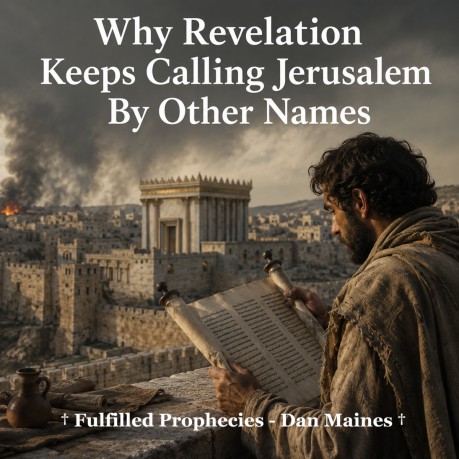
Why Revelation Keeps Calling
Jerusalem By Other Names Introduction Revelation 11:8 Isaiah 1:9-10 Jeremiah 2:20 Ezekiel 16:2, 15 Matthew 23:34-36 Revelation 17:1-2, 5-6 Revelation 17:18 Revelation 18:20, 24 Revelation 18:10 Luke 13:33-35 Historical References How It Applies To Us Today Q & A Appendix Q: What is the strongest evidence that
Revelation's great city points to Jerusalem? Q: Why would Revelation call Jerusalem
Babylon? Q: Does this mean every reference to Babylon in
the Bible means Jerusalem? † This is the fulfilled perspective we proclaim at
Fulfilled Prophecies †
By Dan Maines
† Revelation
doesn't identify the covenant-breaking city by only one name. It
calls the city Babylon, Sodom, Egypt, the great city, and presents it
as the great harlot.
† These names aren't
random geographical labels. They are prophetic covenant names
describing what Jerusalem had become through rebellion, spiritual
adultery, persecution, and bloodshed.
† The
Old Testament prophets had already spoken about Jerusalem this way.
Isaiah compared Jerusalem to Sodom, Jeremiah described Jerusalem as
an adulterous wife, and Ezekiel portrayed Jerusalem as a harlot.
†
Revelation uses that established prophetic language and brings it to
its final judgment setting. The strongest identification appears in
Revelation 11:8, the great city is the place where their Lord was
crucified.
† Jesus wasn't crucified in
literal Babylon, Sodom, or Egypt. He was crucified at Jerusalem.
Revelation itself therefore gives us the key for understanding why
Jerusalem could be described under these other prophetic names.
And their dead bodies will
lie on the street of the great city which spiritually is called Sodom
and Egypt, where also their Lord was crucified.
†
Revelation doesn't leave the identity of this great city entirely to
speculation. It gives a geographical marker, their Lord was crucified
there.
† The city is spiritually called Sodom
and Egypt. The word spiritually tells us these names are symbolic
descriptions of the city's spiritual and covenant condition, not
statements that Jerusalem had geographically become Sodom or Egypt.
†
Jerusalem had become like Sodom in corruption and like Egypt in
opposition to God's people. Revelation applies the characteristics of
former enemies of God to the city that rejected and crucified Christ.
(Luke 13:33-34; Matthew 23:37)
† This verse
provides an interpretive anchor for the great-city imagery that
appears throughout Revelation. Before looking outside the
first-century covenant world for another city, we should allow
Revelation to explain its own symbolism. (Revelation 14:8; 16:19;
17:18; 18:10)
If the Lord of armies Had not
left us a few survivors, We would be like Sodom, We would be like
Gomorrah. Hear the word of the Lord, You rulers of Sodom; Listen to
the instruction of our God, You people of Gomorrah!
†
Centuries before Revelation, Isaiah addressed Judah and Jerusalem
using the names Sodom and Gomorrah. Isaiah wasn't confused about
geography. He was using prophetic comparison to expose covenant
corruption. (Isaiah 1:1, 21)
† The rulers
weren't literally governing ancient Sodom, and the people weren't
literally citizens of Gomorrah. God was describing what His covenant
people had become morally and spiritually.
†
Revelation 11:8 follows this same prophetic pattern when Jerusalem is
spiritually called Sodom. John wasn't inventing a new method of
interpretation, he was using language already established by Israel's
prophets.
† When Revelation calls the city
Sodom, an Old Testament reader would already have a biblical
framework for understanding the accusation. (Deuteronomy 32:32;
Ezekiel 16:46-50)
For long ago I broke your yoke
And tore off your restraints; But you said, 'I will not serve!' For
on every high hill And under every leafy tree You have lain down as a
prostitute.
† Jeremiah described covenant
unfaithfulness as harlotry. Jerusalem belonged to God by covenant but
pursued other gods and repeatedly violated that covenant
relationship. (Jeremiah 3:1-3; 3:6-10)
† This
is essential background for Revelation's harlot imagery. A harlot in
prophetic covenant language isn't identified only by sexual
immorality, the image can represent spiritual adultery against God.
†
Revelation therefore didn't suddenly introduce the concept of a
harlot city without precedent. The prophets had already established
the vocabulary that John later used.
† The
accusation becomes especially significant because Revelation's harlot
is guilty not only of corruption but also of shedding the blood of
God's servants. (Revelation 17:6; 18:24)
Son of man, make known to
Jerusalem her abominations, But you trusted in your beauty and became
unfaithful because of your fame, and you poured out your obscene
practices on every passer-by to whom it might be tempting.
†
Ezekiel removes any doubt about the identity of the woman in his
prophecy. God specifically tells Ezekiel to make Jerusalem know her
abominations.
† Jerusalem is then portrayed
as a woman who became unfaithful and played the harlot. This covenant
imagery existed long before Revelation described another great harlot
facing judgment. (Ezekiel 16:8; 16:26-32)
†
The point isn't that every prophetic use of the word harlot must
always mean Jerusalem. The point is that Scripture had already
established Jerusalem herself as a covenant harlot, giving
Revelation's readers a familiar prophetic pattern.
†
Revelation's imagery should therefore be interpreted within the
prophetic vocabulary of Scripture before imposing a completely
foreign system upon it.
Therefore, behold, I am
sending you prophets and wise men and scribes; some of them you will
kill and crucify, and some of them you will flog in your synagogues,
and persecute from city to city, so that upon you will fall the guilt
of all the righteous blood shed on earth, from the blood of righteous
Abel to the blood of Zechariah, the son of Berechiah, whom you
murdered between the temple and the altar. Truly I say to you, all
these things will come upon this generation.
†
Jesus placed responsibility for the accumulated blood of the
righteous upon the first-century generation He was addressing.
†
Notice the same themes that later appear in Revelation, prophets sent
by God, persecution, righteous blood, and judgment upon the guilty
city and generation. (Matthew 23:29-33; Luke 11:49-51)
†
Jesus didn't place this judgment thousands of years beyond His
audience. He said all these things would come upon this generation.
†
This becomes extremely important when Revelation later describes a
city drunk with the blood of the saints and prophets. Revelation's
imagery matches the covenant lawsuit Jesus had already pronounced
against Jerusalem. (Revelation 17:6; 18:20)
Then one of the seven
angels who had the seven bowls came and spoke with me, saying, Come
here, I will show you the judgment of the great prostitute who sits
on many waters, with whom the kings of the earth committed acts of
sexual immorality, and those who live on the earth became drunk with
the wine of her sexual immorality." and on her forehead a name
was written, a mystery: "BABYLON THE GREAT, THE MOTHER OF
PROSTITUTES AND OF THE ABOMINATIONS OF THE EARTH." And I saw the
woman drunk with the blood of the saints, and with the blood of the
witnesses of Jesus. When I saw her, I wondered greatly.
†
Revelation calls the woman both the great prostitute/harlot and
Babylon the Great. Babylon functions as a prophetic name representing
a city characterized by rebellion, corruption, oppression, and
judgment.
† The woman is drunk with the blood
of the saints and the witnesses of Jesus. This parallels Jesus'
indictment of Jerusalem as the city responsible for killing God's
prophets and persecuting His messengers. (Matthew 23:34-37)
†
Calling the city Babylon doesn't require the city to be literal
Babylon any more than calling Jerusalem Sodom and Egypt in Revelation
11:8 requires Jerusalem to be geographically located in either
place.
† Revelation layers prophetic names
together because each name communicates something about the city's
covenant condition and approaching judgment.
The woman whom you saw is
the great city, which reigns over the kings of the earth.
†
This creates an important internal connection within Revelation. The
harlot is the great city, and Revelation 11:8 identifies the great
city as the place where their Lord was crucified.
†
John therefore gives us both sides of the identification, the woman
is the great city, and the great city is where Jesus was crucified.
(Revelation 11:8; 17:1, 5)
Rejoice over her, O
heaven, and you saints and apostles and prophets, because God has
pronounced judgment for you against her. And in her was found the
blood of prophets and of saints, and of all who have been slaughtered
on the earth.
† The blood accusation is one
of the strongest connections between Revelation's Babylon and Jesus'
judgment declaration against Jerusalem.
†
Jesus said Jerusalem killed the prophets and stoned those sent to
her. He then declared that the righteous blood would be required from
His generation. (Matthew 23:35-37; Luke 11:50-51)
†
Revelation says blood of prophets and saints was found in Babylon.
Jesus had already identified Jerusalem as the city with this covenant
bloodguilt.
† The shared language isn't
incidental. Revelation presents the culmination of the judgment Jesus
announced against the city that rejected God's messengers and
ultimately rejected God's Son.
standing at a distance
because of the fear of her torment, saying, 'Woe, woe, the great
city, Babylon, the strong city! For in one hour your judgment has
come.'
† Here Revelation directly connects
the expressions the great city and Babylon. Babylon is therefore
functioning as a prophetic designation for the city under judgment.
†
Revelation 11:8 has already identified the great city by the decisive
statement, where also their Lord was crucified.
†
When these passages are allowed to interpret one another, the
terminology forms a coherent picture. The great city can be
spiritually called Sodom and Egypt and prophetically called Babylon
because these names describe its covenant rebellion.
†
Jerusalem had become what the names represented, corrupt like Sodom,
oppressive like Egypt, adulterous like the harlot, and destined for
judgment like Babylon.
Nevertheless I must go on My
journey today and tomorrow and the next day; for it cannot be that a
prophet would perish outside Jerusalem. Jerusalem, Jerusalem, the
city that kills the prophets and stones those who have been sent to
her! How often I wanted to gather your children together, just as a
hen gathers her young under her wings, and you were unwilling!
Behold, your house is left to you desolate; and I say to you, you
will not see Me until you say, 'Blessed is the One who comes in the
name of the Lord!'
† Jesus identifies
Jerusalem as the city that kills the prophets. Revelation later
identifies Babylon by the blood of prophets and saints found within
her. (Revelation 18:24)
† Jesus also
announces that Jerusalem's house would be left desolate. This wasn't
an unrelated warning, it belonged to the same covenant judgment that
dominates His final warnings to Jerusalem. (Matthew 23:36-38;
24:1-2)
† Jerusalem's guilt reached its
climax in rejecting Christ and persecuting those He sent.
Revelation's judgment language continues that same biblical
storyline.
† The Bible therefore gives us a
connected chain of evidence, the prophets described Jerusalem with
symbolic covenant names, Jesus pronounced bloodguilt and desolation
upon Jerusalem, and Revelation describes the great city using those
same prophetic themes.
†
Josephus recorded the horrors surrounding Jerusalem and its
destruction in AD 70, including internal violence, famine, factional
bloodshed, the Roman siege, the burning of the temple, and the
devastation of the city. His account provides historical background
for the catastrophic end of first-century Jerusalem. (Josephus, The
Wars of the Jews, Books 5-7, especially 5.10; 6.3-6; 6.8-10; 7.1)
†
Tacitus also recorded the Roman siege of Jerusalem under Titus and
described the enormous conflict surrounding the city and temple.
(Tacitus, Histories, Book 5, chapters 10-13)
†
Eusebius later connected Jesus' warnings concerning Jerusalem with
the calamities that came upon the city and recorded the Christian
tradition that believers departed Jerusalem before the final
destruction. (Eusebius, Ecclesiastical History, Book 3, chapters
5-7)
† These historical writers don't
determine the meaning of Scripture, Scripture determines the meaning
of Scripture. Their writings provide historical testimony concerning
the first-century events surrounding Jerusalem's fall.
†
Revelation should be read through the prophetic vocabulary Scripture
itself provides. We shouldn't assume every symbolic name in
Revelation refers to a different literal geographical location.
†
When Revelation says spiritually called Sodom and Egypt, it tells us
directly that symbolic geographical names are being used to
communicate spiritual realities.
†
Understanding the Old Testament prophets helps us understand
Revelation. John repeatedly draws his imagery from the covenant
language, judgments, symbols, and prophetic patterns already found
throughout Scripture.
† Revelation 11:8 gives
us a powerful interpretive key, the great city was where their Lord
was crucified. That directs our attention back to first-century
Jerusalem.
† Babylon, Sodom, Egypt, the great
city, and the harlot aren't five unrelated mysteries requiring five
unrelated cities. They are prophetic images that describe different
dimensions of covenant rebellion and judgment.
†
For believers today, the message isn't to wait for another Jerusalem
to become another Babylon. The message is to recognize the completed
covenant transition and live faithfully in Christ and His New
Covenant kingdom. (Hebrews 12:22-24; Colossians 1:13)
Q: How
can Jerusalem be called Sodom, Egypt, and Babylon if it wasn't
literally any of those places?
A: Revelation
itself says the great city was spiritually called Sodom and Egypt and
then identifies it as the place where the Lord was crucified.
Scripture had already used this kind of prophetic language for
Jerusalem. The names describe spiritual and covenant characteristics
rather than geographical identity. (Isaiah 1:9-10; Revelation 11:8)
A:
Revelation 11:8 gives the clearest identifying statement, where also
their Lord was crucified. Jesus also identified Jerusalem as the city
that killed the prophets, while Revelation says the blood of prophets
and saints was found in the city called Babylon. The descriptions
converge on Jerusalem. (Luke 13:33-35; Matthew 23:34-37; Revelation
18:24)
A: Babylon had become a biblical
symbol of arrogance, oppression, idolatry, and divine judgment. By
the first century, Jerusalem had rejected Christ and persecuted His
messengers. Calling the condemned city Babylon communicated what
Jerusalem had become and what judgment awaited it. (Matthew 23:34-38;
Revelation 17:5-6; 18:10)
A: No. Historical
Babylon was a real empire and city. The issue is how Revelation uses
the name in its own prophetic context. Revelation openly demonstrates
that it can apply symbolic geographical names to another city when it
calls the place where Jesus was crucified Sodom and Egypt.
(Revelation 11:8)
© Fulfilled Prophecies - Dan
Maines.
Source Index
†
Revelation 11:8; Isaiah 1:9-10; Jeremiah 2:20; Ezekiel 16:2, 15;
Matthew 23:34-36; Revelation 17:1-2, 5-6; Revelation 17:18;
Revelation 18:20, 24; Revelation 18:10; Luke 13:33-35
†
Historical writers: Josephus, The Wars of the Jews, Books 5-7, 5.10;
6.3-6; 6.8-10; 7.1; Tacitus, Histories, Book 5, chapters 10-13;
Eusebius, Ecclesiastical History, Book 3, chapters 5-7
Links