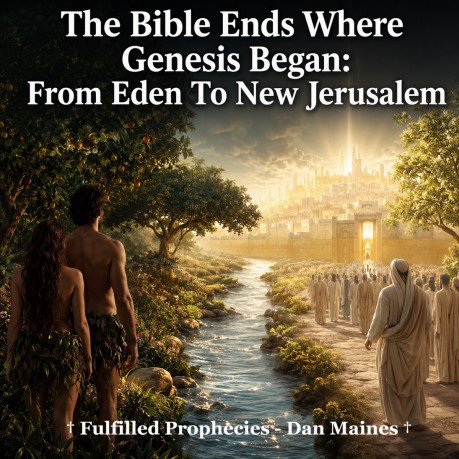
The Bible Ends Where Genesis
Began: From Eden To New Jerusalem Introduction Genesis 2:8-10 Genesis 3:17-19 Genesis 3:22-24 Hebrews 9:2-3, 5, 8 † The cherubim guarding Eden weren't an
isolated image. Cherubim appeared again in Israel's sanctuary, where
access to God's presence was restricted behind the veil. (Exodus
26:31-33) † Hebrews explains what that restricted access
meant. The way into the holy place had not yet been fully manifested
while the first tabernacle was still standing. (Hebrews 10:19-22) † This connects Eden, the tabernacle, and New
Jerusalem. Genesis shows the way guarded, the Old Covenant sanctuary
shows the way restricted, and Revelation shows the gates open with
access to the tree of life. (Genesis 3:24; Revelation 21:25;
Revelation 22:14) † The Bible's movement is unmistakable, guarded
access, restricted access, then restored access through Christ.
(Ephesians 2:18) Revelation 21:1-3 Revelation 21:4-5 Revelation 21:22-23 Revelation 22:1-2 Revelation 22:3-5 Revelation 22:14-15 Historical References How It Applies To Us Today Q & A Appendix Q: If Revelation 21-22 is fulfilled, why are
sinners and nations still present? Q: What is the great contrast between Genesis 3
and Revelation 22? Q: Are Christians still waiting for New Jerusalem
to come someday? † This is the fulfilled perspective we proclaim at
Fulfilled Prophecies †
By Dan Maines
† The Bible
begins with humanity in the presence of God, and it ends with
humanity in the presence of God.
† Genesis
opens with a garden, a river, the tree of life, fellowship with God,
and access to His presence. Sin brought death, the curse, and
separation from that access.
† Revelation
closes the story by showing the river again, the tree of life again,
the removal of the curse, the defeat of death, and God's dwelling
with His people.
† This is one of the most
powerful connections in the entire Bible. Revelation doesn't abandon
the story Genesis began, it completes it.
†
The Bible moves from Eden lost to New Jerusalem revealed, from access
barred to access restored, from death entering the story to death
being defeated, and from the curse entering creation to there being
no curse anymore.
† When Revelation 21-22 is
read against Genesis 2-3, its imagery becomes much clearer. John is
showing us the completion of the Bible's opening story.
The Lord God planted a garden
toward the east, in Eden; and there He placed the man whom He had
formed. Out of the ground the Lord God caused every tree to grow that
is pleasing to the sight and good for food; the tree of life was also
in the midst of the garden, and the tree of the knowledge of good and
evil. Now a river flowed out of Eden to water the garden; and from
there it divided and became four rivers.
†
The Bible begins with a garden containing the tree of life and a
river flowing from Eden.
† These aren't
insignificant details. They establish images that reappear at the
very end of Revelation, where John sees the river of the water of
life and the tree of life.
† Genesis gives us
the beginning of the story, Revelation gives us its completed
redemptive picture. The same themes appear at both ends of Scripture
because Revelation deliberately reaches back to Eden. (Revelation
22:1-2)
† The river represents life flowing
from God's presence, and the tree of life represents the life found
in fellowship with Him. What humanity lost through sin is restored
through Christ. (John 4:14; John 7:37-39)
Then to Adam He said,
"Because you have listened to the voice of your wife, and have
eaten from the tree about which I commanded you, saying, 'You shall
not eat from it'; Cursed is the ground because of you; With hard
labor you shall eat from it All the days of your life. Both thorns
and thistles it shall grow for you; Yet you shall eat the plants of
the field; By the sweat of your face You shall eat bread, Until you
return to the ground, Because from it you were taken; For you are
dust, And to dust you shall return."
†
Here the curse and death enter the biblical story through sin.
†
From this point forward, Scripture develops the story of God's
redemption from sin, death, alienation, and condemnation. (Romans
5:12-19)
† Revelation eventually answers
Genesis with the remarkable declaration that there will no longer be
any curse. The problem introduced near the beginning of Scripture is
answered at its conclusion. (Revelation 22:3)
†
Revelation's ending can't be properly understood without Genesis
because John is intentionally showing the reversal of what happened
in Eden.
Then the Lord God said,
"Behold, the man has become like one of Us, knowing good and
evil; and now, he might reach out with his hand, and take fruit also
from the tree of life, and eat, and live forever"- therefore the
Lord God sent him out of the Garden of Eden, to cultivate the ground
from which he was taken. So He drove the man out; and at the east of
the Garden of Eden He stationed the cherubim and the flaming sword
which turned every direction to guard the way to the tree of life.
†
This is one of the great tragedies of Genesis. Humanity is driven
from the garden, and the way to the tree of life is guarded.
†
The issue isn't geography alone, it is access to God and the life
found in His presence.
† The Bible's story
then moves toward the restoration of that access. Through Christ,
God's people are brought near and given access to the Father.
(Ephesians 2:13, 18; Hebrews 10:19-22)
†
Genesis closes Eden to sinful humanity, but Revelation ends with the
tree of life accessible in the city of God. The Bible's final
chapters answer the problem established in its opening chapters.
(Revelation 22:2, 14)
For a tabernacle was
equipped, the outer sanctuary, in which were the lampstand, the
table, and the sacred bread; this is called the Holy Place. Behind
the second veil there was a tabernacle which is called the Most Holy
Place, and above it were the cherubim of glory overshadowing the
atoning cover; but about these things we cannot now speak in detail.
The Holy Spirit is signifying this, that the way into the holy place
has not yet been disclosed while the outer tabernacle is still
standing,
Then I saw a new heaven
and a new earth; for the first heaven and the first earth passed
away, and there is no longer any sea. And I saw the holy city, new
Jerusalem, coming down out of heaven from God, prepared as a bride
adorned for her husband. And I heard a loud voice from the throne,
saying, "Behold, the tabernacle of God is among the people, and
He will dwell among them, and they shall be His people, and God
Himself will be among them,
† Here we reach
the great goal of the biblical story, God dwelling with His people.
†
The imagery isn't primarily about God abandoning His redemptive story
and replacing the planet with a strange future world. John is
describing the arrival of New Jerusalem, the bride, and the restored
dwelling of God with humanity.
† New
Jerusalem comes down out of heaven. God's people don't wait for the
city to be constructed by human hands, the city comes from God.
(Galatians 4:26; Hebrews 12:22-24)
† Hebrews
told first-century believers that they had already come to Mount Zion
and the heavenly Jerusalem. Revelation shows that covenant reality
reaching its completed form. (Hebrews 12:22-24)
†
Eden began with God and humanity together. Sin disrupted that
fellowship. Revelation closes the redemptive story with the
announcement, Behold, the tabernacle of God is with men.
and He will wipe away
every tear from their eyes; and there will no longer be any death;
there will no longer be any mourning, or crying, or pain; the first
things have passed away." And He who sits on the throne said,
"Behold, I am making all things new." And He said, "Write,
for these words are faithful and true."
†
Genesis introduced death through sin, Revelation announces the defeat
of death through the completed work of Christ.
†
Paul identified death as the last enemy and connected its defeat with
resurrection and the victory of Christ. (1 Corinthians 15:26,
54-57)
† John isn't saying ordinary physical
death no longer occurs on planet earth. Revelation itself describes
people outside the city after New Jerusalem appears. The picture
concerns covenant life, reconciliation, and victory over the death
brought through Adam. (Revelation 22:14-15)
†
In Adam came death, but in Christ came life. The story that began
with death entering through Adam reaches its redemptive conclusion in
Christ. (Romans 5:17-21; 1 Corinthians 15:22)
I saw no temple in it,
for the Lord God the Almighty and the Lamb are its temple. And the
city has no need of the sun or of the moon to shine on it, for the
glory of God has illuminated it, and its lamp is the Lamb.
†
Eden had no temple building because God's presence was there. New
Jerusalem also has no temple building because God and the Lamb are
its temple.
† This is the end of the old
temple-centered system. Access to God isn't through an earthly
sanctuary, priesthood, sacrifices, or geographical holy place. (John
4:21-24; Hebrews 9:8-12)
† The entire city is
filled with God's presence. What the earthly temple represented in
shadow has reached its reality in Christ and His people. (Ephesians
2:19-22)
† The Bible began with God's
presence among humanity, and Revelation ends with God's presence
among His redeemed people.
And he showed me a river
of the water of life, clear as crystal, coming from the throne of God
and of the Lamb, in the middle of its street. On either side of the
river was the tree of life, bearing twelve kinds of fruit, yielding
its fruit every month; and the leaves of the tree were for the
healing of the nations.
† Here is the
unmistakable return to Eden. Genesis had a river and the tree of
life, Revelation has the river of life and the tree of life.
†
But Revelation expands the picture. The river now proceeds from the
throne of God and the Lamb, and the leaves of the tree are for the
healing of the nations.
† Notice that nations
still need healing. This isn't a description of a planet where human
activity has ceased. It is the picture of God's life flowing outward
to the nations through the completed New Covenant kingdom. (Ezekiel
47:1-12)
† What was restricted in Eden is now
pictured as abundant. The river flows, the tree continually bears
fruit, and healing reaches the nations.
† The
story has moved from one garden to a worldwide kingdom of life in
Christ.
There will no longer be
any curse; and the throne of God and of the Lamb will be in it, and
His bond-servants will serve Him; they will see His face, and His
name will be on their foreheads. And there will no longer be any
night; and they will not have need of the light of a lamp nor the
light of the sun, because the Lord God will illuminate them; and they
will reign forever and ever.
† Genesis 3
announced the curse. Revelation 22 announces that there is no curse
anymore.
† Genesis described humanity hiding
from God's presence. Revelation describes God's servants seeing His
face.
† Genesis described humanity driven
from sacred access. Revelation describes God's servants living and
reigning in His presence.
† This is covenant
restoration language at its highest point. The separation created
through sin has been answered through the redemptive work of Christ.
(2 Corinthians 5:17-19)
† Revelation isn't
leaving Genesis behind. It is deliberately answering Genesis.
Blessed are those who
wash their robes, so that they will have the right to the tree of
life, and may enter the city by the gates. Outside are the dogs, the
sorcerers, the sexually immoral persons, the murderers, the
idolaters, and everyone who loves and practices lying.
†
This passage gives us one of the clearest clues for understanding New
Jerusalem. There are people entering the city, and there are people
outside the city.
† The gates provide access,
and the tree of life is available within. The imagery isn't
describing the end of human existence, it is describing access to
covenant life in God's presence.
† Genesis
said the way to the tree of life was guarded. Revelation says the
redeemed have the right to the tree of life and may enter through the
gates into the city.
† That is the wow. The
Bible begins with humanity outside the guarded way to the tree of
life, and it ends with the way opened in Christ.
†
The story isn't about escaping God's creation. It is about
reconciliation, restoration, access, life, and God's presence through
Jesus Christ. (John 10:9-10; Hebrews 10:19-22)
†
Josephus described the destruction of Jerusalem and the temple in AD
70, documenting the historical collapse of the Old Covenant center of
worship that had dominated Israel's national life.
†
Eusebius later recorded the tradition that believers in Jerusalem
fled before the city's destruction, connecting the first-century
church with the judgment Jesus had warned was coming upon
Jerusalem.
† Irenaeus repeatedly drew
connections between Adam's disobedience and Christ's redemptive work,
emphasizing Christ as the One who reverses Adam's failure.
†
These historical witnesses don't determine the meaning of Scripture,
but they help demonstrate how strongly early Christian history was
centered on Christ, the end of the temple order, and the restoration
accomplished through Him.
†
We aren't waiting for access to God. Through Christ we have access to
the Father now. (Ephesians 2:18)
† We aren't
waiting to come to the heavenly Jerusalem. Scripture says believers
have come to Mount Zion and the heavenly Jerusalem. (Hebrews
12:22-24)
† We don't need an earthly temple
to approach God. God dwells with His people, and Christ is our access
into His presence. (Ephesians 2:19-22)
† We
carry the water of life to a thirsty world by proclaiming the gospel
of Jesus Christ. The invitation remains open for those who thirst to
receive the water of life. (Revelation 22:17)
†
We live in the reality toward which the biblical story was moving,
reconciliation with God through Christ.
†
Genesis shows us what was lost through Adam. Revelation shows us what
has been restored through Christ.
† The Bible
begins with a river, a tree, God's presence, and humanity in
fellowship with Him. It ends with a river, a tree, God's presence,
and redeemed humanity dwelling with Him.
†
Eden wasn't forgotten. Eden's story was fulfilled and surpassed in
New Jerusalem.
† Writing this brought tears
of joy to my eyes. I hope reading it brings that same joy to your
heart as you see the beautiful story of redemption come full circle,
from Eden to New Jerusalem.
Q: Why
does Revelation end with the same imagery found in Genesis?
A:
Because Revelation is completing the redemptive story Genesis began.
Genesis introduces the tree of life, river, curse, death, and lost
access to God's presence. Revelation closes with the tree of life,
river of life, no curse, death defeated, and restored access to God.
(Genesis 2:8-10; Genesis 3:22-24; Revelation 21:3-5; Revelation
22:1-5)
A: Because
New Jerusalem describes the New Covenant reality, not the
disappearance of human life from the earth. Revelation shows nations
receiving healing, people outside the city, people entering through
its gates, and an invitation still going out to those who thirst.
(Revelation 21:24-26; Revelation 22:2, 14-17)
A: Genesis 3 shows humanity
driven away and access to the tree of life guarded. Revelation 22
shows God's people entering the city and having the right to the tree
of life. What was lost through Adam is restored through Christ.
(Genesis 3:22-24; Revelation 22:14)
A: No. Paul called the
Jerusalem above our mother, and Hebrews told first-century believers
that they had already come to Mount Zion and the heavenly Jerusalem.
Revelation shows the completed New Covenant city and God's dwelling
with His people. (Galatians 4:26; Hebrews 12:22-24; Revelation
21:2-3)
© Fulfilled Prophecies - Dan
Maines.
Source Index
†
Genesis 2:8-10; Genesis 3:17-19; Genesis 3:22-24; Hebrews 9:2-3, 5,
8; Revelation 21:1-3; Revelation 21:4-5; Revelation 21:22-23;
Revelation 22:1-2; Revelation 22:3-5; Revelation 22:14-15
†
Historical writers: Josephus; Eusebius; Irenaeus
Links