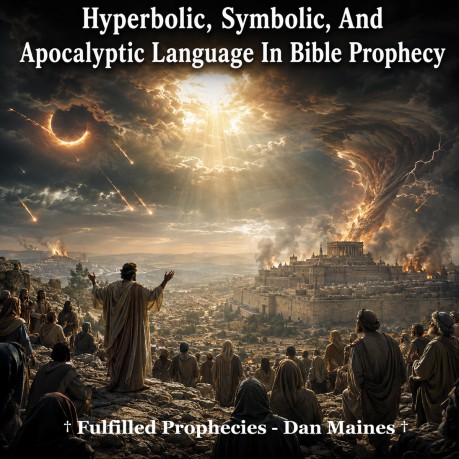
Hyperbolic, Symbolic, And
Apocalyptic Language In Bible Prophecy Introduction Psalm 18:1-3 Psalm 18:7-10 Psalm 18:12-15 Isaiah 13:9-13 Isaiah 34:4-5 Isaiah 19:1 Psalm 104:3 Micah 1:3-4 Nahum 1:3-6 Luke 21:20-22 Matthew 24:29-30 Matthew 24:34 Acts 2:16-21 Revelation 6:12-14 Revelation 1:1-3 Historical References How It Applies To Us Today Q & A Appendix Q: Does symbolic language mean nothing actually
happened? Q: Why is this important when interpreting
Matthew 24? Q: Did cloud-coming language always require a
visible bodily descent from heaven? Q: Approximately how many hyperbolic, symbolic,
or apocalyptic verses are there in the Old Testament and New
Testament? Q: If Christ's return is still future, why do
some Christians look forward to prophetic events that they believe
will bring terrible suffering upon others? † This is the fulfilled perspective we proclaim at
Fulfilled Prophecies †
By Dan Maines
† The Bible
frequently uses hyperbolic, symbolic, poetic, and apocalyptic
language to describe God's judgment, deliverance, the fall of
nations, and major covenant events. Hyperbole intentionally uses
exaggerated imagery to emphasize the greatness or seriousness of an
event, while apocalyptic language often describes historical events
through cosmic symbols.
† One of the clearest
examples is Psalm 18. David tells us exactly what he's describing,
God's deliverance of him from Saul and his enemies. Yet David
describes that historical deliverance as God coming down from heaven,
riding upon a cherub, shaking the earth, moving the foundations of
the mountains, sending fire, hailstones, thunder, and exposing the
foundations of the world.
† David wasn't
claiming that the physical planet was destroyed or that God literally
traveled through the atmosphere riding on a visible cherub. He was
using powerful prophetic imagery to describe God's intervention in
history. Once we recognize this language in the Old Testament, we
have to allow Jesus and the New Testament writers to use the same
prophetic vocabulary. (2 Samuel 22:1; Matthew 24:29-34)
For the music director. A Psalm
of David, the servant of the Lord, who spoke to the Lord the words of
this song on the day that the Lord rescued him from the hand of all
his enemies and from the hand of Saul. And he said, "I love You,
Lord, my strength." The Lord is my rock and my fortress and my
savior, My God, my rock, in whom I take refuge; My shield and the
horn of my salvation, my stronghold. I call upon the Lord, who is
worthy to be praised, And I am saved from my enemies.
†
The setting couldn't be clearer. David is celebrating God's
deliverance from his enemies. What follows is David's inspired
description of that historical deliverance.
†
This context controls the language that follows. David isn't
predicting the destruction of planet earth. He's describing God's
judgment against his enemies and God's deliverance of His servant.
†
This becomes an important interpretive key because later prophets,
Jesus, and the writers of the New Testament use the same kind of
judgment language. (Isaiah 13:9-13; Matthew 24:29-34)
Then the earth shook and
quaked; And the foundations of the mountains were trembling And were
shaken, because He was angry. Smoke went up out of His nostrils, And
fire from His mouth was devouring; Coals burned from it. He also
bowed the heavens down low, and came down With thick darkness under
His feet. He rode on a cherub and flew; And He sped on the wings of
the wind.
† Did the entire physical earth
literally shake? Did the foundations of every mountain physically
move? Did God visibly descend from the sky riding upon a cherub? The
text itself gives us no reason to turn David's poetic description
into a literal worldwide catastrophe.
† David
uses cosmic language because God's intervention was enormous from
David's perspective. God's judgment and deliverance are pictured as
heaven and earth being shaken.
† This same
prophetic vocabulary appears throughout Scripture. If we recognize it
as figurative in David, we can't automatically demand wooden
literalism when similar language appears in prophecy. (Isaiah 13:10;
Isaiah 34:4; Matthew 24:29)
From the brightness before
Him passed His thick clouds, Hailstones and coals of fire. The Lord
also thundered in the heavens, And the Most High uttered His voice,
Hailstones and coals of fire. He sent out His arrows, and scattered
them, And lightning flashes in abundance, and routed them. Then the
channels of water appeared, And the foundations of the world were
exposed By Your rebuke, Lord, At the blast of the breath of Your
nostrils.
† David describes his deliverance
with hailstones, fire, thunder, lightning, exposed waters, and the
foundations of the world being uncovered.
†
The historical event was real, but the imagery used to describe God's
intervention is highly poetic and symbolic. The symbolism doesn't
make the event less real. It makes the description more powerful.
†
This is one of the mistakes people make when discussing fulfilled
prophecy. Symbolic fulfillment doesn't mean imaginary fulfillment.
Biblical symbolism communicates genuine historical and covenantal
realities. (Psalm 97:1-5; Habakkuk 3:3-15)
Behold, the day of the Lord
is coming, Cruel, with fury and burning anger, To make the land a
desolation; And He will exterminate its sinners from it. For the
stars of heaven and their constellations Will not flash their light;
The sun will be dark when it rises And the moon will not shed its
light. So I will punish the world for its evil And the wicked for
their wrongdoing; I will also put an end to the audacity of the proud
And humiliate the arrogance of the tyrants. I will make mortal man
scarcer than pure gold And mankind than the gold of Ophir. Therefore
I will make the heavens tremble, And the earth will be shaken from
its place At the fury of the Lord of armies In the day of His burning
anger.
† Isaiah uses extraordinary cosmic
language, the stars stop shining, the sun becomes dark, the moon
gives no light, the heavens tremble, and the earth is shaken from its
place.
† Yet the context identifies the
judgment as the burden concerning Babylon. This language described
the catastrophic fall of a kingdom, not the literal destruction of
the universe. (Isaiah 13:1, 17-19)
† This
establishes an important biblical precedent. Sun, moon, stars,
heavens, and earth could be used prophetically to describe rulers,
kingdoms, governments, and established orders being brought down
under God's judgment.
And all the heavenly lights
will wear away, And the sky will be rolled up like a scroll; All its
lights will also wither away As a leaf withers from the vine, Or as
one withers from the fig tree. For My sword has drunk its fill in
heaven; Behold it shall descend for judgment upon Edom, And upon the
people whom I have designated for destruction.
†
This is one of the strongest examples of apocalyptic language in the
Old Testament. Isaiah says the heavens would be rolled together like
a scroll and the heavenly host would fall, yet the next verse
identifies the object of God's judgment as Edom.
†
The physical universe didn't disappear when Edom was judged. The
language describes the catastrophic overthrow of a nation under
divine judgment.
† This becomes especially
important when Revelation uses nearly identical language about heaven
being removed like a scroll. John was using prophetic vocabulary
already established centuries earlier. (Revelation 6:13-14)
The pronouncement concerning
Egypt: Behold, the Lord is riding on a swift cloud and is about to
come to Egypt; The idols of Egypt will tremble at His presence, And
the heart of the Egyptians will melt within them.
†
Here God is pictured riding upon a swift cloud and coming into Egypt.
This was judgment language directed against Egypt.
†
Scripture doesn't require us to imagine God physically sitting on a
cloud and traveling through the atmosphere. The cloud-coming
represented divine presence, authority, and judgment.
†
This matters enormously when we read New Testament cloud-coming
passages. Jesus and His Jewish audience already possessed an Old
Testament vocabulary in which coming on clouds represented divine
judgment. (Daniel 7:13-14; Matthew 24:30)
He lays the beams of His upper
chambers in the waters; He makes the clouds His chariot; He walks on
the wings of the wind;
† Scripture itself
describes the clouds as God's chariot. Cloud language communicates
God's majesty, presence, authority, and activity.
†
This strengthens Isaiah 19:1, where God rides upon a swift cloud in
judgment against Egypt. The Bible had established cloud imagery long
before Jesus spoke about coming on the clouds. (Isaiah 19:1; Daniel
7:13-14; Matthew 24:30)
For behold, the Lord is coming
forth from His place. He will come down and tread on the high places
of the earth. The mountains will melt under Him And the valleys will
be split, Like wax before the fire, Like water poured down a steep
place.
† Micah says God comes down, walks
upon the high places of the earth, melts mountains, and splits
valleys.
† The prophet immediately identifies
the historical objects of this judgment as Samaria and Jerusalem. The
imagery is cosmic, but the judgment has identifiable historical
targets. (Micah 1:5-6)
† Mountains melting
like wax communicates the irresistible power of God's judgment. No
kingdom, city, ruler, or covenant order can stand when God rises in
judgment.
The Lord is slow to anger and
great in power, And the Lord will by no means leave the guilty
unpunished. In the gale and the storm is His way, And clouds are the
dust beneath His feet. He rebukes the sea and dries it up; He dries
up all the rivers. Bashan and Carmel wither, The blossoms of Lebanon
wither. Mountains quake because of Him, And the hills come apart;
Indeed the earth is upheaved by His presence, The world and all the
inhabitants in it. Who can stand before His indignation? Who can
endure the burning of His anger? His wrath gushes forth like fire,
And the rocks are broken up by Him.
† Nahum
describes God's judgment with whirlwinds, storms, clouds, drying seas
and rivers, shaking mountains, melting hills, an upheaved earth,
fire, and shattered rocks.
† Yet Nahum
identifies the historical subject of the prophecy as Nineveh. The
cosmic imagery communicates the overwhelming power of God's judgment
against a real city and kingdom. (Nahum 1:1)
†
This gives us another clear biblical example where dramatic
earth-shaking language doesn't require the literal destruction of the
physical planet.
But when you see Jerusalem
surrounded by armies, then recognize that her desolation is near.
Then those who are in Judea must flee to the mountains, and those who
are inside the city must leave, and those who are in the country must
not enter the city; because these are days of punishment, so that all
things which have been written will be fulfilled.
†
Luke gives us the unmistakable historical setting for Jesus' judgment
prophecy. Jerusalem would be surrounded by armies, Judea was told to
flee, and Jesus called these the days of vengeance.
†
Most importantly, Jesus said these were the days in which all things
written would be fulfilled. That directly connects the language of
Israel's prophets with the approaching judgment upon Jerusalem.
(Daniel 9:26-27; Luke 21:32)
† This prevents
us from taking Matthew's apocalyptic imagery out of its first-century
setting and moving it thousands of years beyond Jesus' audience.
Matthew gives us the prophetic imagery, while Luke gives us the
unmistakable historical sign. (Matthew 24:15-21, 29-34)
But immediately after the
tribulation of those days the sun will be darkened, and the moon will
not give its light, and the stars will fall from the sky, and the
powers of the heavens will be shaken. And then the sign of the Son of
Man will appear in the sky, and then all the tribes of the earth will
mourn, and they will see the Son of Man coming on the clouds of the
sky with power and great glory.
† Jesus
didn't invent a completely new prophetic vocabulary in Matthew 24. He
used language already established throughout the Hebrew Scriptures.
†
Darkened sun, failing moon, falling stars, shaken heavens, and
cloud-coming were familiar prophetic descriptions of divine judgment
and the collapse of established powers. (Isaiah 13:9-13; Isaiah 19:1;
Isaiah 34:4; Daniel 7:13-14)
† Jesus also
placed these events within the generation standing before Him. We
shouldn't separate His prophetic imagery from His explicit time
statement. (Matthew 24:34)
Truly I say to you, this
generation will not pass away until all these things take place.
†
Jesus didn't say some of these things. He said all these things.
†
The cosmic imagery of the preceding verses doesn't give us permission
to move the fulfillment thousands of years beyond the generation
Jesus identified.
† The Old Testament teaches
us how to understand the imagery, and Jesus tells us when His
prophecy would be fulfilled. The language and the time statement work
together. (Matthew 16:27-28; Matthew 23:36; Luke 21:20-22, 32)
but this is what has been
spoken through the prophet Joel: 'And it shall be in the last days,'
God says, 'That I will pour out My Spirit on all mankind; And your
sons and your daughters will prophesy, And your young men will see
visions, And your old men will have dreams; And even on My male and
female servants I will pour out My Spirit in those days, And they
will prophesy. And I will display wonders in the sky above And signs
on the earth below, Blood, fire, and vapor of smoke. The sun will be
turned into darkness And the moon into blood, Before the great and
glorious day of the Lord comes. And it shall be that everyone who
calls on the name of the Lord will be saved.'
†
Peter said, this is that. He placed Joel's prophecy within the events
unfolding in his own generation.
† Joel's
imagery included blood, fire, smoke, a darkened sun, and the moon
becoming blood. Peter didn't push this language into the distant
future. He announced that the prophetic period had arrived.
†
The same generation that witnessed the outpouring of the Spirit would
experience the approaching Day of the Lord against the Old Covenant
world that was passing away. (Hebrews 8:13; Hebrews 10:25, 37; 1
Peter 4:7)
And I looked when He
broke the sixth seal, and there was a great earthquake; and the sun
became as black as sackcloth made of hair, and the whole moon became
like blood; and the stars of the sky fell to the earth, as a fig tree
drops its unripe figs when shaken by a great wind. The sky was split
apart like a scroll when it is rolled up, and every mountain and
island was removed from its place.
†
Revelation uses the same prophetic vocabulary found throughout the
Old Testament, earthquake, darkened sun, blood-colored moon, falling
stars, disappearing heaven, and moving mountains.
†
We shouldn't suddenly abandon the Bible's established prophetic
language when we reach Revelation. John expected his readers to
recognize imagery drawn directly from Israel's prophets. (Isaiah
13:10; Isaiah 34:4; Joel 2:10)
† Revelation
itself repeatedly tells its original audience that these events were
near, would happen soon, and that the appointed time was near.
(Revelation 1:1-3; Revelation 22:6, 10)
The Revelation of Jesus
Christ, which God gave Him to show to His bond-servants, the things
which must soon take place; and He sent and communicated it by His
angel to His bond-servant John, who testified to the word of God and
to the testimony of Jesus Christ, everything that he saw. Blessed is
the one who reads, and those who hear the words of the prophecy and
keep the things which are written in it; for the time is near.
†
Revelation tells us at its beginning how its symbolic visions must be
approached. The things revealed to John were to shortly come to pass,
and the time was at hand.
† The symbolic
nature of Revelation doesn't erase its time statements. Falling
stars, a darkened sun, a blood-colored moon, moving mountains, and a
disappearing heaven must be interpreted within the timeframe the book
itself establishes.
† Revelation closes with
the same message with which it begins, these things were near and
coming quickly. (Revelation 22:6, 10, 12, 20)
†
Josephus described extraordinary signs surrounding the Jewish War and
the destruction of Jerusalem, including a star resembling a sword, a
comet, unusual light around the temple, a heavenly appearance of
armed forces, and voices associated with the temple. Whatever
conclusions we draw about individual reports, Josephus clearly
understood the destruction of Jerusalem as an extraordinary
historical catastrophe. (Josephus, Wars of the Jews, Book 6, Chapter
5, Section 3)
† Eusebius connected Jesus'
warnings concerning Jerusalem with the calamities that overtook the
city and recorded the escape of believers before the war. He treated
Christ's warnings as directly relevant to first-century Jerusalem.
(Eusebius, Ecclesiastical History, Book 3, Chapters 5-7)
†
Biblical prophetic imagery doesn't require us to turn every sun,
moon, star, cloud, earthquake, mountain, fire, and shaking into a
literal physical event. The Old Testament itself provides the
interpretive foundation for understanding this language.
†
We need to let Scripture interpret Scripture. Before declaring that
prophetic imagery must describe events in our future, we should ask
how the Bible previously used the same language.
†
When David described God's deliverance, he didn't rejoice because
innocent people suffered. He rejoiced because God delivered him from
those who sought his destruction. There's an important difference
between rejoicing in God's justice and taking personal pleasure in
human suffering.
† Christians shouldn't revel
in the demise, suffering, or destruction of other people. Jesus
taught us to love our enemies and pray for those who persecute us.
(Matthew 5:44)
† Fulfilled prophecy shouldn't
produce arrogance or cruelty. Understanding judgment should make us
appreciate God's justice, Christ's victory, and the blessings we now
possess in the New Covenant. (Hebrews 12:22-24)
†
We live on the fulfilled side of those prophetic judgments. Our
message isn't that we're waiting for the heavens to collapse around
us. Our message is that Jesus Christ reigns, His kingdom has been
established, and those who belong to Him have come to the heavenly
Jerusalem. (Colossians 1:13; Hebrews 12:22-24)
Q: What
is hyperbolic language in the Bible?
A:
Hyperbolic language intentionally uses extreme or enlarged
descriptions to communicate the magnitude of something. Biblical
writers also use poetic, symbolic, and apocalyptic imagery. Psalm 18
is a powerful example because David describes a real historical
deliverance with the earth shaking, mountains moving, heavens bowing,
God riding upon a cherub, fire, lightning, and the foundations of the
world being exposed. (Psalm 18:7-15)
A: Absolutely not. The event can be
completely real while the language describing it is symbolic. Babylon
really fell, even though the physical stars didn't stop shining and
planet earth wasn't literally moved from its orbit. (Isaiah 13:1,
9-13, 17-19)
A: Because Jesus used the
established language of Israel's prophets. Isaiah had already used a
darkened sun, failing moon, shaking heavens, and a shaken earth to
describe national judgment. Jesus then used the same prophetic
vocabulary and said all these things would occur within this
generation. (Isaiah 13:9-13; Matthew 24:29-34)
A: No.
Isaiah described God riding upon a swift cloud and coming into Egypt
in judgment. This gives us an Old Testament precedent for
understanding cloud-coming as divine judgment language. (Isaiah 19:1;
Matthew 24:30)
A: There isn't an inspired or
universally accepted verse count because interpreters don't classify
every metaphor, hyperbole, symbol, poetic expression, and apocalyptic
image the same way. The safest answer is that there are hundreds of
verses in the Old Testament and many dozens, arguably well over a
hundred depending on classification, in the New Testament that
contain this kind of figurative or symbolic language. The important
point isn't an exact number, it's that this language occurs
throughout Scripture and forms an established biblical vocabulary for
judgment, deliverance, kingdoms, and covenantal change. (Psalm
18:7-15; Isaiah 13:9-13; Isaiah 19:1; Micah 1:3-4; Matthew 24:29-34;
Acts 2:16-21; Revelation 6:12-14)
A:
Christians should never take pleasure in the suffering or destruction
of other people. Yet some futurist interpretations portray future
prophecy as involving worldwide war, famine, persecution,
catastrophic judgments, and the deaths of countless people, while
believers are encouraged to anticipate those events as signs that
Christ's return is near. Scripture teaches us to love our enemies,
pray for those who persecute us, and never rejoice when an enemy
falls. God's righteous judgment can be acknowledged without
celebrating human suffering. (Matthew 5:44; Proverbs 24:17; Romans
12:19-21)
© Fulfilled Prophecies - Dan
Maines.
Source Index
†
Psalm 18:1-3, 7-10, 12-15; Isaiah 13:9-13; Isaiah 19:1; Micah 1:3-4;
Matthew 24:29-30, 34; Acts 2:16-21; Revelation 6:12-14
†
Josephus, Wars of the Jews, Book 6, Chapter 5, Section 3; Eusebius,
Ecclesiastical History, Book 3, Chapters 5-7
Links