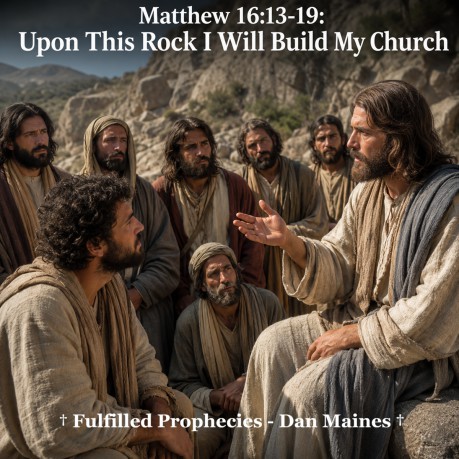
Matthew 16:13-19: Upon This
Rock I Will Build My Church Introduction Matthew 16:13-19 1 Corinthians 3:11 Ephesians 2:19-22 Matthew 18:18-20 Acts 2:36-41 Colossians 1:12-14 Hebrews 2:14-15 Hebrews 12:28 Historical References How It Applies To Us Today Q & A Appendix † This is the fulfilled perspective we proclaim at
Fulfilled Prophecies † Source Index
By Dan Maines
† Matthew
16:13-19 is one of the most important conversations Jesus ever had
with His disciples. It identifies who Jesus is, what His church is
built upon, who holds authority over death and Hades, and how the
kingdom of heaven would be opened.
† The
central question isn't ultimately about Peter, it's about Jesus. "Who
do you say that I am?" Everything that follows rests upon
Peter's confession that Jesus is the Christ, the Son of the living
God.
† Jesus didn't announce the
establishment of another earthly kingdom, another physical temple, or
another religious system centered in Jerusalem. He announced, "I
will build my church," and He declared that the gates of Hades
wouldn't prevail against it.
† This passage
reaches directly into the first-century transition from the Old
Covenant order to the kingdom Christ established. The promised
kingdom was already drawing near, and Jesus was preparing His
disciples for what was about to unfold. (Matthew 4:17; Luke 21:31-32)
Now when Jesus came into
the region of Caesarea Philippi, He was asking His disciples, "Who
do people say that the Son of Man is?" And they said, "Some
say John the Baptist; and others, Elijah; and still others, Jeremiah,
or one of the other prophets." He said to them, "But who do
you yourselves say that I am?" Simon Peter answered, "You
are the Christ, the Son of the living God." And Jesus said to
him, "Blessed are you, Simon Barjona, because flesh and blood
did not reveal this to you, but My Father who is in heaven. And I
also say to you that you are Peter, and upon this rock I will build
My church; and the gates of Hades will not overpower it. I will give
you the keys of the kingdom of heaven; and whatever you bind on earth
shall have been bound in heaven, and whatever you loose on earth
shall have been loosed in heaven."
† The
entire passage begins with the identity of Christ. Peter's confession
that Jesus is the Christ, the Son of the living God, is the
foundation of everything Jesus says afterward. The church belongs to
Christ because Christ is its foundation and its Lord. (1 Corinthians
3:11; Ephesians 2:20)
† Jesus said, "I
will build my church." He didn't say He would restore the Old
Covenant nation, rebuild an earthly temple, or establish His kingdom
thousands of years later. His kingdom was already being announced as
near, and His disciples were being prepared to enter it. (Matthew
4:17; Colossians 1:13)
† The "gates of
Hades" picture the power of death. Gates don't attack, they hold
people inside. Jesus was declaring that death and Hades couldn't
imprison His people permanently. Christ would conquer death and
ultimately abolish the power that Hades held over the dead. (Hebrews
2:14-15; Revelation 1:18)
For no one can lay a
foundation other than the one which is laid, which is Jesus Christ.
†
Paul leaves no room for another ultimate foundation. Jesus Christ is
the foundation upon which God's people stand.
†
This helps explain Matthew 16. Whatever role Peter had among the
apostles, the church doesn't ultimately rest upon a mortal man. It
rests upon Jesus Christ and the truth of who He is. (Matthew 21:42; 1
Peter 2:4-6)
† Peter himself later directed
believers to Christ as the living stone and cornerstone. Peter didn't
present himself as the object of faith, he pointed people to Jesus.
(1 Peter 2:4-6)
So then you are no longer
strangers and foreigners, but you are fellow citizens with the
saints, and are of God's household, having been built on the
foundation of the apostles and prophets, Christ Jesus Himself being
the cornerstone, in whom the whole building, being fitted together,
is growing into a holy temple in the Lord, in whom you also are being
built together into a dwelling of God in the Spirit.
†
Paul explains what Christ was building. It wasn't another physical
temple in Jerusalem. God's people themselves were being built
together into His spiritual dwelling.
†
Christ is the chief cornerstone, while the apostles and prophets form
the foundational witness through which the gospel was proclaimed. The
emphasis remains centered on Christ. (1 Corinthians 3:11; 1 Peter
2:5-6)
† Jew and Gentile were being formed
into one household and one holy temple in Christ. This was the New
Covenant reality replacing the old system of physical sanctuary,
priesthood, and covenant separation. (Ephesians 2:14-18; Hebrews
8:13)
Truly I say to you,
whatever you bind on earth shall have been bound in heaven; and
whatever you loose on earth shall have been loosed in heaven. "Again
I say to you, that if two of you agree on earth about anything that
they may ask, it shall be done for them by My Father who is in
heaven. For where two or three have gathered together in My name, I
am there in their midst."
† Matthew 18
is important because the authority to bind and loose isn't presented
as something belonging exclusively to Peter. Jesus speaks this
authority to His disciples in connection with the administration and
discipline of His community.
† The apostles
had a unique foundational role as Christ established His church and
revealed the New Covenant message. Their authority came from Christ,
not from themselves. (John 20:21-23; Ephesians 2:20)
†
The kingdom wasn't dependent upon an earthly throne or physical
headquarters. Christ promised His presence among His gathered people.
Therefore let all the house of
Israel know for certain that God has made Him both Lord and
Christ-this Jesus whom you crucified. Now when they heard this, they
were pierced to the heart, and said to Peter and the rest of the
apostles, "Brothers, what are we to do?" Peter said to
them, "Repent, and each of you be baptized in the name of Jesus
Christ for the forgiveness of your sins; and you will receive the
gift of the Holy Spirit. For the promise is for you and your children
and for all who are far away, as many as the Lord our God will call
to Himself." And with many other words he solemnly testified and
kept on urging them, saying, "Be saved from this perverse
generation!" So then, those who had received his word were
baptized; and that day there were added about three thousand souls.
†
Here we see Peter exercising the responsibility Christ had given him.
He publicly proclaimed Jesus as Lord and Christ and opened the gospel
message to thousands.
† Notice that Peter
didn't direct people to himself. He directed them to Jesus Christ,
repentance, forgiveness, and the gift of the Holy Spirit.
†
Peter also warned that first-century audience concerning "this
crooked generation." The church was growing while that Old
Covenant generation was approaching the judgment Jesus had already
announced. (Matthew 23:36; Matthew 24:34)
giving thanks to the
Father, who has qualified us to share in the inheritance of the
saints in light. For He rescued us from the domain of darkness, and
transferred us to the kingdom of His beloved Son, in whom we have
redemption, the forgiveness of sins.
† Paul
didn't tell believers that the kingdom remained thousands of years in
their future. He said they had already been transferred into the
kingdom of God's Son.
† This is critical when
reading Matthew 16. Jesus had promised the keys of the kingdom, and
within the New Testament itself believers are described as already
participating in that kingdom.
† The kingdom
was becoming a present spiritual reality in Christ during the
first-century covenant transition, even while the Old Covenant order
was growing old and approaching its removal. (Hebrews 8:13; Hebrews
12:28)
Therefore, since the
children share in flesh and blood, He Himself likewise also partook
of the same, so that through death He might destroy the one who has
the power of death, that is, the devil, and free those who through
fear of death were subject to slavery all their lives.
†
This helps us understand the force of Jesus' statement that "the
gates of Hades shall not prevail against it." Christ entered
death and conquered its power.
† The church
couldn't be defeated by Hades because its Lord had authority over
death. Jesus' resurrection demonstrated that the grave couldn't hold
Him. (Acts 2:24; Revelation 1:18)
† The New
Testament story moves toward the complete victory over death and
Hades, not toward their permanent continuation as victorious powers
over God's people. (1 Corinthians 15:54-57; Revelation 20:14)
Therefore, since we receive a
kingdom which cannot be shaken, let's show gratitude, by which we may
offer to God an acceptable service with reverence and awe;
†
The believers addressed by Hebrews were receiving the unshakable
kingdom. The language is present and active, not a prediction about
Christians waiting thousands of years for the kingdom to begin.
†
The surrounding context contrasts what could be shaken with what
would remain. The temporary covenant order was passing away while the
unshakable kingdom remained. (Hebrews 8:13; Hebrews 12:26-27)
†
This is the church Christ promised to build, a kingdom and people
founded upon Him that couldn't be destroyed by persecution,
Jerusalem's fall, death, or Hades.
†
Clement of Rome, writing about the apostles, specifically identifies
Peter and Paul as examples who endured persecution and suffering for
Christ. Clement's testimony shows the prominent first-century
ministry of Peter while keeping the focus upon faithfulness to
Christ. (1 Clement 5)
† Eusebius records the
early Christian tradition concerning Peter's preaching and martyrdom
during Nero's reign. Whatever later traditions developed concerning
Peter, the earliest historical picture presents him as an apostolic
witness to Christ, exactly as we see throughout Acts. (Eusebius,
Ecclesiastical History, Book 2, Chapter 25)
†
Eusebius also records that before the war and Jerusalem's
destruction, believers in Jerusalem were instructed to leave the city
and settle at Pella. This historical tradition fits the first-century
setting of Jesus' warnings concerning Jerusalem and the preservation
of His people through that judgment. (Eusebius, Ecclesiastical
History, Book 3, Chapter 5)
† Josephus
records the catastrophic destruction of Jerusalem and the temple in
AD 70. That historical judgment brought the Old Covenant temple order
to its visible end, while the church Christ built continued beyond
Jerusalem's destruction. (Josephus, The Wars of the Jews, Book 6,
Chapters 4-5)
†
Our faith isn't built upon an earthly city, physical temple,
denomination, religious institution, or human leader. Jesus Christ is
the foundation. (1 Corinthians 3:11)
† We
don't need to wait for Christ to establish His kingdom. Believers
have been transferred into the kingdom of God's Son and have received
a kingdom that can't be shaken. (Colossians 1:13; Hebrews 12:28)
†
We are God's spiritual household and temple. God's presence isn't
confined to Jerusalem or any physical sanctuary. His people are being
built together in Christ. (Ephesians 2:19-22)
†
Death doesn't overthrow Christ's church. Jesus has the keys of death
and Hades, and our hope rests in the One who conquered death.
(Revelation 1:18)
† The question Jesus asked
remains the question every person must answer: Who is Jesus? Peter's
answer remains the heart of Christian confession, Jesus is the
Christ, the Son of the living God. (Matthew 16:15-16)
Q: Was
Jesus saying that Peter personally was the ultimate foundation of the
church?
A: Peter clearly had a unique apostolic
role, but Scripture explicitly identifies Jesus Christ as the
foundation and chief cornerstone. Peter himself pointed believers to
Christ as the chosen cornerstone. (1 Corinthians 3:11; Ephesians
2:20; 1 Peter 2:4-6)
Q: What did Jesus mean by
the gates of Hades not prevailing against His church?
A:
Hades represented the realm and power of death. Jesus was declaring
that death couldn't ultimately hold or defeat His people. Christ
conquered death and holds the keys of death and Hades. (Hebrews
2:14-15; Revelation 1:18)
Q: Were the keys of
the kingdom given because Peter would replace Christ as head of the
church?
A: No. Peter received an important
apostolic responsibility, but Christ remained the builder,
foundation, cornerstone, and head of His church. Peter consistently
preached Christ rather than himself. (Acts 2:36-41; 1 Corinthians
3:11; Colossians 1:18)
Q: Is Christ's kingdom
still waiting to be established in our future?
A:
No. Paul said first-century believers had already been transferred
into Christ's kingdom, and Hebrews said they were receiving a kingdom
that couldn't be shaken. We live in that kingdom reality today.
(Colossians 1:13; Hebrews 12:28)
© Fulfilled Prophecies - Dan
Maines.
† Matthew
16:13-19; 1 Corinthians 3:11; Ephesians 2:19-22; Matthew 18:18-20;
Acts 2:36-41; Colossians 1:12-14; Hebrews 2:14-15; Hebrews 12:28
†
Clement of Rome, 1 Clement 5; Eusebius, Ecclesiastical History, Book
2, Chapter 25; Book 3, Chapter 5; Josephus, The Wars of the Jews,
Book 6, Chapters 4-5
Links