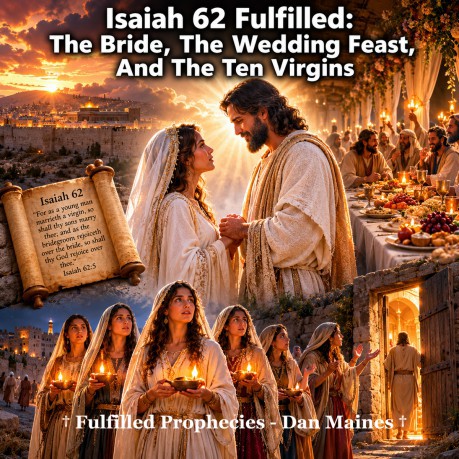
Isaiah 62 Fulfilled: The
Bride, The Wedding Feast, And The Ten Virgins Introduction Isaiah 62:1-2 Isaiah 62:4-5 Isaiah 62:10-12 Matthew 22:1-7 Matthew 22:8-10 Matthew 21:43 Matthew 24:34 Matthew 25:1-10 2 Corinthians 11:2 Revelation 19:7-9 Revelation 21:2-3 Historical References How It Applies To Us Today Q & A Appendix Q: How does Isaiah 62 connect with Matthew 22? Q: How does Isaiah 62 connect with the ten
virgins? Q: Who is the bride in the completed New Covenant
picture? Q: Why can't the wedding simply be moved
thousands of years into our future? † This is the fulfilled perspective we proclaim at
Fulfilled Prophecies † Source Index
By Dan Maines
† Isaiah 62
isn't a prophecy waiting for fulfillment in modern Israel or in some
future generation. It describes God's redemptive purpose for Zion,
her salvation, her new name, her marriage, and the arrival of her
Savior.
† The key to understanding Isaiah 62
is that the New Testament takes this marriage imagery and applies it
to Christ and His people. Jesus didn't leave Isaiah's wedding imagery
unexplained.
† In Matthew 22, Jesus described
the kingdom as a wedding feast prepared by a king for his son. The
original invited guests rejected the invitation, persecuted the
messengers, and the king destroyed their city.
†
In Matthew 25, Jesus again described the kingdom through wedding
imagery. The bridegroom came, the prepared virgins entered the
wedding feast, and the door was shut.
† These
aren't unrelated illustrations. Isaiah announced the coming marriage,
and Jesus announced the generation in which the covenantal wedding
would reach its fulfillment.
† Isaiah 62
therefore belongs within the biblical story of the transition from
Old Covenant Jerusalem to the New Covenant people of God, not a
prophecy calendar thousands of years beyond Jesus' first-century
audience. (Galatians 4:21-31; Hebrews 12:22-24)
For Zion's sake I will not
keep silent, And for Jerusalem's sake I will not keep quiet, Until
her righteousness goes forth like brightness, And her salvation like
a torch that is burning. The nations will see your righteousness,
And all kings your glory; And you will be called by a new name Which
the mouth of the Lord will designate.
†
Isaiah begins with salvation, righteousness, the nations, and a new
name. These are redemptive themes that the New Testament places in
Christ and the New Covenant, not in a future restoration of the Old
Covenant system. (Acts 13:46-48; 2 Corinthians 5:17)
†
Notice that the nations would see Zion's righteousness. The promise
was never about isolating one ethnic nation from everyone else. God's
salvation was going outward to the nations through Christ. (Luke
2:30-32; Romans 15:8-12)
† The new name
points toward a transformed covenant identity. God's people would no
longer be defined by the old distinctions of Jew and Gentile, but by
belonging to Christ. (Galatians 3:26-29; Colossians 3:10-11)
†
Isaiah's Zion must therefore be interpreted through the New Testament
revelation of Zion, where believers had already come to Mount Zion
and the heavenly Jerusalem. (Hebrews 12:22-24)
It will no longer be said to
you, "Forsaken," Nor to your land will it any longer be
said, "Desolate"; But you will be called, "My delight
is in her," And your land, "Married"; For the Lord
delights in you, And to Him your land will be married. For as a young
man marries a virgin, So your sons will marry you; And as the groom
rejoices over the bride, So your God will rejoice over you.
†
Here Isaiah openly introduces the marriage. Zion would no longer be
Forsaken or Desolate. She would be called God's delight, and the
prophecy says that she would be married.
†
This is covenant marriage language. Throughout Scripture, God's
relationship with His people is described in marital terms, which is
why Jesus repeatedly used bridegroom and wedding imagery when
announcing the kingdom. (Matthew 9:15; John 3:29)
†
Jesus identified Himself as the bridegroom. That identification is
enormously important because Isaiah had promised the time when God's
people would experience the joy of the bridegroom and the bride.
(Matthew 9:15)
† Paul likewise described
Christ and the church through the mystery of marriage. The
destination of Isaiah's marriage prophecy isn't a rebuilt Old
Covenant nation, it's the covenant relationship between Christ and
His people. (Ephesians 5:25-32)
Go through, go through the
gates, Clear a way for the people! Build up, build up the highway,
Remove the stones, lift up a flag over the peoples. Behold, the Lord
has proclaimed to the end of the earth: Say to the daughter of Zion,
"Behold, your salvation is coming; Behold His reward is with
Him, and His compensation before Him." And they will call them,
"The holy people, The redeemed of the Lord"; And you will
be called, "Sought Out, A City Not Abandoned."
†
This passage strengthens the connection between Isaiah 62 and the
coming of Christ. Zion's salvation is pictured as arriving with His
reward and recompense, language that Jesus later used concerning His
own coming. (Matthew 16:27-28)
† Jesus said
the Son of Man would come in the glory of His Father and reward each
person according to his deeds, then immediately said some standing
there wouldn't die before seeing the Son of Man coming in His
kingdom. That places Isaiah's reward language within a first-century
expectation. (Matthew 16:27-28)
† Isaiah also
says this proclamation would go to the end of the earth. The New
Testament repeatedly declares that the gospel had gone throughout the
world in the apostolic generation. (Romans 10:18; Colossians 1:6, 23)
Jesus spoke to them again in
parables, saying, The kingdom of heaven is like a king who held a
wedding feast for his son. And he sent his slaves to call those who
had been invited to the wedding feast, and they were unwilling to
come. Again he sent other slaves, saying, 'Tell those who have been
invited, "Behold, I have prepared my dinner; my oxen and my
fattened cattle are all butchered and everything is ready. Come to
the wedding feast!"' But they paid no attention and went their
separate ways, one to his own farm, another to his business, and the
rest seized his slaves and treated them abusively, and then killed
them. Now the king was angry, and he sent his armies and destroyed
those murderers and set their city on fire.
†
Jesus placed the marriage feast directly within the judgment of the
generation that rejected Him. The king prepared the marriage of his
son, but the original invited guests refused to come.
†
They didn't simply reject the invitation. They abused and killed the
king's servants. Jesus repeatedly charged Jerusalem with killing
God's prophets and messengers. (Matthew 23:29-37)
†
Then comes the unmistakable judgment language, the king sent his
armies, destroyed the murderers, and burned their city. That fits
Jesus' warning concerning Jerusalem and its coming destruction.
(Matthew 23:36-38; Luke 21:20-22)
† The
wedding feast and the judgment on the rebellious city belong to the
same parable. Separating the wedding from the first-century judgment
destroys the very framework Jesus gave us.
Then he said to his slaves,
'The wedding feast is ready, but those who were invited were not
worthy. So go to the main roads, and invite whomever you find there
to the wedding feast.' Those slaves went out into the streets and
gathered together all whom they found, both bad and good; and the
wedding hall was filled with dinner guests.
†
Jesus said the wedding was ready. He didn't describe a wedding that
would remain postponed for thousands of years.
†
When the original invited guests rejected the invitation, the
invitation went outward. This matches the first-century movement of
the gospel from Israel outward to the Gentiles. (Acts 13:46-48;
Romans 1:16)
† This is exactly what Isaiah
anticipated when he said that the nations would see Zion's
righteousness and all kings her glory. (Isaiah 62:2)
†
Isaiah's prophecy and Jesus' parable tell the same redemptive story,
salvation goes to the nations, God's people receive their covenant
identity, and the marriage becomes a reality.
Therefore I say to you, the
kingdom of God will be taken away from you and given to a people
producing its fruit.
† This statement comes
immediately before the wedding feast parable and establishes its
covenantal setting. Jesus told the religious leaders that the kingdom
would be taken from them and given to a people producing its fruit.
†
Matthew 21 and Matthew 22 belong together. Jesus first announced the
removal of the kingdom from the unfaithful covenant leadership, then
pictured the same judgment through the wedding feast and the
destruction of the rebellious city. (Matthew 21:45; Matthew 22:1-7)
†
This makes it even more difficult to move Isaiah 62 into a future
restoration of the very covenant order Jesus was judging. The
promised people of God are defined around Christ and faithfulness to
Him. (1 Peter 2:9-10)
Truly I say to you, this
generation will not pass away until all these things take place.
†
This verse establishes the time frame before Jesus gives the parable
of the ten virgins. The chapter division between Matthew 24 and
Matthew 25 wasn't part of Jesus' discourse.
†
Jesus didn't suddenly move the wedding thousands of years into the
future when He began speaking about the ten virgins. The bridegroom
parable continues His warning to remain watchful for what He had just
placed within that generation. (Matthew 24:42-44; Matthew 25:1-13)
†
This is one of the strongest safeguards against turning Matthew 25
into a twenty-first-century prophecy. Jesus supplied the audience and
the time frame before giving the wedding parable. (Matthew 24:33-34)
Then the kingdom of heaven
will be comparable to ten virgins, who took their lamps and went out
to meet the groom. Five of them were foolish, and five were prudent.
For when the foolish took their lamps, they did not take extra oil
with them; but the prudent ones took oil in flasks with their lamps.
Now while the groom was delaying, they all became drowsy and began to
sleep. But at midnight there finally was a shout: 'Behold, the groom!
Come out to meet him.' Then all those virgins got up and trimmed
their lamps. But the foolish virgins said to the prudent ones, 'Give
us some of your oil, because our lamps are going out.' However, the
prudent ones answered, 'No, there most certainly would not be enough
for us and you too; go instead to the merchants and buy some for
yourselves.' But while they were on their way to buy the oil, the
groom came, and those who were ready went in with him to the wedding
feast; and the door was shut.
† Isaiah spoke
of the marriage. Jesus spoke of the bridegroom coming and those who
were ready entering the marriage feast. The imagery is too consistent
to separate.
† The bridegroom delayed, but he
didn't delay for thousands of years. Matthew 25 belongs to the same
discourse in which Jesus had already said, This generation shall not
pass away, till all these things be accomplished. (Matthew 24:34)
†
The issue was readiness among those living in anticipation of the
bridegroom's coming. Jesus repeatedly warned His first-century
disciples to watch because they didn't know the precise day or hour.
(Matthew 24:42-44)
† When the bridegroom
came, those who were ready entered the marriage feast. This continues
the same wedding theme Jesus had already established in Matthew 22.
†
Isaiah's promised marriage, Matthew 22's prepared wedding, and
Matthew 25's arriving bridegroom form one consistent covenantal
picture.
For I am jealous for you
with a godly jealousy; for I betrothed you to one husband, to present
you as a pure virgin to Christ.
† Paul shows
that the wedding wasn't an event disconnected from the first-century
church. He told living first-century believers that they had already
been betrothed to Christ.
† This fits
perfectly between Isaiah's promised marriage and Revelation's
announcement that the marriage of the Lamb had come. The apostolic
church was living during the betrothal and preparation leading toward
that covenantal consummation. (Ephesians 5:25-27; Revelation
19:7-9)
† It also strengthens the connection
with the ten virgins. Paul used the imagery of presenting a pure
virgin to Christ, while Jesus described virgins waiting for the
bridegroom. Both belong to the New Covenant wedding theme. (Matthew
25:1-10)
Let's rejoice and be glad
and give the glory to Him, because the marriage of the Lamb has come,
and His bride has prepared herself. It was given to her to clothe
herself in fine linen, bright and clean; for the fine linen is the
righteous acts of the saints. Then he said to me, "Write:
'Blessed are those who are invited to the wedding feast of the
Lamb.'" And he said to me, "These are the true words of
God."
† Revelation brings the same
biblical imagery together, the bride, her preparation, the marriage,
and the marriage supper of the Lamb.
†
Compare the language carefully. Isaiah announced the marriage, Jesus
announced the wedding feast and the coming bridegroom, and Revelation
announced that the marriage of the Lamb had come.
†
Revelation itself says that its events were shortly to come to pass
and that the time was near. The marriage therefore can't reasonably
be pushed thousands of years beyond John's original audience.
(Revelation 1:1-3; Revelation 22:6, 10)
† The
bride's preparation also matches Matthew 25. The wise virgins were
ready, and Revelation says the Lamb's wife had made herself ready.
The same wedding expectation runs through both passages.
And I saw the holy city,
new Jerusalem, coming down out of heaven from God, prepared as a
bride adorned for her husband. And I heard a loud voice from the
throne, saying, Behold, the tabernacle of God is among the people,
and He will dwell among them, and they shall be His people, and God
Himself will be among them,
† The bride is
identified with New Jerusalem. This is crucial because the New
Testament had already told first-century believers that the Jerusalem
above was their mother and that they had come to the heavenly
Jerusalem. (Galatians 4:26; Hebrews 12:22-24)
†
Isaiah's Zion therefore reaches its fulfillment in the New Covenant
reality centered in Christ, not in restoring the shadows of the Old
Covenant.
† The story moves from old
Jerusalem to New Jerusalem, from covenant desolation to covenant
marriage, and from the old order to God's dwelling with His people.
†
Isaiah 62 isn't waiting for modern Israel to fulfill it. Its marriage
promise reaches its goal in Christ and His New Covenant bride.
†
Josephus records the catastrophic destruction of Jerusalem and the
temple in AD 70, providing the historical setting that corresponds
with Jesus' warning about the city that rejected God's messengers and
faced destruction. Josephus, Wars of the Jews, Book 6.
†
Josephus describes the temple burning and Jerusalem's devastation
during the Roman siege, strikingly consistent with Jesus' wedding
parable in which the king destroyed the murderers and burned their
city. Josephus, Wars of the Jews, Book 6, Chapters 4-9.
†
Eusebius records the early Christian understanding that believers
escaped Jerusalem before its destruction after receiving a warning to
leave the city. Eusebius, Ecclesiastical History, Book 3, Chapter
5.
† These historical witnesses don't create
the interpretation. Scripture establishes the interpretation, while
history confirms that the judgment Jesus announced against Jerusalem
occurred in the first century.
†
We aren't waiting for Isaiah 62 to become true. We live on the
fulfilled side of the covenant transition it anticipated.
†
Our hope isn't a return to Old Covenant Jerusalem, an earthly temple,
ethnic separation, or another covenant system. Our hope is Christ and
the New Covenant reality established through Him. (Hebrews 8:6-13)
†
We don't need to turn Isaiah's wedding prophecy into a prediction
about twenty-first-century Israel. Jesus already showed us how to
understand the wedding, the bridegroom, the invited guests, the
judgment of the rebellious city, and the entrance into the marriage
feast.
† Isaiah announced the marriage. Jesus
announced that the wedding was ready. Matthew 25 announced the
bridegroom's coming. Revelation announced that the marriage of the
Lamb had come.
† The Bible gives us one
unfolding wedding story, and its center is Jesus Christ and His New
Covenant people.
Q: Is
Isaiah 62 still waiting for fulfillment in modern Israel?
A:
No. The New Testament takes Zion, Jerusalem, salvation, the nations,
and marriage imagery and brings them to fulfillment in Christ and the
New Covenant people of God. Believers had already come to Mount Zion
and the heavenly Jerusalem. (Hebrews 12:22-24; Galatians 4:26)
A:
Isaiah promised Zion's marriage, and Jesus described the kingdom as a
marriage feast prepared for the king's son. Those originally invited
rejected the invitation, persecuted the messengers, and had their
city destroyed. That places the wedding imagery directly within the
first-century judgment upon Jerusalem. (Matthew 22:1-10; Matthew
23:34-38)
A: Isaiah described God rejoicing over
His people as a bridegroom rejoices over his bride. Jesus then
described the bridegroom coming, the prepared virgins entering the
marriage feast, and the door being shut. Matthew 25 belongs to the
same discourse in which Jesus said all these things would occur
within that generation. (Matthew 24:34; Matthew 25:1-13)
A: Revelation identifies the holy
city, New Jerusalem, as a bride prepared for her husband. Paul
identified the Jerusalem above with God's covenant people, and
Hebrews says believers had already come to the heavenly Jerusalem.
(Revelation 21:2; Galatians 4:26; Hebrews 12:22-24)
A: Because
Jesus placed the wedding alongside the destruction of the city that
rejected God's messengers, said the wedding was ready, and placed His
coming within the time framework of that generation. Revelation
likewise said its events were near and shortly to take place.
(Matthew 22:7-8; Matthew 24:34; Revelation 1:1-3; Revelation 22:6,
10)
© Fulfilled Prophecies - Dan
Maines.
† Isaiah
62:1-2; Isaiah 62:4-5; Matthew 22:1-7; Matthew 22:8-10; Matthew
25:1-10; Revelation 19:7-9; Revelation 21:2-3
†
Josephus, Wars of the Jews, Book 6, Chapters 4-9; Eusebius,
Ecclesiastical History, Book 3, Chapter 5
Links