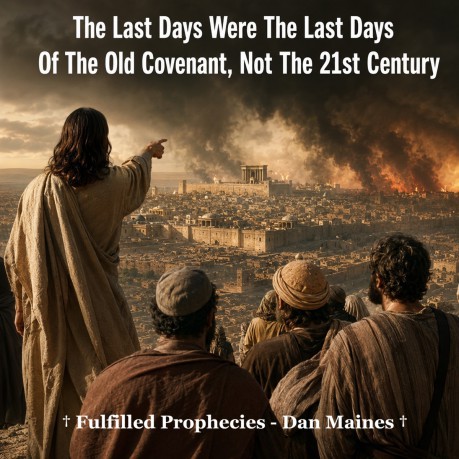
The Last Days Were The Last
Days Of The Old Covenant, Not The 21st Century Introduction † One of the most common assumptions in modern
Christianity is that the phrase "last days" refers to the
twenty-first century or a future period just before the end of the
physical world. Yet when we allow Scripture to define its own terms,
we discover something very different. The writers of the New
Testament repeatedly declared that they themselves were living in the
last days. They did not point their readers thousands of years into
the future. They spoke of events taking place in their own generation
as the Old Covenant age was coming to its appointed end. This sermon
examines every New Testament passage that explicitly speaks of the
last days, last day, last hour, or last time and allows the inspired
writers to explain what they meant. Hebrews 1:1-2 God, after He spoke long ago to the fathers in the prophets in
many portions and in many ways, in these last days has spoken to us
in His Son, whom He appointed heir of all things, through whom He
also made the world. † The writer did not say God would speak in the
last days thousands of years later. He said God had spoken in His Son
at the end of these days. † The contrast is between the Old Covenant era
of the prophets and the New Covenant revealed through Christ. † The last days had already begun in the
lifetime of the apostles. (Matthew 21:33-45; Hebrews 8:13) Acts 2:16-17 but this is what has been spoken through the prophet Joel: 'And it
shall be in the last days,' God says,' That I will pour out My Spirit
on all mankind; And your sons and your daughters will prophesy, And
your young men will see visions, And your old men will have dreams; † Peter did not say Joel would be fulfilled
thousands of years later. † He declared, This is that, identifying
Pentecost as the fulfillment of Joel's prophecy. † If Pentecost occurred in the last days, then
the last days had already begun in the first century. (Joel 2:28-32;
Acts 2:33) 1 Peter 1:20 For He was foreknown before the foundation of the world, but has
appeared in these last times for the sake of you † Peter said Christ was manifested at the end
of the times. † Jesus did not arrive before the beginning of
another two thousand years of history. He appeared at the close of
the covenant age. † Peter's readers were already living in that
closing period. (Galatians 4:4; Hebrews 9:26) Hebrews 9:26 Otherwise, He would have needed to suffer often since the
foundation of the world; but now once at the consummation of the ages
He has been revealed to put away sin by the sacrifice of Himself. † The inspired writer located Christ's
sacrifice at the end of the ages. † This was the end of the covenant ages that
led to Christ, not the end of the physical universe. † Jesus fulfilled the Law and the Prophets and
established the New Covenant before Jerusalem's destruction. (Matthew
5:17-18; Hebrews 8:13) 1 Corinthians 10:11 Now these things happened to them as an example, and they were
written for our instruction, upon whom the ends of the ages have
come. † Paul said the ends of the ages had come upon
his own generation. † He did not place the end of the ages
thousands of years into the future. † This perfectly agrees with Hebrews 9:26 that
Christ appeared at the end of the ages. (Hebrews 9:26; Romans 15:4) James 5:3 Your gold and your silver have corroded, and their corrosion will
serve as a testimony against you and will consume your flesh like
fire. It is in the last days that you have stored up your treasure! † James addressed people living in his own day. † He warned them that they had stored up wealth
in the last days. † His warning loses its meaning if the last
days were still thousands of years away. (James 5:7-9) Hebrews 8:13 When He said, "A new covenant," He has made the first
obsolete. But whatever is becoming obsolete and growing old is about
to disappear. † The Old Covenant was already growing old and
was about to disappear. † This explains why the apostles repeatedly
called their generation the last days. † The last days were the closing days of the
covenant that was about to vanish. (Matthew 24:1-2; Luke 21:20-22) 2 Timothy 3:1-5 But realize this, that in the last days difficult times will come.
For people will be lovers of self, lovers of money, boastful,
arrogant, slanderers, disobedient to parents, ungrateful, unholy,
unloving, irreconcilable, malicious gossips, without self-control,
brutal, haters of good, treacherous, reckless, conceited, lovers of
pleasure rather than lovers of God, holding to a form of godliness
although they have denied its power; avoid such people as these. † Paul warned Timothy about conditions he would
personally face. † He even instructed Timothy to turn away from
such people. † The warning was immediate, not directed
toward believers living two thousand years later. (2 Timothy 4:1-5) 2 Peter 3:3-4 Know this first of all, that in the last days mockers will come
with their mocking, following after their own lusts, and saying,
"Where is the promise of His coming? For ever since the fathers
fell asleep, all things continue just as they were from the beginning
of creation." † Peter warned his own readers about mockers
already arising among them. † They questioned Christ's promised coming
because they expected it within their own lifetime. † Peter answered by assuring them that God's
promise would not fail. (2 Peter 3:8-14) 1 John 2:18 Children, it is the last hour; and just as you heard that
antichrist is coming, even now many antichrists have appeared; from
this we know that it is the last hour. † John could not have spoken more plainly. † He said it is the last hour, not it will be
the last hour thousands of years from now. † The appearance of many antichrists proved to
John that his generation was living in that final hour. (Matthew
24:24; 2 John 7) Hebrews 10:25 not abandoning our own meeting together, as is the habit of some
people, but encouraging one another; and all the more as you see the
day drawing near. † The readers could see the day drawing near. † This was not an event hidden thousands of
years in the future. † The approaching day was the covenant judgment
Jesus had foretold upon Jerusalem. (Matthew 24:34; Luke 21:20-22) Jude 17-19 But you, beloved, ought to remember the words that were spoken
beforehand by the apostles of our Lord Jesus Christ, that they were
saying to you, "In the last time there will be mockers,
following after their own ungodly lusts." These are the ones who
cause divisions, worldly-minded, devoid of the Spirit. † Jude reminded his readers that the prophecy
had already become reality. † He did not describe future mockers. † He identified the mockers as people already
present among them. (2 Peter 3:3) John 6:39-40 And this is the will of Him who sent Me, that of everything that
He has given Me I will lose nothing, but will raise it up on the last
day. For this is the will of My Father, that everyone who sees the
Son and believes in Him will have eternal life, and I Myself will
raise him up on the last day. † Jesus repeatedly spoke of the last day
without redefining it as the end of the physical world. † The last day was the climax of the covenant
age when every promise concerning redemption reached its fulfillment. † The New Testament consistently points to that
first-century consummation. (John 11:24-26; Daniel 12:1-7) Historical References † Josephus described the unparalleled
suffering, famine, civil war, and destruction that came upon
Jerusalem in AD 70, fulfilling Jesus' warnings concerning that
generation. Josephus, The Wars of the Jews, Books V-VI. † Eusebius recorded that the Christians fled
Jerusalem before its destruction, remembering the Lord's warning
concerning the coming judgment. Eusebius, Ecclesiastical History,
Book III, Chapter 5. † Tacitus recorded the devastation of Judea and
Jerusalem under the Roman armies during the reign of Vespasian and
Titus. Tacitus, Histories, Book V. † Irenaeus testified that the Apocalypse was
seen toward the close of Domitian's reign. Although many use this
statement to argue for a late date of Revelation, the statement
itself is disputed because the Greek grammar allows the subject to
refer to John rather than the book. Irenaeus, Against Heresies, Book
V, Chapter 30. † This demonstrates that the dating of
Revelation should not be based on one disputed historical statement
but on the internal time statements of Scripture. (Revelation 1:1-3;
Revelation 22:6-10) How It Applies To Us Today † We don't live waiting for the last days
because Scripture says they occurred during the lifetime of the
apostles. † We live in the everlasting New Covenant
established by Christ through His finished work. † Our confidence rests in fulfilled prophecy,
not in constantly moving biblical promises into our future. † Christ reigns now, His Kingdom stands now,
and His people enjoy the blessings of the covenant that will never
pass away. (Hebrews 12:22-28) Q & A Appendix Q: If the apostles said they were living in the
last days, why do many people still place the last days in our
future? A: Many systems assume the last days refer to the
end of the physical world instead of the end of the Old Covenant age.
The New Testament writers consistently placed the last days in their
own lifetime. (Acts 2:16-17; Hebrews 1:1-2; 1 John 2:18) Q: What were the last days the last days of? A: They were the last days of the Old Covenant
age. The Law, the Temple, the Levitical priesthood, and the old
covenant order were passing away and reached their end with the
destruction of Jerusalem in AD 70. (Hebrews 8:13; Hebrews 9:26;
Matthew 24:34) Q: Are we living in the last days today? A: No. We are living under the everlasting New
Covenant established by Christ. The last days belonged to the
covenant transition that the apostles experienced, not to the
twenty-first century. (Hebrews 12:28; Ephesians 2:13-22) Q: If the last days ended in the first century,
why does the New Testament still matter today? A: Because the fulfillment of the last days
established the everlasting New Covenant that remains forever. We
don't live waiting for those events, we live because those events
were fulfilled. (Hebrews 12:22-28; Ephesians 2:13-22) Q: When were the last days? A: The last days began with Christ's first coming
and the outpouring of the Holy Spirit and ended with the destruction
of Jerusalem in AD 70, marking the end of the Old Covenant age. The
New Testament repeatedly says the apostles themselves were living in
the last days, not predicting them thousands of years later. (Acts
2:16-17; Hebrews 1:1-2; 1 Corinthians 10:11; Hebrews 8:13) Q: Why were they called the last days? A: They were called the last days because they
were the closing days of the Old Covenant, not the last days of
planet Earth. The Temple, Levitical priesthood, sacrifices, and the
Old Covenant system were all about to pass away and be replaced by
the everlasting New Covenant. (Hebrews 8:13; Hebrews 9:26; Matthew
24:1-3, 34) Q: If we're not living in the last days, what age
are we living in now? A: We are living in the everlasting New Covenant
age, the Kingdom that cannot be shaken. The last days have passed,
Christ reigns, and His covenant will never come to an end. (Hebrews
12:22-28; Ephesians 2:13-22; Luke 1:32-33) † This is the fulfilled perspective we proclaim at
Fulfilled Prophecies † © Fulfilled Prophecies - Dan Maines. Source Index † Hebrews 1:1-2; Acts 2:16-17; 1 Peter 1:20;
Hebrews 9:26; 1 Corinthians 10:11; James 5:3; Hebrews 8:13; 2 Timothy
3:1-5; 2 Peter 3:3-4; 1 John 2:18; Hebrews 10:25; Jude 17-19; John
6:39-40 † Josephus, The Wars of the Jews, Books V-VI;
Eusebius, Ecclesiastical History, Book III, Chapter 5; Tacitus,
Histories, Book V; Irenaeus, Against Heresies, Book V, Chapter 30
By Dan Maines
Links