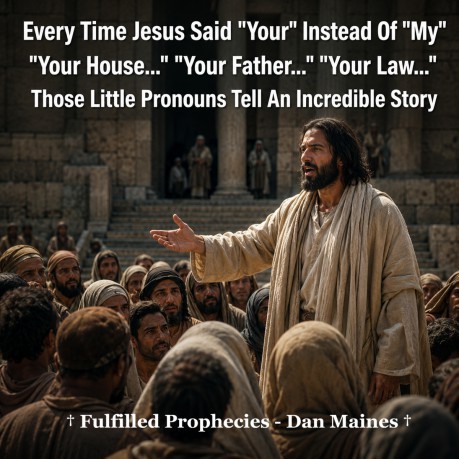
Every Time Jesus Said "Your"
Instead Of "My" Introduction † Most people read right over the little
pronouns Jesus used, yet they reveal a dramatic covenant transition
taking place before Israel's eyes. † Jesus often spoke of "my Father,"
but when addressing unbelieving Israel He frequently said "your
house," "your father," and "your law." Those
weren't accidental word choices. † These expressions exposed the growing
separation between the Old Covenant leadership and the Son of God.
What once belonged to God was about to be left desolate because they
rejected their Messiah. † Those small pronouns become powerful evidence
that the Old Covenant system was coming to its appointed end. Matthew 23:38 Behold, your house is being left to you desolate! † Jesus didn't call the temple "My
Father's house" here as He had earlier in His ministry. He now
called it "your house," showing that judgment was imminent.
(John 2:16; Matthew 23:38) † The covenant relationship with that temple
system was ending because Israel's leaders had rejected their
Messiah. (Hebrews 8:13) † This perfectly fits the approaching
destruction of Jerusalem in AD 70. (Luke 21:20-22) John 8:44 You are of your father the devil, and you want to do the desires
of your father. He was a murderer from the beginning, and does not
stand in the truth because there is no truth in him. Whenever he
tells a lie, he speaks from his own nature, because he is a liar and
the father of lies. † Jesus did not recognize Abraham as the true
spiritual father of those rejecting Him. † By saying "your father," He exposed
their true spiritual allegiance through their actions rather than
their ancestry. (John 8:39-41) † Covenant membership was no longer determined
by physical descent but by faith in Christ. (Romans 9:6-8) John 8:17 Even in your Law it has been written that the testimony of two
people is true. † Jesus referred to the Law as "your law,"
not because it was untrue, but because those opposing Him claimed to
uphold it while rejecting the One to whom it pointed. † The Law belonged to the Old Covenant
administration that was passing away. (Galatians 3:24-25) † Christ fulfilled everything written in the
Law and established the better covenant. (Hebrews 8:6) John 7:19 "Did Moses not give you the Law, and yet none of you carries
out the Law? Why are you seeking to kill Me?" † Jesus again speaks of the Law as something
possessed by His opponents while exposing their failure to obey it. † They appealed to Moses while plotting the
murder of the very Prophet Moses foretold. (Deuteronomy 18:15-19) † Their rejection demonstrated that possessing
the Law was never the same as keeping it. John 15:25 But this has happened so that the word that is written in their
Law will be fulfilled: 'They hated Me for no reason.' † Jesus again distanced Himself from those
using the Scriptures against Him. † Ironically, the very Law they appealed to
testified against them because it foretold their rejection of the
Messiah. (Psalm 35:19) † Their misuse of Scripture became evidence
that prophecy was being fulfilled exactly as written. (Luke 24:44) Matthew 15:7-9 You hypocrites, rightly did Isaiah prophesy about you, by saying:
'This people honors Me with their lips, But their heart is far away
from Me. And in vain do they worship Me, Teaching as doctrines the
commandments of men.' † Jesus repeatedly emphasized "you"
and "your" when exposing the traditions that had replaced
God's commandments. † Their religion had become centered on human
authority instead of obedience to God. † The coming judgment would remove that corrupt
system and establish the New Covenant people of God. (Hebrews
12:26-28) John 5:45-47 Do not think that I will accuse you before the Father; the one who
accuses you is Moses, in whom you have put your hope. For if you
believed Moses, you would believe Me; for he wrote about Me. But if
you do not believe his writings, how will you believe My words? † Jesus showed that the very authority they
trusted would become their accuser. † Moses pointed directly to Christ, making
their rejection of Jesus a rejection of Moses himself. † Their confidence in the Old Covenant became
the evidence against them. (Acts 3:22-23) John 2:16 and to those who were selling the doves He said, "Take these
things away from here; stop making My Father's house a place of
business!" † Earlier in His ministry Jesus called the
temple "my Father's house." † By the time He reached Matthew 23:38 He
called it "your house," revealing a significant covenant
change. † Those two statements form bookends showing
Israel's opportunity, rejection, and coming judgment. Luke 13:34-35 Jerusalem, Jerusalem, the city that kills the prophets and stones
those who have been sent to her! How often I wanted to gather your
children together, just as a hen gathers her young under her wings,
and you were unwilling! Behold, your house is left to you desolate;
and I say to you, you will not see Me until you say, 'Blessed is the
One who comes in the name of the Lord!' † Luke records the exact same declaration as
Matthew, proving "your house" was one of Jesus' final
covenant pronouncements against Jerusalem. † This wasn't merely about a building. It was
the entire Old Covenant system centered in Jerusalem that was about
to be abandoned. † Luke immediately connects this theme to the
events fulfilled in the destruction of Jerusalem. (Luke 21:20-22) Historical References † Josephus recorded that the temple and
Jerusalem were completely destroyed by the Roman armies in AD 70,
exactly as Jesus foretold in Matthew 23 and Luke 21. (Josephus, Wars
of the Jews, Book 6, Chapters 4-8) † Eusebius recorded that Christians remembered
Jesus' warning and fled Jerusalem before its destruction. (Eusebius,
Ecclesiastical History, Book 3, Chapter 5) † The historical record confirms that the house
Jesus called "your house" was left desolate exactly as He
declared. † Irenaeus affirmed that Christ fulfilled the
Law and the Prophets through His first-century ministry, showing
continuity between prophecy and fulfillment. (Against Heresies, Book
4, Chapters 33-34) † Tacitus likewise records the destruction of
Jerusalem under Titus, confirming the historical judgment that Jesus
announced. (Histories, Book 5) How It Applies To Us Today † We belong to Christ through the New Covenant,
not through an earthly temple or Old Covenant system. † Our identity comes from our heavenly Father
through Jesus Christ, not through physical lineage. † We should pay attention to every word Jesus
spoke because even the smallest pronouns reveal profound covenant
truth. † God's dwelling is now His people, not a
building made with human hands. (Ephesians 2:19-22) † We should never overlook the small words of
Scripture because Jesus often revealed profound covenant truth
through a single pronoun. † The difference between "my" and
"your" reveals the transition from the Old Covenant
administration to the New Covenant Kingdom. † Those little pronouns become another witness
that Jesus' judgment upon Jerusalem was approaching exactly as He
foretold. Q & A Appendix Q: Why did Jesus change from saying "my
Father's house" to "your house"? (John 2:16; Matthew
23:38) A: Early in His ministry Jesus still recognized
the temple as His Father's house. After Israel's continued rejection
of Him, He declared it "your house," announcing that it
would soon be left desolate. Q: Why did Jesus say "your law" instead
of "our law"? (John 8:17; John 15:25) A: Jesus had fulfilled the Law and exposed those
who claimed to honor it while rejecting the One it testified about.
Their appeal to the Law only condemned them because they refused its
fulfillment in Christ. Q: What do these pronouns teach us today?
(Hebrews 8:13; Ephesians 2:19-22) A: They remind us that the Old Covenant has
passed away. God's people are now identified by faith in Christ, and
God's dwelling place is His redeemed people. † This is the fulfilled perspective we proclaim at
Fulfilled Prophecies † © Fulfilled Prophecies - Dan Maines. Source Index † Matthew 23:38; John 8:44; John 8:17; John
7:19; John 15:25; Matthew 15:7-9; John 5:45-47; John 2:16; Luke
13:34-35; John 8:39-41; Luke 21:20-22; Hebrews 8:13; Hebrews 8:6;
Galatians 3:24-25; Psalm 35:19; Luke 24:44; Hebrews 12:26-28; Romans
9:6-8; Ephesians 2:19-22; Deuteronomy 18:15-19; Acts 3:22-23 † Josephus, Wars of the Jews, Book 6, Chapters
4-8; Eusebius, Ecclesiastical History, Book 3, Chapter 5; Irenaeus,
Against Heresies, Book 4, Chapters 33-34; Tacitus, Histories, Book 5
By Dan Maines
"Your House..."
"Your Father..." "Your Law..."
Those
Little Pronouns Tell An Incredible Story
Links