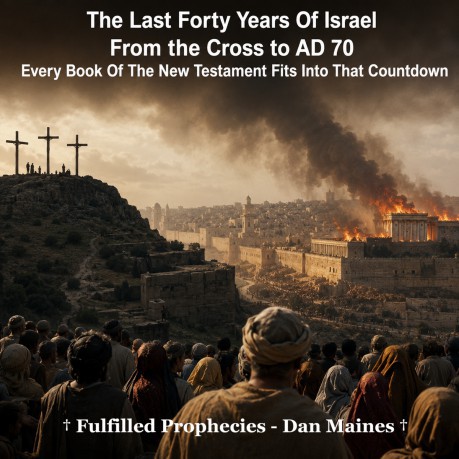
The Last Forty Years Of
Israel Introduction † Most Christians read the New Testament as if
it were written over a long period with no unifying timeline. But the
writers themselves saw something very different. They believed they
were living in the final generation of Old Covenant Israel. From the
cross until the destruction of Jerusalem in AD 70 was a forty-year
period of transition, just as Israel wandered forty years before
entering the Promised Land. Every New Testament book fits somewhere
within that covenant countdown, warning that the end of the Old
Covenant age was near. † Jesus' death established the New Covenant,
but the Old Covenant order remained standing until God's judgment
fell upon Jerusalem and the temple. Throughout those forty years the
apostles repeatedly warned that the end was approaching. † When we read the New Testament within its
original time frame, the repeated statements of "near," "at
hand," "this generation," and "the last days"
all become perfectly consistent. Matthew 24:34 Truly I say to you, this generation will not pass away until all
these things take place. † Jesus placed the fulfillment within the
lifetime of His own generation, not thousands of years later. † Every New Testament writer remained faithful
to this same time expectation because they believed Jesus' words. † The forty-year countdown began with Christ's
ministry and ended exactly as He foretold with Jerusalem's
destruction. Hebrews 8:13 When He said, "A new covenant," He has made the first
obsolete. But whatever is becoming obsolete and growing old is about
to disappear. † Hebrews describes the Old Covenant as growing
old and ready to disappear. † The temple was still standing when Hebrews
was written, showing the final removal had not yet occurred. † Only AD 70 completely removed the Old
Covenant system exactly as the writer expected. Hebrews 10:25 not abandoning our own meeting together, as is the habit of some
people, but encouraging one another; and all the more as you see the
day drawing near. † The writer expected his readers to actually
see "the day" approaching. † This wasn't describing an event thousands of
years in the future. † It confirms the same forty-year countdown
found throughout the New Testament. James 5:8-9 You too be patient; strengthen your hearts, for the coming of the
Lord is near. Do not complain, brothers and sisters, against one
another, so that you may not be judged; behold, the Judge is standing
right at the door. † James did not describe a coming thousands of
years away. † "At hand" and "before the
doors" describe an event that was extremely close to his
readers. † James encouraged endurance because the
covenant judgment was rapidly approaching. 1 Corinthians 10:11 Now these things happened to them as an example, and they were
written for our instruction, upon whom the ends of the ages have
come. † Paul says the ends of the ages had already
come upon his generation. † He places his readers at the climax of
redemptive history, not people living thousands of years later. † This perfectly fits the final years before
the Old Covenant age ended. 1 Peter 4:7 The end of all things is near; therefore, be of sound judgment and
sober spirit for the purpose of prayer. † Peter spoke of the end that his audience
expected to witness. † The context concerns the end of the Old
Covenant world, not the end of planet Earth. (Matthew 24:3) † Peter urged believers to remain spiritually
alert because that covenantal end was near. 1 John 2:18 Children, it is the last hour; and just as you heard that
antichrist is coming, even now many antichrists have appeared; from
this we know that it is the last hour. † John didn't say the last hour would come
someday. † He declared they were already living in it. † The appearance of many antichrists proved the
Old Covenant age was reaching its conclusion. Revelation 1:1-3 The Revelation of Jesus Christ, which God gave Him to show to His
bond-servants, the things which must soon take place; and He sent and
communicated it by His angel to His bond-servant John, who testified
to the word of God and to the testimony of Jesus Christ, everything
that he saw. Blessed is the one who reads, and those who hear the
words of the prophecy and keep the things which are written in it;
for the time is near. † Revelation opens by declaring that its
prophecies would happen shortly. † John repeats that the time was at hand,
matching Jesus, James, Peter, and Hebrews. † The entire book belongs within the final
years leading to Jerusalem's destruction. Revelation 22:10 And he said to me, "Do not seal up the words of the prophecy
of this book, for the time is near. † Revelation closes exactly as it opened,
declaring the time was at hand. † The first and last chapters leave no room to
postpone these prophecies for thousands of years. † John's message remained focused on events
about to occur in his generation. Luke 21:20-22 But when you see Jerusalem surrounded by armies, then recognize
that her desolation is near. Then those who are in Judea must flee to
the mountains, and those who are inside the city must leave, and
those who are in the country must not enter the city; because these
are days of punishment, so that all things which have been written
will be fulfilled. † Jesus gave His disciples a visible sign that
the end had arrived. † The destruction of Jerusalem fulfilled the
covenant judgments promised throughout the Old Testament. † AD 70 completed the forty-year transition
from Old Covenant Israel to the fully established New Covenant. Romans 13:11-12 Do this, knowing the time, that it is already the hour for you to
awaken from sleep; for now salvation is nearer to us than when we
first believed. The night is almost gone, and the day is near.
Therefore let's rid ourselves of the deeds of darkness and put on the
armor of light. † Paul says salvation was nearer than when they
first believed because the New Covenant transition was nearing
completion. † The repeated expression "the day is at
hand" agrees with every other New Testament writer. † Romans belongs within the same forty-year
countdown leading to Jerusalem's destruction. Historical References † Josephus (Wars of the Jews, Book 6, Chapters
3-5) records the destruction of Jerusalem and the burning of the
temple in AD 70, exactly as Jesus foretold. † Eusebius (Ecclesiastical History, Book 3,
Chapter 5) records that Christians fled Jerusalem before its
destruction in obedience to Christ's warning. † Tacitus (Histories, Book 5) confirms the
Roman siege and destruction of Jerusalem during the reign of
Vespasian and Titus. How It Applies To Us Today † We can trust every time statement Jesus and
the apostles gave because history confirms their fulfillment. † We no longer live waiting for the Old
Covenant to end because Christ has already established His
everlasting kingdom. † We now live under the finished New Covenant,
enjoying direct access to God through Jesus Christ. † Understanding the forty-year transition
brings the entire New Testament into harmony and removes the
confusion created by postponing its prophecies into our future. Q & A Appendix Q: Why was there a forty-year period instead of
immediate judgment after the cross? A: God demonstrated remarkable patience, giving
Israel one final generation to repent before covenant judgment came
upon Jerusalem. (Matthew 23:37-39; Luke 21:20-22; 2 Peter 3:9) Q: Were all the New Testament books written
during this forty-year countdown? A: Yes. Every New Testament book was written
during the transition between Christ's death and the destruction of
Jerusalem, addressing believers living in those last days of the Old
Covenant. (Hebrews 1:1-2; James 5:8-9; Revelation 1:1-3) Q: Why is AD 70 so important to understanding the
New Testament? A: Because it marked the complete removal of the
Old Covenant system, the destruction of the temple, and the
fulfillment of Jesus' covenant judgment prophecies. (Matthew 24:34;
Luke 21:20-22; Hebrews 8:13) Q: If the New Testament was written during the
last forty years of Israel, why don't the writers ever mention the
temple had already been destroyed? A: Because the temple was still standing when
they wrote. They consistently speak of its destruction as a coming
event, not a past event. Had AD 70 already occurred, the greatest
covenant event of their generation would certainly have been
mentioned as fulfilled. (Hebrews 8:13; Hebrews 10:25; Matthew 24:1-2;
Luke 21:20-22) Q: Why is the forty-year period significant? A: Just as Israel wandered forty years before
entering the Promised Land, first-century Israel experienced a
forty-year covenant transition from the cross until Jerusalem's
destruction. God gave that generation time to repent before bringing
the covenant judgment Jesus had foretold. (Numbers 14:33-34; Matthew
23:37-39; Matthew 24:34; Luke 21:22) Q: What was God doing during those forty years? A: God was establishing the New Covenant while
patiently calling Israel to repentance through the preaching of
Christ's apostles. When that generation rejected the gospel, the Old
Covenant system came to its appointed end in AD 70. (Acts 2:38-40;
Hebrews 8:13; Hebrews 12:26-28; 2 Peter 3:9) † This is the fulfilled perspective we proclaim at
Fulfilled Prophecies. † © Fulfilled Prophecies - Dan Maines. Source Index † Matthew 24:34; Hebrews 8:13; James 5:8-9; 1
Peter 4:7; Revelation 1:1-3; Luke 21:20-22 † Josephus, Wars of the Jews, Book 6, Chapters
3-5; Eusebius, Ecclesiastical History, Book 3, Chapter 5; Tacitus,
Histories, Book 5
By Dan Maines
From the Cross to AD 70
Every
Book Of The New Testament Fits Into That Countdown
Links