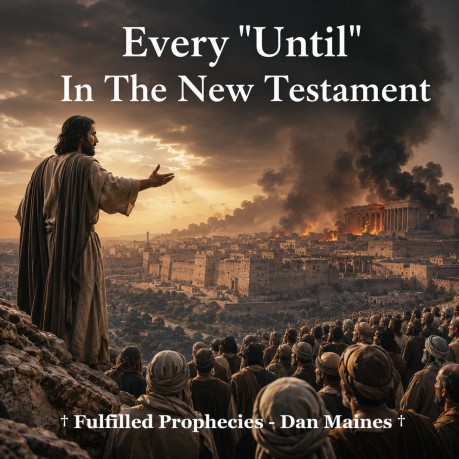
Every "Until" In
The New Testament Introduction † One of the most overlooked words in Bible
prophecy is the word Until. It marks a limit, an
endpoint, or a time when something would change. † Jesus and the apostles repeatedly used Until
to describe events that were approaching in their own generation, not
thousands of years later. † When every New Testament "Until"
is studied in its context, they all point to the same covenant
transition, the passing of the Old Covenant and the full
establishment of the New Covenant, culminating in the destruction of
Jerusalem in AD 70. Matthew 5:18 For truly I say to you, Until heaven and earth
pass away, not the smallest letter or stroke of a letter shall pass
from the Law, Until all is accomplished! † Jesus gave two "Until"
statements in the same verse. The Law remained in force Until
heaven and earth passed away and Until all things
written were fulfilled. † The "heaven and earth" of this
passage refers to the covenant world of Israel, not the physical
universe. (Isaiah 51:15-16; Hebrews 12:26-28) † Hebrews later declares the Old Covenant was
becoming obsolete and ready to disappear, showing that this
fulfillment occurred in the first century. (Hebrews 8:13) Matthew 10:23 But whenever they persecute you in one city, flee to the next; for
truly I say to you, you will not finish going through the cities of
Israel Until the Son of Man comes. † Jesus limited this promise to the cities of
Israel, not the entire world. † The coming of the Son of Man here was His
covenant coming in judgment against Jerusalem. (Matthew 24:30; Luke
21:20-22) † This "Until" had
to occur before the disciples finished going through Israel's cities,
proving a first-century fulfillment. Matthew 23:39 For I say to you, from now on you will not see Me Until
you say, 'Blessed is the One who comes in the name of the Lord!' † Jesus was speaking directly to Jerusalem's
leaders who had rejected Him. † Their opportunity ended with the destruction
of their city and temple. (Matthew 23:37-38) † This was not a promise to a future generation
but a warning to the generation standing before Him. (Matthew 24:34) Matthew 24:34 Truly I say to you, this generation will not pass away Until
all these things take place. † This is one of the clearest time statements
in the New Testament. † "All these things" includes
everything Jesus had just described, including the great tribulation,
His coming in judgment, and the destruction of the temple. † Jesus didn't leave the fulfillment
open-ended. He placed it within the lifetime of His own generation. Luke 21:32 Truly I say to you, this generation will not pass away Until
all things take place. † Luke records the same prophecy as Matthew and
uses the identical "Until" time
limitation. † Jesus again places every event within the
lifetime of His own generation. † Matthew and Luke together remove any
possibility of extending these events thousands of years into the
future. (Matthew 24:34; Luke 21:20-22) Luke 21:24 and they will fall by the edge of the sword, and will be led
captive into all the nations; and Jerusalem will be trampled
underfoot by the Gentiles Until the times of the
Gentiles are fulfilled. † Jerusalem would remain under Gentile
domination Until God's covenant purpose for the
Gentiles reached fulfillment. † Paul identifies this same event as the
fullness of the Gentiles coming in. (Romans 11:25) † The destruction of Jerusalem marked the
completion of that covenant transition. Romans 11:25 For I do not want you, brothers and sisters, to be uninformed of
this mystery-so that you will not be wise in your own estimation-that
a partial hardening has happened to Israel Until the
fullness of the Gentiles has come in; † Israel's partial hardening was temporary. † The mystery Paul revealed was reaching its
completion during the first-century transition into the New Covenant. † This "Until"
belongs to the same covenant timeline as Luke 21:24. Acts 3:21 whom heaven must receive Until the period of
restoration of all things, about which God spoke by the mouths of His
holy prophets from ancient times. † Jesus remained in heaven Until
the restoration spoken by the prophets reached its fulfillment. † Peter preached that these events were
unfolding in his own generation and called Israel to repent before
judgment came. (Acts 3:22-26) † This restoration was the completion of God's
covenant promises through Christ, not the restoration of national
Israel. 1 Corinthians 11:26 For as often as you eat this bread and drink the cup, you proclaim
the Lord's death Until He comes. † The Lord's Supper proclaimed Christ's death
Until His coming. † Paul expected that coming during the lifetime
of his readers. (1 Corinthians 7:29-31) † The covenant coming of Christ brought the
complete establishment of the New Covenant order. 1 Corinthians 15:25 For He must reign Until He has put all His
enemies under His feet. † Christ began reigning at His ascension. † His reign continued Until
every covenant enemy had been placed under His feet. † The last covenant enemy, death under the Old
Covenant order, was abolished with the completion of redemption.
(Hebrews 2:14-15; Revelation 20:13-14) Hebrews 10:12-13 but He, having offered one sacrifice for sins for all time, sat
down at the right hand of God, waiting from that time onward Until
His enemies are made a footstool for His feet. † Christ wasn't waiting to begin reigning, He
was already seated on the throne. † The expectation was the complete defeat of
His covenant enemies. † Hebrews repeatedly says these events were
about to occur. (Hebrews 8:13; Hebrews 10:37) Acts 2:34-35 For it was not David who ascended into heaven, but he himself
says: 'The Lord said to my Lord, “Sit at My right hand, Until
I make Your enemies a footstool for Your feet.”' † Peter declared this Psalm was already being
fulfilled through Christ's exaltation. † Christ was already reigning from heaven while
His covenant enemies were being brought to judgment. † This agrees perfectly with Paul's teaching
that Christ reigns Until every enemy has been
subdued. (1 Corinthians 15:25) Revelation 6:11 And a white robe was given to each of them; and they were told
that they were to rest for a little while longer, Until
the number of their fellow servants and their brothers and sisters
who were to be killed even as they had been, was completed also. † The martyrs were told to wait only a little
time. † Revelation begins and ends by declaring its
events were about to happen. (Revelation 1:1-3; Revelation 22:6, 10) † Their vindication came in the judgment upon
Jerusalem, where the prophets and saints had been slain. (Revelation
18:20-24) Revelation 22:10 And he said to me, Do not seal up the words of the prophecy of
this book, for the time is near. † The waiting period for the martyrs was short
because Revelation repeatedly says its fulfillment was near. † The command not to seal the prophecy stands
in direct contrast with Daniel, whose fulfillment was still far away.
(Daniel 12:4) † The "Until" of
Revelation 6 could not extend for thousands of years when Revelation
itself says the time was at hand. Historical References † Josephus, Wars of the Jews, Book 6, Chapters
3-5 records the destruction of Jerusalem and the temple exactly as
Jesus foretold. † Eusebius, Ecclesiastical History, Book 3,
Chapter 5 records the flight of the Christians from Jerusalem before
its destruction. † Tacitus, Histories, Book 5 records the Roman
siege and destruction of Jerusalem. How It Applies To Us Today † We don't live waiting for prophecy to be
fulfilled, we live because it has been fulfilled. † Our confidence rests in a Savior who kept
every time statement exactly as He promised. † Every New Testament "Until"
reminds us that God's promises are trustworthy and His covenant is
complete. Q & A Appendix Q: Did any New Testament "Until"
point thousands of years into our future? A: No. Every "Until"
is connected to first-century covenant events that Jesus and the
apostles declared were near. (Matthew 24:34; Revelation 1:1-3) Q: Why is the word "Until"
so important? A: Because it establishes a definite ending
point. Once the condition was fulfilled, the temporary arrangement
ended and the New Covenant stood complete. (Hebrews 8:13; Hebrews
10:37) Q: Is Christ still waiting to reign? A: No. Christ reigns now. The New Testament says
He reigned Until His covenant enemies were placed
under His feet. (1 Corinthians 15:25; Hebrews 10:12-13) Q: Why are there so many "Until"
statements in the New Testament? A: Because God was marking the end of the Old
Covenant age. Every "Until" pointed to a
coming fulfillment, and once those events occurred, the temporary
covenant gave way to the everlasting New Covenant. (Matthew 5:18;
Hebrews 8:13; Hebrews 10:37) † This is the fulfilled perspective we proclaim at
Fulfilled Prophecies. † © Fulfilled Prophecies - Dan Maines. Source Index † Matthew 5:18; Matthew 10:23; Matthew 23:39;
Matthew 24:34; Luke 21:24; Luke 21:32; Acts 2:34-35; Acts 3:21;
Romans 11:25; 1 Corinthians 11:26; 1 Corinthians 15:25; Hebrews
10:12-13; Revelation 6:11; Revelation 22:10 † Josephus, Wars of the Jews, Book 6, Chapters
3-5; Tacitus, Histories, Book 5; Eusebius, Ecclesiastical History,
Book 3, Chapter 5
By Dan Maines
Links