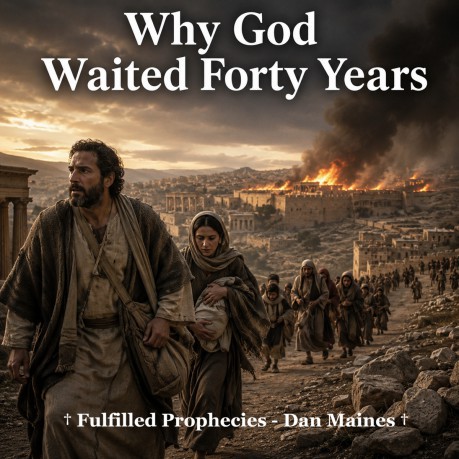
Why God Waited Forty Years Introduction † One of the most overlooked questions in
Scripture is why God waited about forty years after the cross before
Jerusalem and the temple were destroyed. If Israel rejected and
crucified the Messiah, why wasn't judgment immediate? The answer is
found in a biblical pattern that began long before the first century. † God had already established a forty-year
period of testing, patience, and covenant transition in Israel's
history. The generation that rejected Him in the wilderness wandered
for forty years before judgment finally came. The generation that
rejected Christ followed the very same pattern. † The cross secured the victory, but God gave
that generation one final period of mercy, calling them to repentance
before the covenant judgment of AD 70. Numbers 14:33-34 Also, your sons will be shepherds in the wilderness for forty
years, and they will suffer for your unfaithfulness, until your
bodies perish in the wilderness. In accordance with the number of
days that you spied out the land, forty days, for every day you shall
suffer the punishment for your guilt a year, that is, forty years,
and you will know My opposition. † God established a forty-year judgment pattern
after Israel rejected His promise in the wilderness. (Deuteronomy
8:2; Psalm 95:8-11) † That unbelieving generation was given time
before the sentence reached its completion. † The first-century generation repeated the
same unbelief, rejecting the greater Joshua, Jesus Christ. Deuteronomy 2:14 Now the time that it took for us to come from Kadesh-barnea until
we crossed over the Wadi Zered was thirty-eight years, until all the
generation of the men of war perished from within the camp, just as
the Lord had sworn to them. † This confirms the wilderness judgment lasted
until the entire unbelieving generation had passed away. (Numbers
14:33-34) † God did not shorten the period or extend it
beyond what He had declared. † Jesus likewise allowed the first-century
generation to run its full course before judgment fell. (Matthew
24:34) Matthew 23:37-38 Jerusalem, Jerusalem, who kills the prophets and stones those who
have been sent to her! How often I wanted to gather your children
together, the way a hen gathers her chicks under her wings, and you
were unwilling. Behold, your house is being left to you desolate! † Jesus announced that the temple had been
abandoned by God long before it was physically destroyed. (Matthew
21:43) † The words "your house" reveal that
it was no longer God's house. † The verdict had already been declared, but
the execution of judgment would come later. Matthew 24:34 Truly I say to you, this generation will not pass away until all
these things take place. † Jesus put a time limit on every prophecy He
had just spoken. † The same generation that rejected Him would
live to see Jerusalem's destruction. (Luke 21:20-22) † Forty years later, exactly as Jesus said,
that generation came to its end. Luke 13:6-9 And He began telling this parable: "A man had a fig tree
which had been planted in his vineyard; and he came looking for fruit
on it and did not find any. And he said to the vineyard-keeper,
'Look! For three years I have come looking for fruit on this fig tree
without finding any. Cut it down! Why does it even use up the
ground?' But he answered and said to him, 'Sir, leave it alone for
this year too, until I dig around it and put in fertilizer; and if it
bears fruit next year, fine; but if not, cut it down.'" † God's character is patient, even when
judgment has already been determined. (2 Peter 3:9) † Israel was given every opportunity to repent
through Christ, the apostles, and the early church. † When the nation remained fruitless, the
judgment Jesus predicted finally arrived. Acts 2:40 And with many other words he solemnly testified and kept on urging
them, saying, "Be saved from this perverse generation!" † Peter wasn't warning them about the end of
the physical world. † He was warning that very generation to escape
the coming covenant judgment. † Thousands responded, but the nation as a
whole continued in unbelief. (Acts 3:19-26) Acts 3:22-23 Moses said, 'The Lord God will raise up for you a prophet like me
from your countrymen; to Him you shall listen regarding everything He
says to you. And it shall be that every soul that does not listen to
that prophet shall be utterly destroyed from among the people.' † Peter warned Israel that rejecting Christ
would bring covenant judgment. † The destruction would be from among the
covenant people, not from the physical planet. † This warning was still being extended during
the forty-year period of mercy. (Acts 2:40) Hebrews 8:13 When He said, "A new covenant," He has made the first
obsolete. But whatever is becoming obsolete and growing old is about
to disappear. † Hebrews was written during the forty-year
transition between the cross and AD 70. † The Old Covenant was still standing
outwardly, but it had already become obsolete. † God was allowing time for the New Covenant to
be fully established before removing the old covenant order forever. Hebrews 10:37 For yet in a very little while, He who is coming will come, and
will not delay. † The writer expected the fulfillment to occur
very soon. † This fits perfectly within the closing years
before AD 70. † The Old Covenant was about to disappear
exactly as Hebrews declared. (Hebrews 8:13) Luke 21:20-22 But when you see Jerusalem surrounded by armies, then recognize
that her desolation is near. Then those who are in Judea must flee to
the mountains, and those who are inside the city must leave, and
those who are in the country must not enter the city; because these
are days of punishment, so that all things which have been written
will be fulfilled. † Jesus identified the destruction of Jerusalem
as the fulfillment of everything written concerning that covenant
judgment. † The forty-year period ended exactly as the
wilderness period had ended, with judgment falling upon the
unbelieving generation. † God's patience did not cancel His judgment,
it delayed it until His appointed time. Matthew 24:14 This gospel of the kingdom shall be preached in the whole world as
a testimony to all the nations, and then the end will come. † God did not bring covenant judgment until the
gospel had first been proclaimed throughout the Roman world.
(Colossians 1:6, 23) † The forty years provided time for the
apostles to carry the gospel to Israel and the nations. † Judgment followed only after God's witness
had gone forth. Historical References † Josephus, Wars of the Jews, Book 6, Chapters
3-5, records the horrific destruction of Jerusalem and the temple in
AD 70, confirming the fulfillment of Jesus' prophecy. † Eusebius, Ecclesiastical History, Book 3,
Chapter 5, records that Christians remembered Jesus' warning and fled
Jerusalem before the city's destruction. † Irenaeus, Against Heresies, Book 4, Chapter
26, speaks of God's long-suffering before bringing judgment upon the
disobedient. How It Applies To Us Today † God's patience should never be mistaken for
approval of sin. † God's promises and judgments always arrive
exactly when He has determined. † We live under the completed New Covenant
where God's dwelling is with His people, not in temples made with
hands. Q & A Appendix Q: Why didn't God destroy Jerusalem immediately
after the crucifixion? A: Because He followed the same forty-year
pattern He established in the wilderness, giving that generation time
to repent before covenant judgment came. (Numbers 14:33-34; Acts
2:40; Hebrews 8:13) Q: Why forty years? A: Forty years represented a complete period of
testing and probation in Israel's history. The first wilderness
generation failed after forty years, and the generation that rejected
Christ did the same. (Numbers 14:33-34; Psalm 95:8-11) Q: What happened during those forty years? A: The gospel was preached throughout Israel, the
New Covenant was established, and believers were called out before
Jerusalem's destruction. (Acts 2:40; Acts 3:19-26; Hebrews 8:13) Q: Does this prove AD 70 was part of God's
covenant plan? A: Yes. Jesus foretold Jerusalem's destruction as
the days of vengeance in which all things written would be fulfilled.
(Luke 21:20-22; Matthew 23:37-38) Q: Why did God wait forty years instead of
judging Jerusalem immediately? A: Because God's pattern had already been
established in Israel's history. The wilderness generation received
forty years before judgment was complete, and the generation that
rejected Christ received the same covenant period of testing, mercy,
and warning before Jerusalem fell in AD 70. (Numbers 14:33-34;
Matthew 24:34; Luke 21:20-22) † This is the fulfilled perspective we proclaim at
Fulfilled Prophecies. † © Fulfilled Prophecies - Dan Maines. Source Index † Numbers 14:33-34, Deuteronomy 2:14, Matthew
23:37-38, Luke 13:6-9, Acts 2:40, Acts 3:22-23, Hebrews 8:13, Hebrews
10:37, Matthew 24:14, Matthew 24:34, Luke 21:20-22 † Josephus, Wars of the Jews, Book 6, Chapters
3-5, Eusebius, Ecclesiastical History, Book 3, Chapter 5, Irenaeus,
Against Heresies, Book 4, Chapter 26
By Dan Maines
Links