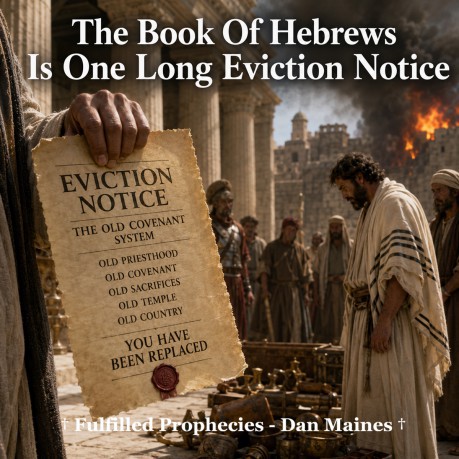
The Book Of Hebrews Is One
Long Eviction Notice Introduction † The Book of Hebrews is often studied as a
book about faith, but its central message is much bigger than that.
It is God's formal announcement that the Old Covenant system was
passing away because something infinitely better had arrived. † Every major theme in Hebrews points in the
same direction. The old priesthood was being replaced. The old
covenant was becoming obsolete. The old sacrifices were ending. The
earthly temple was giving way to a heavenly reality. The earthly
homeland was replaced with a better country. † Hebrews wasn't written to encourage believers
to return to Judaism. It was written to warn them not to remain in a
covenant God Himself was removing. Hebrews 7:22 † Jesus didn't come to improve the Mosaic
Covenant. He came to guarantee a better one. (Hebrews 8:6) Hebrews 7:18-19 † Hebrews says the former commandment was
"disannulled," meaning it was set aside. Hebrews 8:13 † God Himself declared the first covenant old.
No man abolished it, God did. Hebrews 8:6 † The New Covenant wasn't simply newer, it was
better in every way. Hebrews 9:11-12 † Jesus entered the true heavenly sanctuary
instead of the earthly temple. Hebrews 10:11-14 † The Levitical priests stood daily because
their work was never finished. Hebrews 10:18 † Once forgiveness was accomplished, no further
sacrifices were needed. Hebrews 11:16 † Hebrews wasn't directing believers toward an
earthly kingdom. Hebrews 13:14 † The earthly Jerusalem was never the
believer's permanent home. Hebrews 12:22-24 † Notice the writer says, "you have come,"
not "you will someday come." Hebrews 12:26-28 † The things being removed were the Old
Covenant institutions that were about to pass away. Historical References † Josephus, Wars of the Jews, Book 6, Chapter 4
records the destruction of Jerusalem and the temple in AD 70,
bringing the Old Covenant sacrificial system to its permanent end. † Eusebius, Ecclesiastical History, Book 3,
Chapter 5 records that Christians fled Jerusalem before its
destruction, following Jesus' warning in Luke 21. † Tacitus, Histories, Book 5 describes the
Roman siege and destruction of Jerusalem, confirming the catastrophic
end of the Jewish temple system. † Irenaeus, Against Heresies, Book 4 explains
that Christ fulfilled the Law and established the New Covenant
through His sacrifice. † Clement of Rome, First Clement, Chapters
40-44 describes the continuing Levitical priesthood shortly before
the temple's destruction, demonstrating that Hebrews was written
during the transition period before AD 70.
How It Applies To Us Today † We don't live under an earthly priesthood
because Christ is our eternal High Priest. † We don't offer sacrifices because His one
sacrifice was sufficient forever. † We aren't looking for another covenant
because we already live under the better covenant. † We aren't waiting for another temple because
we have access to God through Jesus Christ. † We aren't waiting to enter the heavenly
Jerusalem because Scripture says we have already come to it through
Christ. Q & A Appendix Q: Why do you call Hebrews an eviction notice? A: Because every chapter announces that the Old
Covenant system was giving way to something better. The priesthood,
sacrifices, covenant, sanctuary, and promises were all being replaced
by Christ. (Hebrews 7:22, Hebrews 8:13, Hebrews 9:11-12, Hebrews
10:11-14) Q: Who was being evicted? A: Not individual Jews, but the Old Covenant
order itself. God was bringing the Mosaic system to its appointed end
and establishing the everlasting New Covenant through Christ.
(Hebrews 8:13, Jeremiah 31:31-34) Q: When did the eviction become visible? A: The process began with Christ's death,
resurrection, and ascension, and reached its covenantal conclusion
when Jerusalem and the temple were destroyed in AD 70, exactly as
Jesus foretold. (Luke 21:20-22, Hebrews 8:13) Q: What is the repeated message throughout
Hebrews? A: Better Priest. Better Covenant. Better
Sacrifice. Better Temple. Better Country. Everything under Christ is
better because it is complete, permanent, and cannot be replaced.
(Hebrews 7:22, Hebrews 9:11-12, Hebrews 10:14, Hebrews 11:16) Q: Why does Hebrews keep using the word "better"? A: Because the entire purpose of the book is to
show that Christ fulfilled and surpassed every part of the Old
Covenant. Every "better" is another announcement that the
old order was passing away. (Hebrews 1:4; Hebrews 7:19, 22; Hebrews
8:6; Hebrews 9:23; Hebrews 10:34; Hebrews 11:16; Hebrews 12:24) Q: If Hebrews is an eviction notice, who issued
it? A: God did. He declared the first covenant old,
established a New Covenant through His Son, and brought the Old
Covenant age to its end exactly as He promised. (Hebrews 8:13;
Jeremiah 31:31-34; Luke 21:20-22) † This is the fulfilled perspective we proclaim at
Fulfilled Prophecies. † © Fulfilled Prophecies - Dan Maines. Source Index † Hebrews 7:18-19, 22; Hebrews 8:6, 13; Hebrews
9:11-12; Hebrews 10:11-14, 18; Hebrews 11:16; Hebrews 12:22-24,
26-28; Hebrews 13:14; Luke 21:20-22; Jeremiah 31:31-34; John 19:30;
Romans 5:1-2; Haggai 2:6 † Historical Writers: Josephus, Wars of the
Jews, Book 6, Chapter 4; Tacitus, Histories, Book 5; Eusebius,
Ecclesiastical History, Book 3, Chapter 5; Irenaeus, Against
Heresies, Book 4; Clement of Rome, First Clement, Chapters 40-44.
By Dan Maines
by the same extent Jesus also
has become the guarantee of a better covenant.
†
If one covenant is better, the former covenant was no longer God's
final arrangement. (Hebrews 8:13)
† This was
the first notice that the old system was being replaced by something
permanent.
For, on the one hand, there
is the nullification of a former commandment because of its weakness
and uselessness (for the Law made nothing perfect); on the other
hand, there is the introduction of a better hope, through which we
come near to God.
†
This wasn't merely an addition to Moses, it was the replacement of
the old system.
† The better hope is Christ,
through whom believers now have direct access to God. (Hebrews 8:6;
Romans 5:1-2)
When He said, "A new
covenant," He has made the first obsolete. But whatever is
becoming obsolete and growing old is about to disappear.
† Hebrews says
it was "near to disappearing," showing the readers were
living during the transition before Jerusalem fell in AD 70. (Luke
21:20-22)
† The old covenant wasn't meant to
continue forever because Christ had established the New Covenant.
But now He has obtained a more
excellent ministry, to the extent that He is also the mediator of a
better covenant, which has been enacted on better promises.
† Better promises
require a better covenant and a better Mediator.
†
This continues the repeated theme of Hebrews that everything in
Christ is superior. (Hebrews 7:22; Hebrews 12:24)
But when Christ appeared as
a high priest of the good things having come, He entered through the
greater and more perfect tabernacle, not made by hands, that is, not
of this creation; and not through the blood of goats and calves, but
through His own blood, He entered the holy place once for all time,
having obtained eternal redemption.
† His
sacrifice accomplished what animal sacrifices could never accomplish.
(Hebrews 10:1-4)
† Once the perfect sacrifice
had been offered, the temple sacrifices had fulfilled their purpose.
Every priest stands daily
ministering and offering time after time the same sacrifices, which
can never take away sins; but He, having offered one sacrifice for
sins for all time, sat down at the right hand of God, waiting from
that time onward until His enemies are made a footstool for His feet.
For by one offering He has perfected for all time those who are
sanctified.
† Jesus sat
down because His work was complete.
† A
completed sacrifice meant the entire sacrificial system had become
obsolete.
Now where there is forgiveness
of these things, an offering for sin is no longer required.
† This verse alone
ends the entire Levitical sacrificial system.
†
Continuing temple sacrifices after Christ could never improve what He
had already completed. (John 19:30)
But as it is, they desire a
better country, that is, a heavenly one. Therefore God is not ashamed
to be called their God; for He has prepared a city for them.
† Their inheritance was a
heavenly country fulfilled in the New Covenant relationship with God.
(Hebrews 12:22-24)
† The better country
wasn't postponed for thousands of years, it was the inheritance
Christ secured for His people.
For here we do not have a
lasting city, but we are seeking the city which is to come.
† Hebrews points
believers toward the heavenly city established through Christ.
†
This fits perfectly with Hebrews 12:22-24 and the coming judgment
upon earthly Jerusalem. (Luke 21:20-24)
But you have come to Mount
Zion and to the city of the living God, the heavenly Jerusalem, and
to myriads of angels, to the general assembly and church of the
firstborn who are enrolled in heaven, and to God, the Judge of all,
and to the spirits of the righteous made perfect, and to Jesus, the
mediator of a new covenant, and to the sprinkled blood, which speaks
better than the blood of Abel.
† The
readers had already entered the heavenly Jerusalem through Christ.
†
The earthly Jerusalem was about to pass away, but the heavenly
Jerusalem would remain forever.
And His voice shook the
earth then, but now He has promised, saying, "Yet once more I
will shake not only the earth, but also the heaven." This
expression, "Yet once more," denotes the removing of those
things which can be shaken, as of created things, so that those
things which cannot be shaken may remain. Therefore, since we receive
a kingdom which cannot be shaken, let's show gratitude, by which we
may offer to God an acceptable service with reverence and awe;
†
The kingdom that remains is the unshakable New Covenant kingdom.
†
This is the climax of Hebrews' "eviction notice" theme, the
old is removed so the permanent may remain. (Hebrews 8:13; Haggai
2:6)
Links