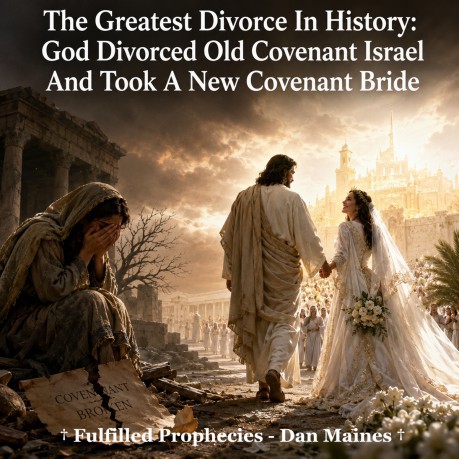
The Greatest Divorce In
History: God Divorced Old Covenant Israel And Took A New Covenant
Bride Introduction † Most Christians know about the marriage of
Christ and His Bride, but few realize the Bible first tells the story
of God's covenant divorce from Old Covenant Israel. † This wasn't the end of God's redemptive plan,
it was the necessary end of one covenant so a better covenant could
begin. † From Jeremiah to Revelation, Scripture tells
one continuous covenant story. The Old Covenant wife proved
unfaithful, God promised a New Covenant, Christ purchased His Bride
with His blood, and by AD 70 the old marriage had fully passed away. † Understanding this covenant transition
removes confusion about prophecy and reveals the beauty of the New
Covenant we enjoy today. Jeremiah 3:8-10 And I saw that for all the adulteries of faithless Israel, I had
sent her away and given her a certificate of divorce, yet her
treacherous sister Judah did not fear; but she went and prostituted
herself also. And because of the thoughtlessness of her prostitution,
she defiled the land and committed adultery with stones and trees.
Yet in spite of all this her treacherous sister Judah did not return
to Me with all her heart, but rather in deception," declares the
Lord. † God explicitly declared that He divorced
covenant Israel because of her spiritual adultery. This wasn't
symbolic language without meaning, it described the breaking of the
Mosaic covenant. (Jeremiah 3:8-10) † Judah witnessed Israel's judgment but
repeated the same covenant unfaithfulness instead of repenting.
(Jeremiah 3:9-10) † This divorce explains why a New Covenant
became necessary. God wasn't repairing the old covenant, He was
preparing to replace it. (Hebrews 8:7-13) Isaiah 50:1 This is what the Lord says: Where is the certificate of divorce By
which I have sent your mother away? Or to whom of My creditors did I
sell you? Behold, you were sold for your wrongdoings, And for your
wrongful acts your mother was sent away. † Israel's separation from God wasn't because
He failed His covenant, it was because they continually broke it.
(Isaiah 50:1) † The problem was never God's faithfulness, it
was Israel's persistent rebellion against the covenant. (Deuteronomy
31:16-18) † The prophets consistently described Israel's
relationship with God as a marriage covenant, making the language of
divorce completely covenantal. (Hosea 2:2-7) Jeremiah 31:31-32 "Behold, days are coming," declares the Lord, "when
I will make a new covenant with the house of Israel and the house of
Judah, not like the covenant which I made with their fathers on the
day I took them by the hand to bring them out of the land of Egypt,
My covenant which they broke, although I was a husband to them,"
declares the Lord. † God promised a completely New Covenant
because the former covenant had been broken. (Jeremiah 31:31-32) † Notice that God identifies Himself as
Israel's husband under the Mosaic covenant. Marriage language is
covenant language. (Jeremiah 31:32) † The New Covenant wasn't an improved version
of the old one, it was an entirely different covenant established by
Christ. (Luke 22:20) Hebrews 8:6-9 But now He has obtained a more excellent ministry, to the extent
that He is also the mediator of a better covenant, which has been
enacted on better promises. For if that first covenant had been free
of fault, no circumstances would have been sought for a second. For
in finding fault with the people, He says, "Behold, days are
coming, says the Lord, When I will bring about a new covenant With
the house of Israel and the house of Judah, Not like the covenant
which I made with their fathers On the day I took them by the hand To
bring them out of the land of Egypt; For they did not continue in My
covenant, And I did not care about them, says the Lord. † Hebrews quotes Jeremiah 31 to prove that
Christ is the Mediator of the very New Covenant God promised through
the prophet. (Hebrews 8:6-9) † The first covenant became obsolete because
Israel broke it, exactly as Jeremiah foretold. (Hebrews 8:7-9) † The New Covenant wasn't an afterthought, it
was God's promised solution to Israel's covenant failure. (Jeremiah
31:31-32; Hebrews 8:6-9) Hebrews 8:13 When He said, "A new covenant," He has made the first
obsolete. But whatever is becoming obsolete and growing old is about
to disappear. † The writer of Hebrews declared that the Old
Covenant was already growing old and was about to disappear. (Hebrews
8:13) † The transition period was underway while
Hebrews was being written, but the Old Covenant had not yet
completely vanished. (Hebrews 8:13) † That complete removal occurred in the
judgment upon Jerusalem and the temple in AD 70, ending the covenant
that God had divorced. (Matthew 24:1-2) Matthew 23:37-38 Jerusalem, Jerusalem, who kills the prophets and stones those who
have been sent to her! How often I wanted to gather your children
together, the way a hen gathers her chicks under her wings, and you
were unwilling. Behold, your house is being left to you desolate! † Jesus declared that Israel's house was being
left desolate because they rejected their Messiah. (Matthew 23:37-38) † The covenant relationship was ending, and the
temple would no longer be God's dwelling place. (Matthew 23:38) † This prepares for the complete removal of the
temple in the next chapter. (Matthew 24:1-2) Matthew 24:1-2 Jesus left the temple area and was going on His way when His
disciples came up to point out the temple buildings to Him. But He
responded and said to them, "Do you not see all these things?
Truly I say to you, not one stone here will be left upon another,
which will not be torn down." † Jesus announced the destruction of the
temple, the visible center of the Old Covenant system. (Matthew
24:1-2) † When the temple fell in AD 70, the Old
Covenant order reached its covenantal end. (Hebrews 8:13) † God wasn't merely judging a city, He was
bringing the Old Covenant administration to its close. (Matthew
24:1-2) Ephesians 5:25-27 Husbands, love your wives, just as Christ also loved the church
and gave Himself up for her, so that He might sanctify her, having
cleansed her by the washing of water with the word, that He might
present to Himself the church in all her glory, having no spot or
wrinkle or any such thing; but that she would be holy and blameless. † Christ didn't return to His former covenant
wife, He purchased a glorious New Covenant Bride with His own blood.
(Acts 20:28) † The church isn't replacing an existing wife,
she is the Bride of the New Covenant established through Christ's
sacrifice. (Ephesians 5:25-27) † The Bride is made holy through Christ, not
through the Law of Moses. (Galatians 3:24-29) 2 Corinthians 11:2 For I am jealous for you with a godly jealousy; for I betrothed
you to one husband, to present you as a pure virgin to Christ. † Paul described the church as a virgin
promised to one husband, Christ. (2 Corinthians 11:2) † The apostles consistently viewed believers as
the New Covenant Bride. (Ephesians 5:25-27) † The marriage imagery is covenant language
throughout the New Testament. (2 Corinthians 11:2) John 3:28-29 You yourselves are my witnesses that I said, 'I am not the
Christ,' but, 'I have been sent ahead of Him.' He who has the bride
is the groom; but the friend of the groom, who stands and listens to
him, rejoices greatly because of the groom's voice. So this joy of
mine has been made full. † John the Baptist identified Jesus as the
Bridegroom long before Revelation described the marriage of the Lamb.
(John 3:28-29) † The friend of the Bridegroom rejoices because
the promised covenant marriage had begun through Christ. (John 3:29) † This connects the Gospels with the
fulfillment seen in Revelation. (Revelation 19:7-9) Revelation 19:7-9 Let's rejoice and be glad and give the glory to Him, because the
marriage of the Lamb has come, and His bride has prepared herself. It
was given to her to clothe herself in fine linen, bright and clean;
for the fine linen is the righteous acts of the saints. Then he said to me, "Write: 'Blessed are those who are
invited to the wedding feast of the Lamb.'" And he said to me,
"These are the true words of God."
† The marriage of the Lamb follows the judgment
of the great harlot, showing the end of one covenant relationship
before the full establishment of another. (Revelation 17-19) † God doesn't have two covenant wives. The
former covenant had to end before the New Covenant marriage reached
its fulfillment. (Jeremiah 3:8, Hebrews 8:13) † This is one of the great covenant transitions
of Scripture, the divorce of the Old Covenant and the marriage of the
New Covenant Bride. (Revelation 19:7-9) Revelation 21:2-3 And I saw the holy city, new Jerusalem, coming down out of heaven
from God, prepared as a bride adorned for her husband. And I heard a
loud voice from the throne, saying, Behold, the tabernacle of God is
among the people, and He will dwell among them, and they shall be His
people, and God Himself will be among them, † The New Jerusalem is presented as the Bride
because God's covenant people are now His everlasting dwelling place.
(Revelation 21:2-3) † The temple is no longer a building of stone,
God's presence now dwells with His redeemed people. (Ephesians
2:19-22) † The covenant story ends with God permanently
dwelling with His Bride under the New Covenant. (Revelation 21:2-3) Historical References † Josephus described the destruction of
Jerusalem and the temple in AD 70 in Wars of the Jews, Books 5-6,
recording the covenant judgment that brought the Old Covenant age to
its complete end. † Eusebius, Ecclesiastical History, Book 3,
recorded the fulfillment of Christ's warnings concerning Jerusalem's
destruction and the preservation of the early church. † Irenaeus, Against Heresies, Book 4,
emphasized that Christ established the New Covenant promised by the
prophets. How It Applies To Us Today † We aren't members of the divorced Old
Covenant, we belong to Christ's everlasting New Covenant Bride. † Our relationship with God isn't based upon
the Law of Moses but upon the finished work of Jesus Christ. † We live with the confidence that God now
permanently dwells with His people and will never divorce His New
Covenant Bride. Q & A Appendix Q: Did God actually divorce Israel? A: Yes. Jeremiah plainly says God gave
backsliding Israel a bill of divorce because of her covenant
unfaithfulness. (Jeremiah 3:8) Q: Why was a New Covenant necessary? A: Because Israel broke the first covenant, God
promised an entirely New Covenant through Christ. (Jeremiah 31:31-32,
Hebrews 8:7-13) Q: Who is the Bride of Christ? A: The church, God's redeemed New Covenant
people, is the Bride prepared for the Lamb. (Ephesians 5:25-27,
Revelation 19:7-9) Q: When did the Old Covenant finally end? A: Hebrews says it was about to vanish, and its
covenantal end was completed in the destruction of Jerusalem and the
temple in AD 70. (Hebrews 8:13, Matthew 24:1-2) Q: If God divorced Israel, did He abandon His
promises to Israel? A: No. God fulfilled every promise He made
through Christ. The faithful remnant of Israel entered the New
Covenant, and believing Gentiles were grafted into the same covenant
people. God's promises were fulfilled, not abandoned. (Romans 9:6-8;
Romans 11:5, 17-24; Galatians 3:26-29) Q: Why didn't God simply restore the Old Covenant
instead of making a New Covenant? A: Because the Old Covenant had accomplished its
purpose. It was temporary, pointed to Christ, and was replaced by a
better covenant established on better promises. Once Christ fulfilled
it, there was no reason to return to what had become obsolete.
(Galatians 3:24-25; Hebrews 7:22; Hebrews 8:6-13) Q: Does that make Sabbath keepers members of the
divorced Old Covenant? A: If they believe Christians are still under the
Law of Moses and are required to keep the Sabbath as a covenant
obligation, then they are identifying with the covenant God declared
obsolete and replaced through Christ. The Sabbath was the covenant
sign of the Old Covenant made with Israel, not the sign of the New
Covenant. (Exodus 31:13-17; Hebrews 8:13; Colossians 2:16-17) Q: If someone says Christians must keep the Ten
Commandments because they are still under the Old Covenant, what are
they really saying? A: They are saying the covenant God divorced and
replaced is still binding on believers today. But Scripture teaches
that Christ established a better covenant, made the first obsolete,
and fulfilled the Law. Believers are under the New Covenant, not the
covenant that vanished away. (Jeremiah 3:8; Hebrews 8:6-13; Romans
7:4-6; Galatians 3:24-25) † This is the fulfilled perspective we proclaim at
Fulfilled Prophecies † © Fulfilled Prophecies - Dan Maines. Source Index † Jeremiah 3:8-10, Isaiah 50:1, Jeremiah
31:31-32, Hebrews 8:6-9, Hebrews 8:13, Matthew 23:37-38, Matthew
24:1-2, Ephesians 5:25-27, 2 Corinthians 11:2, John 3:28-29,
Revelation 19:7-9, Revelation 21:2-3 † Historical Writers: Josephus, Wars of the
Jews, Books 5-6; Eusebius, Ecclesiastical History, Book 3; Irenaeus,
Against Heresies, Book 4
By Dan Maines
Links