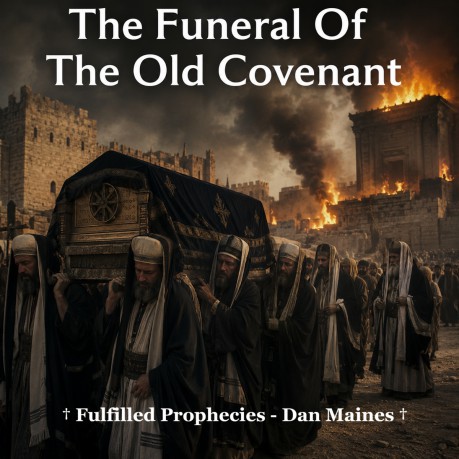
The Funeral Of The Old
Covenant Introduction † The Bible never presents the Old Covenant as
something that would continue forever. It had a beginning at Mount
Sinai, it served its God-given purpose, and it came to its appointed
end in Christ. The New Covenant did not merely improve the Old
Covenant, it replaced it. The funeral of the Old Covenant unfolded in
three distinct stages. The cross was its death. Hebrews was the
obituary. AD 70 was the burial, when the temple, priesthood,
sacrifices, and every visible part of that covenant came to a
permanent end. Hebrews 8:13 When He said, "A new covenant," He has made the first
obsolete. But whatever is becoming obsolete and growing old is about
to disappear. † The writer of Hebrews declared that the first
covenant had already become old because Christ established the New
Covenant. (Hebrews 8:6-13) † Notice that it was "near" vanishing
away, showing that the transition was still underway while Hebrews
was being written. The covenant was legally replaced, but its outward
system was still standing. (Hebrews 9:8-10) † This wasn't speaking about the end of the
physical universe. It was speaking about the covenant established
through Moses that was about to disappear forever. (Jeremiah
31:31-34) Colossians 2:14 having canceled the certificate of debt consisting of decrees
against us, which was hostile to us; and He has taken it out of the
way, having nailed it to the cross. † The cross was the death of the Old Covenant's
legal authority over God's people. (Romans 7:4-6) † Christ fulfilled everything the Law pointed
toward, leaving no further need for the Mosaic covenant to remain in
force. (Matthew 5:17) † The funeral began at Calvary because that is
where the covenant of condemnation lost its authority through the
blood of Christ. (2 Corinthians 3:6-11) Romans 7:4 Therefore, my brothers and sisters, you also were put to death in
regard to the Law through the body of Christ, so that you might
belong to another, to Him who was raised from the dead, in order that
we might bear fruit for God. † Paul plainly says believers died to the Law
through the body of Christ. (Romans 7:4-6) † Death to the Law happened at the cross, not
at AD 70. † This perfectly supports the statement that
the cross was the death of the Old Covenant. Matthew 27:50-51 And Jesus cried out again with a loud voice, and gave up His
spirit. And behold, the veil of the temple was torn in two from top
to bottom; and the earth shook and the rocks were split. † The torn veil was God's public announcement
that access into His presence would no longer come through the
Levitical priesthood. (Hebrews 10:19-22) † The temple was still standing, but its
purpose had already ended because the true sacrifice had been offered
once for all. (Hebrews 9:11-12) † From that moment forward, the Old Covenant
system stood as an empty shell awaiting its final removal. (John
4:21-24) Hebrews 10:9 then He said, "Behold, I have come to do Your will." He
takes away the first in order to establish the second. † God did not repair the first covenant, He
removed it in order to establish the second. (Hebrews 8:6-13) † The New Covenant was never intended to exist
alongside the Old Covenant as two equal systems. † Christ fulfilled the first covenant
completely so the second could stand forever. (Galatians 3:24-25) 2 Corinthians 3:11 For if that which fades away was with glory, much more that which
remains is in glory. † Paul describes the Old Covenant as something
that was passing away while the New Covenant remained. (2 Corinthians
3:7-11) † The passing away language agrees perfectly
with Hebrews 8:13. † The New Covenant wasn't temporary, it remains
forever. Luke 21:20-22 "But when you see Jerusalem surrounded by armies, then
recognize that her desolation is near. Then those who are in Judea
must flee to the mountains, and those who are inside the city must
leave, and those who are in the country must not enter the city;
because these are days of punishment, so that all things which have
been written will be fulfilled. † Jesus identified the destruction of Jerusalem
as the time when everything written concerning covenant judgment
would reach its fulfillment. (Luke 21:20-22) † In AD 70 the temple was destroyed, the
priesthood ended, the sacrifices ceased forever, and the Old Covenant
system was buried before the world. † The burial completed what the cross had
accomplished and what Hebrews had already announced. The covenant was
dead at the cross, declared obsolete in Hebrews, and visibly buried
in AD 70. (Matthew 24:1-2) Matthew 24:1-2 Jesus left the temple area and was going on His way when His
disciples came up to point out the temple buildings to Him. But He
responded and said to them, "Do you not see all these things?
Truly I say to you, not one stone here will be left upon another,
which will not be torn down." † Jesus foretold the complete destruction of
the temple decades before it occurred. (Matthew 24:1-2) † Once the temple fell, there could never again
be a functioning Levitical priesthood or sacrificial system. † This marks the visible burial of the Old
Covenant order. Historical References † Josephus recorded that the temple was burned,
the city destroyed, and the sacrificial system permanently ended in
AD 70. (The Wars of the Jews, Book 6, Chapters 4-8) † Eusebius recorded that the Christians fled
Jerusalem before its destruction in obedience to Christ's warning.
(Ecclesiastical History, Book 3, Chapter 5) † Tacitus confirmed the Roman destruction of
Jerusalem and the temple under Titus. (Histories, Book 5) † Irenaeus testified that the old order had
been fulfilled in Christ and that the New Covenant had replaced the
former covenant. (Against Heresies, Book 4, Chapter 9)
How It Applies To Us Today † We don't live under the Law of Moses because
Christ fulfilled it completely. † We don't seek forgiveness through animal
sacrifices because Christ offered the final sacrifice once for all. † We worship God through the New Covenant where
every believer has direct access to the Father through Jesus Christ. Q & A Appendix Q: If the Old Covenant died at the cross, why
wasn't it completely gone immediately? A: Because although Christ legally fulfilled and
ended it at the cross, God allowed the physical temple system to
remain for a short transition period until His covenant judgment came
upon Jerusalem in AD 70. (Hebrews 8:13; Luke 21:20-22) Q: Why call Hebrews the obituary? A: Because Hebrews repeatedly announced that the
Old Covenant was obsolete, growing old, and ready to disappear, just
as an obituary announces someone's death before the funeral is
completed. (Hebrews 8:13; Hebrews 10:9) Q: Why was AD 70 the burial? A: Because the destruction of the temple
permanently ended the priesthood, sacrifices, and every visible part
of the Old Covenant system, leaving only the New Covenant standing.
(Luke 21:20-22; Matthew 24:1-2) Q: Was the Old Covenant abolished at the cross or
in AD 70? A: Both events were essential, but they
accomplished different things. The cross legally ended the authority
of the Old Covenant through Christ's sacrifice. Hebrews announced it
was obsolete and ready to disappear. AD 70 was God's public and
historical removal of the temple, priesthood, and sacrifices, visibly
burying what had already died at the cross. (Colossians 2:14; Hebrews
8:13; Luke 21:20-22) † This is the fulfilled perspective we proclaim at
Fulfilled Prophecies † © Fulfilled Prophecies - Dan Maines. Source Index † Hebrews 8:13, Colossians 2:14, Matthew
27:50-51, Hebrews 10:9, Luke 21:20-22 † Josephus, The Wars of the Jews, Book 6,
Chapters 4-8; Eusebius, Ecclesiastical History, Book 3, Chapter 5;
Tacitus, Histories, Book 5
By Dan Maines
Links