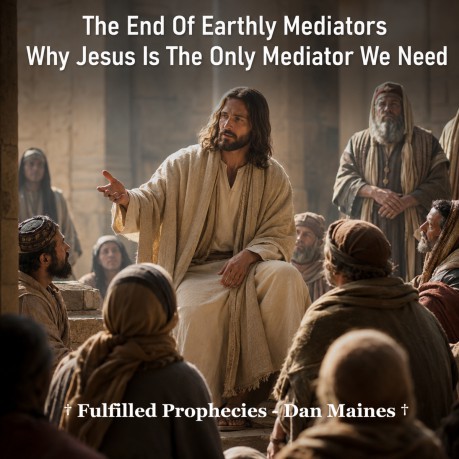
The End Of Earthly
Mediators Introduction † One of the greatest changes between the Old
Covenant and the New Covenant is the end of earthly mediators between
God and His people. † Under the Law, Israel had priests, a high
priest, sacrifices, and a temple because sinful man could not
approach God directly. † Adam and Eve spoke directly with God before
sin entered the world. Under the New Covenant, through Jesus Christ,
believers once again have direct access to God, not because we are
sinless, but because Christ is our eternal Mediator. † Many religious systems still preserve parts
of the Old Covenant by placing pastors, priests, or religious leaders
between believers and God. The New Testament points us to one
Mediator, one High Priest, and one way to the Father. John 14:6 Jesus said to him, I am the way, and the truth, and the life; no
one comes to the Father except through Me. † Jesus didn't say He was one of many ways. He
declared Himself to be the only way to the Father. † Every Old Covenant priest pointed forward to
Christ, but once Christ came, the shadows were fulfilled. (Hebrews
10:1) † No earthly person can improve upon what
Christ has already accomplished. 1 Timothy 2:5 For there is one God, and one mediator also between God and
mankind, the Man Christ Jesus, † Paul couldn't have stated it any more
clearly. There is one Mediator. † A mediator stands between two parties to
bring reconciliation. Jesus alone accomplished that through His
sacrifice. (Hebrews 9:15) † No pastor, priest, elder, preacher, or church
leader shares that role with Christ. Hebrews 9:15 For this reason He is the mediator of a new covenant, so that,
since a death has taken place for the redemption of the violations
that were committed under the first covenant, those who have been
called may receive the promise of the eternal inheritance. † This verse identifies Jesus as the Mediator
of the New Covenant, not merely a mediator in general. † His mediation replaced the first covenant
because His sacrifice accomplished what the Levitical priesthood
never could. † The New Covenant doesn't require another
mediator because Christ's work is complete. (Hebrews 8:6; Hebrews
10:12-14) Hebrews 4:14-16 Therefore, since we have a great high priest who has passed
through the heavens, Jesus the Son of God, let's hold firmly to our
confession. For we do not have a high priest who cannot sympathize
with our weaknesses, but One who has been tempted in all things just
as we are, yet without sin. Therefore let's approach the throne of
grace with confidence, so that we may receive mercy and find grace
for help at the time of our need. † Under the Old Covenant only the high priest
entered the Most Holy Place, and only once each year. † Because Jesus is our eternal High Priest,
every believer is invited to approach God's throne with confidence. † That invitation would make no sense if
another human mediator were still required. (Hebrews 10:19-22) Hebrews 10:19-22 Therefore, brothers and sisters, since we have confidence to enter
the holy place by the blood of Jesus, by a new and living way which
He inaugurated for us through the veil, that is, through His flesh,
and since we have a great priest over the house of God, let's
approach God with a sincere heart in full assurance of faith, having
our hearts sprinkled clean from an evil conscience and our bodies
washed with pure water. † The veil that once separated man from God's
presence has been replaced by a new and living way. † The believer now enters through Christ, not
through an earthly priesthood. † The Old Covenant system of restricted access
has been replaced by direct access through Jesus. (Matthew 27:50-51) Matthew 23:8-10 But as for you, do not be called Rabbi; for only One is your
Teacher, and you are all brothers and sisters. And do not call anyone
on earth your father; for only One is your Father, He who is in
heaven. And do not be called leaders; for only One is your Leader,
that is, Christ. † Jesus redirected His disciples away from
religious titles that elevated men above other believers. † The New Covenant centers on one Teacher, one
Father, and one Master. † Spiritual leadership exists, but no leader
occupies Christ's unique position. (Matthew 28:18-20) 1 Peter 2:5 you also, as living stones, are being built up as a spiritual
house for a holy priesthood, to offer spiritual sacrifices that are
acceptable to God through Jesus Christ. † Peter doesn't describe Christians as
depending upon a priesthood, he calls believers the priesthood. † Every believer now offers spiritual
sacrifices through Christ. † The New Covenant didn't create another
earthly priesthood, it created a spiritual priesthood centered
entirely in Jesus Christ. (Revelation 1:5-6) Revelation 1:5-6 and from Jesus Christ, the faithful witness, the firstborn of the
dead, and the ruler of the kings of the earth. To Him who loves us
and released us from our sins by His blood - and He made us into a
kingdom, priests to His God and Father - to Him be the glory and the
dominion forever and ever. Amen. † Christ made His people priests. † Every believer now serves under the Great
High Priest rather than through an earthly priesthood. † This fulfills God's purpose of creating a
priestly people instead of maintaining a separate priestly class.
(Exodus 19:6; 1 Peter 2:9) Ephesians 2:18 for through Him we both have our access in one Spirit to the
Father. † Jew and Gentile now share the very same
access to the Father. † Our access comes through Christ alone, not
through religious offices or ceremonies. † The unity of the New Covenant rests upon one
Mediator and one body. (Ephesians 4:4-6) Hebrews 8:13 When He said, "A new covenant," He has made the first
obsolete. But whatever is becoming obsolete and growing old is about
to disappear. † The Old Covenant priesthood belonged to the
covenant that was passing away. † As that covenant vanished, its earthly
priesthood vanished with it. † Christ's everlasting priesthood remains
forever and can never be replaced. (Hebrews 7:23-25) Hebrews 7:23-25 The former priests, on the one hand, existed in greater numbers
because they were prevented by death from continuing; Jesus, on the
other hand, because He continues forever, holds His priesthood
permanently. Therefore He is also able to save forever those who come
to God through Him, since He always lives to make intercession for
them. † The Levitical priests were continually
replaced because they died. † Jesus' priesthood never changes because He
lives forever. † Since Christ continually intercedes for His
people, no additional human mediator is needed. (Romans 8:34) Historical References † Josephus records the central role of the
priesthood and temple in first-century Judaism before Jerusalem's
destruction. (Josephus, Antiquities of the Jews, Book 20) † Eusebius records that after Jerusalem's
destruction the temple services and Levitical priesthood came to a
permanent end. (Eusebius, Ecclesiastical History, Book 3, Chapter 5) † The destruction of the temple in AD 70
visibly confirmed that the Old Covenant priestly system had reached
its end. † Irenaeus taught that Christ fulfilled the
priestly ministry and established the New Covenant through His own
sacrifice. (Irenaeus, Against Heresies, Book 4, Chapter 18)
How It Applies To Us Today † We should appreciate faithful pastors and
teachers because they teach God's Word, not because they stand
between us and God. (Ephesians 4:11-13) † Every believer has direct access to the
Father through Jesus Christ. † Our prayers don't become more effective
because another person acts as our mediator. † We should always test every teacher by
Scripture because Christ alone has absolute authority. (Acts 17:11) † The closer we grow to Christ, the less
dependent we become upon religious systems and the more dependent we
become upon His Word. Q & A Appendix Q: Are pastors still important today? A: Yes. Pastors are called to shepherd, teach,
and equip believers, but they are never mediators between God and
man. Christ alone fills that role. (Ephesians 4:11-13; 1 Timothy 2:5) Q: Why did Israel need priests under the Old
Covenant? A: The priesthood served as part of the temporary
covenant system until Christ fulfilled it. Jesus became the final and
eternal High Priest, making the old system obsolete. (Hebrews
7:11-28; Hebrews 8:13) Q: Can Christians pray directly to God? A: Yes. Every believer has direct access to the
Father through Jesus Christ without an earthly mediator. (Hebrews
4:16; Ephesians 2:18) Q: Does this mean church leaders have no
authority? A: Church leaders have authority to teach,
encourage, and shepherd God's people, but they never replace Christ
as Mediator. Their authority is always subject to Scripture. (Hebrews
13:17; Acts 17:11) Q: Doesn't the Bible say we should confess our
faults to one another? A: Yes. Confessing sins to one another encourages
accountability and prayer, but it is never presented as obtaining
forgiveness through another believer. Forgiveness comes through
Christ alone. (James 5:16; 1 John 1:9; 1 Timothy 2:5) Q: If Jesus is our only Mediator, why do some
churches still have priests? A: Many churches continue traditions that
resemble the Old Covenant priesthood, but the New Testament teaches
that Christ fulfilled that system. He is our eternal High Priest and
the only Mediator between God and man. (Hebrews 7:23-28; Hebrews
8:13; 1 Timothy 2:5) Q: Should Christians seek God directly or always
go through a pastor? A: Christians should gladly learn from faithful
pastors and teachers, but every believer has direct access to the
Father through Jesus Christ. No pastor stands between a believer and
God. (Ephesians 2:18; Hebrews 4:16; Hebrews 10:19-22) Q: Does honoring pastors mean they have authority
equal to Christ? A: No. Pastors are servants who teach and
shepherd God's people, but Christ alone is the Head of the church and
the only Mediator. Every pastor's teaching must be tested by
Scripture. (Colossians 1:18; Acts 17:11; 1 Timothy 2:5) † This is the fulfilled perspective we proclaim at
Fulfilled Prophecies. † © Fulfilled Prophecies - Dan Maines. Source Index † John 14:6; 1 Timothy 2:5; Hebrews 9:15;
Hebrews 4:14-16; Hebrews 10:19-22; Matthew 23:8-10; 1 Peter 2:5;
Revelation 1:5-6; Ephesians 2:18; Hebrews 8:13; Hebrews 7:23-25 † Historical References: Josephus, Antiquities
of the Jews, Book 20; Eusebius, Ecclesiastical History, Book 3,
Chapter 5; Irenaeus, Against Heresies, Book 4, Chapter 18
By Dan Maines
Why Jesus Is The Only Mediator We
Need
Links