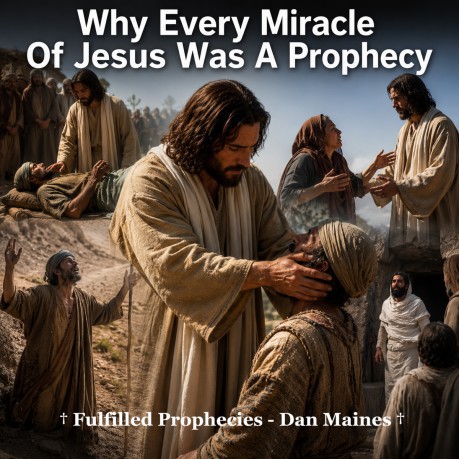
Why
Every Miracle Of Jesus Was A Prophecy Introduction † Many people
believe Jesus performed miracles simply to demonstrate His power or
compassion. While both are true, the Scriptures reveal something much
greater. Every miracle Jesus performed fulfilled what the prophets
had spoken centuries earlier. His miracles weren't random acts of
supernatural power, they were living prophecies announcing that the
promised Messiah had arrived and that God's New Covenant Kingdom was
being established. Every blind eye opened, every deaf ear heard,
every lame person walked, and every dead person raised testified that
God's promises were being fulfilled before Israel's eyes. Isaiah 35:3-6
Strengthen the exhausted, and make the feeble strong. † Isaiah
described what would identify the coming of the Messiah centuries
before Jesus was born. (Isaiah 35:5-6) † These
miracles weren't merely displays of divine power. They were the very
signs God promised would accompany the arrival of His salvation.
(Isaiah 35:4-6) † Every
miracle Jesus performed declared that the promised age of fulfillment
had arrived. (Luke 4:21) Isaiah 61:1-2
The Spirit of the Lord God
is upon me, † Isaiah
foretold the mission of the coming Messiah. † Jesus
fulfilled these promises through both His teaching and His miracles,
demonstrating that God's Kingdom had come near. (Matthew 12:28) † His miracles
revealed that He wasn't simply another prophet but the One whom the
prophets had announced. (Acts 3:18) Matthew 8:16-17
Now when evening came, they brought to Him many who were
demon-possessed; and He cast out the spirits with a word, and healed
all who were ill. This happened so that what was spoken through
Isaiah the prophet would be fulfilled: "He
Himself took our illnesses and carried
away our diseases." † Matthew
doesn't leave the purpose of Jesus' miracles to speculation. He says
they fulfilled Isaiah's prophecy. (Matthew 8:17; Isaiah 53:4) † The miracles
were visible evidence that the promised Messiah had come exactly as
the prophets foretold. (Isaiah 35:5-6; Matthew 11:4-5) Luke 4:16-21
And He came to Nazareth, where He had been brought up; and as was His
custom, He entered the synagogue on the Sabbath, and stood up to
read. And the scroll of Isaiah the prophet was handed to Him. And He
unrolled the scroll and found the place where it was written: "The
Spirit of the Lord is upon Me,
And He rolled up the scroll, gave it back to the attendant, and sat
down; and the eyes of all the people in the synagogue were intently
directed at Him. Now He began to say to them, "Today this
Scripture has been fulfilled in your hearing."
† Jesus didn't
postpone Isaiah's prophecy to a distant future. † He declared
that it was being fulfilled in the hearing of His first-century
audience. (Luke 4:21) † Every
miracle that followed confirmed the truth of His declaration. (John
10:37-38) Matthew 11:2-6
Now while in prison, John heard about the works of Christ, and he
sent word by his disciples, and said to Him, "Are You the Coming
One, or are we to look for someone else?" Jesus answered and
said to them, "Go and report to John what you hear and see:
those who are blind receive
sight and those who limp walk, those with leprosy are cleansed
and those who are deaf hear, the dead are raised, and the poor
have the gospel
preached to them. And blessed is any person who does not take
offense at Me." † Jesus
answered John's question by pointing to fulfilled prophecy rather
than simply saying, "Yes, I am the Messiah." † His miracles
were the evidence because they fulfilled exactly what Isaiah had
written. (Isaiah 35:5-6; Isaiah 61:1-2) † The miracles
themselves testified that the promised Christ had come. (John 5:36) John 5:36 But the testimony I have is greater
than the testimony of John; for the works which the Father has given
Me to accomplish-the very works that I do-testify about Me, that the
Father has sent Me.
† Jesus said
His miracles testified that the Father had sent Him. (John 5:36) † The miracles
weren't performed simply to amaze the crowds but to bear witness that
He was the promised Messiah. (John 20:30-31) John 9:1-7
As Jesus passed by, He saw a man who had been blind from birth. And
His disciples asked Him, "Rabbi, who sinned, this man or his
parents, that he would be born blind?" Jesus answered, "It
was neither that this man sinned, nor his parents; but it was so that
the works of God might be displayed in him. We must carry out the
works of Him who sent Me as long as it is day; night is coming, when
no one can work. While I am in the world, I am the Light of the
world." When He had said this, He spit on the ground, and made
mud from the saliva, and applied the mud to his eyes, and said to
him, "Go, wash in the pool of Siloam" (which is translated,
Sent). So he left and washed, and came back seeing. † Giving sight
to the blind fulfilled one of Isaiah's greatest Messianic promises.
(Isaiah 35:5) † Jesus
demonstrated that He is the Light of the world by giving both
physical and spiritual sight. (John 8:12; John 9:5) † This miracle
pointed beyond one man's healing to the greater work Christ came to
accomplish. (Acts 26:18) John 11:43-44
And when He had said these things, He cried out with a loud voice,
"Lazarus, come out!" Out came the man who had died, bound
hand and foot with wrappings, and his face was wrapped around with a
cloth. Jesus said to them, "Unbind him, and let him go." † Raising
Lazarus demonstrated Christ's authority over death itself. (John
11:25-26) † This miracle
revealed that Jesus is the resurrection and the life long before His
own resurrection. (John 11:25) † It also
pointed forward to the greater covenant victory Christ would
accomplish through His death and resurrection. (Hebrews 2:14-15) Acts 2:22 Men of Israel,
listen to these words: Jesus the Nazarene, a Man attested to you by
God with miracles and wonders and signs which God performed through
Him in your midst, just as you yourselves know † Peter
reminded Israel that Jesus' miracles publicly testified that He had
been sent by God. (Acts 2:22) † Israel
wasn't lacking evidence. The miracles themselves confirmed the
fulfillment of God's promises. (John 5:36; John 20:30-31) John 20:30-31
So then, many other signs Jesus also performed in the presence of the
disciples, which are not written in this book; but these have been
written so that you may believe that Jesus is the Christ, the Son of
God; and that by believing you may have life in His name. † John calls
Jesus' miracles "signs" because they pointed to something
greater than themselves. † Every
miracle testified that Jesus is the promised Messiah foretold by the
prophets. (Acts 10:38-43) † The miracles
weren't the destination, they were signposts directing Israel to
Christ and the fulfillment of God's promises. (Luke 24:44) † John
deliberately calls the miracles "signs" because a sign
points beyond itself to a greater reality. Every miracle pointed to
Jesus as the fulfillment of the Law and the Prophets. (John 20:30-31;
Luke 24:44)
Historical References † Isaiah
foretold the miracles that would identify the coming Messiah more
than seven centuries before the birth of Christ. † The Gospel
writers repeatedly record Jesus' miracles as the fulfillment of Old
Testament prophecy, confirming that He is the promised Messiah sent
to Israel. How It Applies To Us
Today † Our faith
rests upon the One who fulfilled every promise God made concerning
the coming Messiah. (2 Corinthians 1:20) † The miracles
remind us that God's Word never fails. Every prophecy concerning
Christ was fulfilled exactly as God declared. (Luke 4:21; Matthew
5:17) † We don't
simply admire the miracles, we believe in the One to whom every
miracle pointed, Jesus Christ, our fulfilled Messiah. (John 20:30-31) Q & A Appendix Q:
Why did Jesus perform so many miracles? A:
Jesus' miracles fulfilled the prophecies concerning the Messiah and
demonstrated that God's promised Kingdom had arrived. (Isaiah 35:5-6;
Matthew 11:4-5) Q:
Were Jesus' miracles only acts of compassion? A:
No. They certainly showed His compassion, but they also served as
prophetic signs identifying Him as the promised Christ. (John
20:30-31; Luke 4:21) Q:
Why does John call the miracles "signs"? A:
Because they pointed beyond themselves to Jesus as the Christ,
fulfilling the promises spoken by the prophets. (John 20:30-31; Acts
3:18) Q:
Were Jesus' miracles random acts of power? A:
No. Every miracle fulfilled Old Testament prophecy and testified that
Jesus is the promised Messiah and that God's Kingdom had arrived.
(Isaiah 35:5-6; Matthew 11:4-5; John 20:30-31) Of all these, Matthew
8:16-17 is the one I
would definitely add because it explicitly states that Jesus'
miracles were performed "that
it might be fulfilled."
It directly supports the sermon's title better than almost any other
passage. † This is the fulfilled
perspective we proclaim at Fulfilled Prophecies † © Fulfilled Prophecies - Dan Maines. Source Index † Isaiah
35:3-6, Isaiah 61:1-2, Matthew 8:16-17, Luke 4:16-21, Matthew 11:2-6,
John 5:36, John 9:1-7, John 11:43-44, Acts 2:22, John 20:30-31 † Isaiah the
Prophet, Matthew, Luke, John the Apostle, Peter the Apostle
By Dan Maines
Say to
those with anxious heart,
"Take courage, fear not.
Behold,
your God will come with vengeance;
The retribution of God will
come,
But He will save you."
Then the eyes of those
who are blind will be opened,
And the ears of those who are deaf
will be unstopped.
Then those who limp will leap like a
deer,
And the tongue of those who cannot speak will shout for
joy.
For waters will burst forth in the wilderness,
And
streams in the desert.
Because the Lord
anointed me
To bring good news to the humble;
He has sent
me to bind up the brokenhearted,
To proclaim release to
captives
And freedom to prisoners;
To proclaim the
favorable year of the Lord
And
the day of vengeance of our God;
To comfort all who mourn,
Because
He anointed Me to bring good news to the poor.
He
has sent Me to proclaim release to captives,
And
recovery of sight to the blind,
To
set free those who are oppressed,
To
proclaim the favorable year of the Lord."
Links